
The church of San Justo de Pressac retains the foot of a chalice of tin associated with the fire of the Holy Thursday of 1643, when tradition states that a consecrated form remained intact despite the melting of the cup.
The Holy Thursday of 1643
The tradition is located on 2 April 1643, Holy Thursday, in the church of San Justo de Pressac, town of the current French department of Vienne. After the Mass, the repository was prepared to reserve the Eucharist for the liturgy of Good Friday.
The city of Pressac explains that the consecrated form was within a chalice of tin, placed in the monument or reposorium. The structure was adorned and had candles on. That liturgical arrangement became the stage of a fire hours later.
The Repository Fire
During the afternoon, a black humareda came out of the church windows. Those who came found the rest destroyed by the flames. The fabrics, the veil and other fuel elements had been burned, and the heat had seriously affected the metal container.
The municipal source does not turn every circumstance into a forensic reconstruction. It preserves the core of local memory: the fire completely destroyed the repossession and melted the tin cup in which the Eucharistic species were.
The form attributed as intact
According to the story, only the foot of the chalice remained recognizable. On it, in balance, was found the form "whole and without injury." The cup had fused and part of the tin had formed a mass or bubble on the base.
This preservation is the element considered extraordinary. It does not refer to a transformation of the host into flesh or blood, but its apparent resistance to a fire that had melted the nearby metal and consumed the ornaments of the rest.
Qué ocurrió después con la forma
Devotional sources associated with the exposure of San Carlo Acutis claim that the form was consumed the following day. The city center of its current exhibition is at the foot of the chalice and does not present a preserved host.
Therefore, anyone who visits Pressac will not find a material Eucharistic relic of 1643. You will find the metal object linked to the event, the vitral that tells the tradition and the historical church where the fire occurred.
The testimonies collected
The tradition attributes to the priest François du Theil, parish priest of Availles- Limouzine, the collection of testimonies shortly after the events. His report would have been sent to Henri-Louis Chasteigner of La Roche- Posay, Bishop of Poitiers.
The devotional repertoire reproduces an episcopal authorization and a reflection on extraordinary signs. Without digital access to the original act, a legal appointment as a primary test is not offered here. The file identifies the secondary testimony and leaves open a future archival verification.
Documentary recognition and prudence
The historical sources maintain that the bishop allowed the celebration and veneration related to the event. The continuity of the story, its representation in the temple and the preservation of the object show that the memory was received locally.
However, "authorization of veneration," "declaration of miracle" and "canonical recognition" may express different degrees. Until the complete episcopal document is located, this tab avoids assigning a technical formula that cannot be checked directly.
The foot of the chalice in Poitiers
The foot of tin was deposited in the treasure of Poitiers Cathedral. This custody outside Pressac protected the object and linked it to the diocesan headquarters. The full cup is not preserved because, according to tradition, it was fused during the fire.
The move of the foot also did not make the cathedral the place of the event. Pressac remained the historical stage, while Poitiers was for a time the place of custody of the material vestige.
The return to Pressac in 1840
The municipality documents that the foot of the chalice was returned to the parish of Pressac in 1840. It is currently exposed in a garden of the southern wall of the church, next to the side door.
This data makes it possible to guide the visitor correctly and avoids confusing the memorial object with an intact chalice. What is preserved is the basis deformed by fire, appreciated for its historical relationship with the account of Holy Thursday.
El vitral de 1864
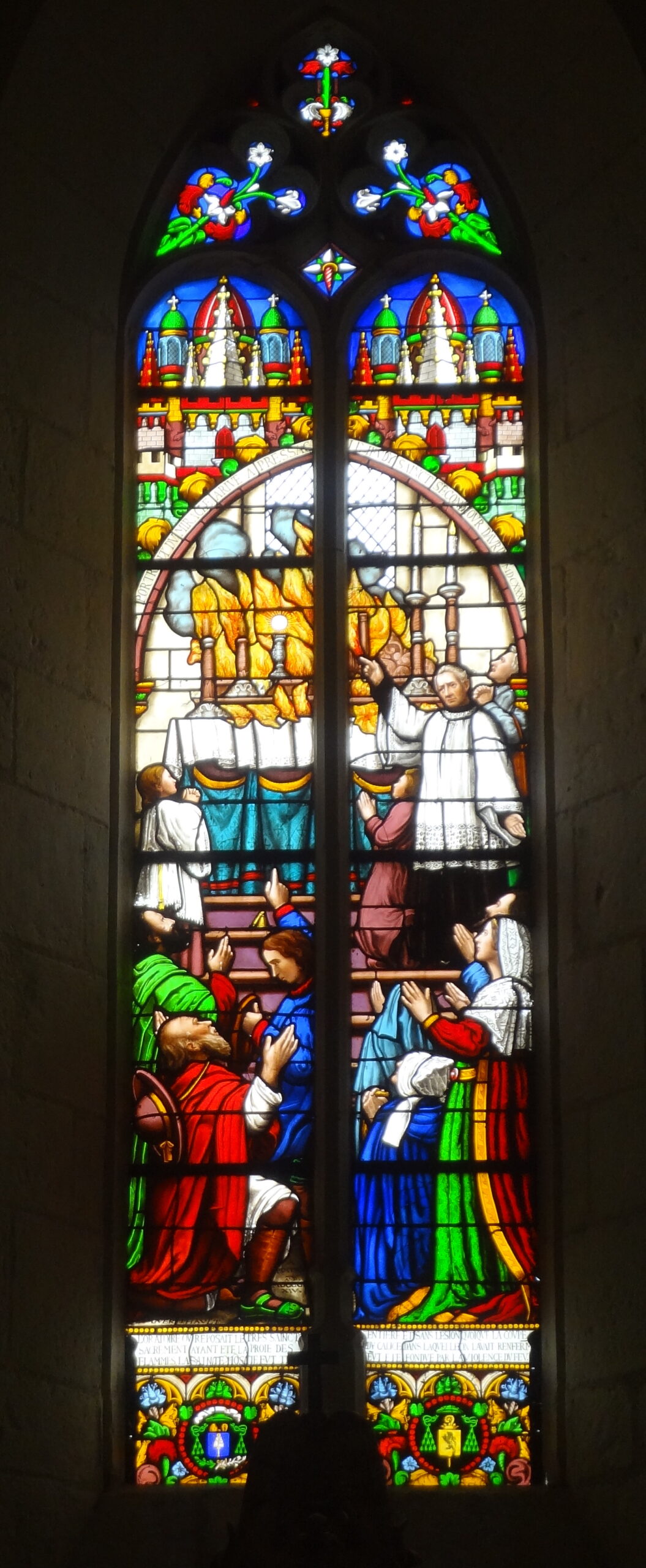
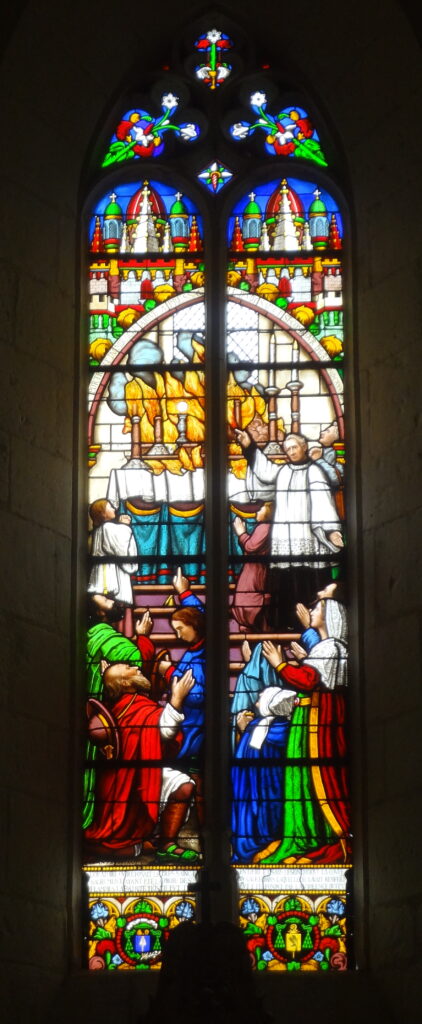
In 1864 a vitral was installed in the church by the workshop Guéritaud de Poitiers. It represents the event with the burning rest, the visible form and the community gathered before the sign.
The picture of this page shows that exact vitral. The work was created more than two centuries after the fire and works as visual catechesis and parish memory. It should not be interpreted as a documentary reproduction of the exact disposition of the temple in 1643.
The church of San Justo
The existence of the temple has been attested to since 1180, although the merovyngeal sarcophages found in the surroundings indicate an older Christian occupation. Its Romanesque ship, its defensive elements and its Gothic choir reflect the different stages of local history.
The church was classified as a historic monument in 1987 and has been restored. In addition to the foot of the chalice and the stained glass, it retains a remarkable golden wooden tabernacle of 1753 for the exhibition of the Most Holy.
The tabernacle and worship
The Baroque tabernacle has a mechanism that opens its central body to present the Most Holy to worship. Although it was realized more than a century after the fire, it shows the continuity of the Eucharistic spirituality of the community.
The value of the sheet does not lie only in narrating a prodigious preservation. It also allows us to understand how a parish expressed its reverence through art, custody, memory and prayer for centuries.
exact location on the map
The church of San Justo is located at André Ravarit, 86460 Pressac, Vienne, Nueva Aquitaine, France. The coordinates 46.1156573, 0.5708018 correspond to the building where the fire occurred and where the foot of the chalice is preserved.
In this case, the historical place and current custody of the memorial object coincide. The marker does not point to a preserved host and does not guarantee opening hours; it is necessary to consult the municipality or the parish community before travelling.
Responsible classification
Pressac appears as "historical tradition with preserved memorial object." The formula recognizes the foot of the chalice, the municipal source, the vitral and the local reception, and at the same time declares that the form does not exist today.
The classification avoids two ends: to present a non-existent Eucharistic relic or to erase a materially documented memory in the temple itself. The degree of episcopal recognition is attributed to secondary sources until the original act can be examined.
Relationship with Faverney
The municipality compares Pressac with Faverney, where in 1608 the preservation of forms during a fire was also transmitted. Both cases belong to the spiritual context of the Catholic Reform and developed their own Eucharistic memories.
They should not be confused: Faverney retains a different history, documents and relics path. Pressac has its own temple, metal object, vitral and custody itinerary between the parish and Poitiers.
Spiritual feeling
The fire recalls the fragility of the objects and the need to carefully guard the Eucharist. The form attributed as preserved led generations of faithful to renew their faith and to contemplate the mystery of Holy Thursday.
Responsible devotion does not seek phenomena or promise automatic physical protection. He invites us to worship Christ, to participate in the liturgy in dignity, to repair the lack of reverence and to turn prayer into charity for those who suffer.
Sources consulted
- Pressac City Council: the town and its heritage, the main institutional source over the church, the fire, the foot of the chalice and the vitral.
- Tourism of Vienne: church of San Justo, heritage and vitral of the miracle.
- Exposure associated with San Carlo Acutis: Pressac, secondary devotional source.
- Pressac Documentary Sheet, account of the testimonies and the episcopal authorization pending contrast to the primary act.
Para orar
Lord Jesus, who you gave yourself for us and remain in the Eucharist, give us reverence, faith and gratitude. Purify our heart and make worship humble service and charity. Amen.
Image credit
Vitral of 1864 of the church of San Justo de Pressac which represents the Eucharistic tradition of 1643. Sébastien Thébault / Wikimedia Commons, CC BY-SA 3.0. File and license in Wikimedia Commons.
