
The tradition of Saint- André reports that, during the veneration of the Forty Hours of January 26, 1902, the parish priest Henri Lacombe and many faithful saw a face in the host exposed. Lacombe would have narrated the episode at the 1904 Eucharistic Congress.
On January 26, 1902
The narrative places the event in the parish church of Saint- André, north-east of the island of La Reunion, then French colony. The community celebrated the worship of the Forty Hours, a practice of prolonged exposure of the Most Holy Sacrament. The parish priest Henri Lacombe began the Mass as custody remained exposed in the sacred or altar of worship, according to the published translation.
At the moment of the godfather, Lacombe would have observed a luminous halo around the rays of custody. As communion approached, he said to distinguish in the host a human face with low eyes, long hair and a crown of thorns. The story describes a painful expression that deeply impressed the priest.
The check sought by the parish priest
The version associated with San Carlo Acutis tells that Lacombe tried not to exteriorize his disturbance. After the Mass, he called several older children from the choir and asked them to observe custody. The children reportedly returned saying that they saw a man's head and that they recognized the Lord.
Adam de Villiers, a 16-year-old who had studied in France, is also mentioned. The priest asked him to come in and say if he was warning anything strange. The young man would have confirmed that he saw a divine face. These checks are part of the statement attributed to Lacombe; there are no independent original testimonies from children or students.
The arrival of the population
The news spread and neighbors of Saint- André went to the temple. The narrative adds the arrival of journalists and people from Saint- Denis, the capital. For several hours, the visitors would have seen the face in the host. In a moment, the expression seemed to be animated and the crown of thorns disappeared.
Lacombe would have ordered the candles to be turned off and the counterparties closed to rule out reflexes. According to his story, the phenomenon became even more clear. A young artist reproduced the face and later the image would have changed until he showed a crucifix that occupied the host. After the Eucharistic Blessing and the Song of Ergo TantumThe vision is gone.
What we know and what remains to be found
The source of dissemination states that the parish priest told thousands of people about the events during the Eucharistic Congress of Angula in 1904 and also about priests gathered in retreat in Périgueux. This would provide a relevant documentary track, but the proceedings of the congress and a complete contemporary transcript have not yet been located to verify the intervention.
Therefore, the fact sheet does not present an alleged original document in quotes, nor does it convert all the details into proven facts. The existence of the church and its location are verifiable; the visual account is attributed to Lacombe through modern collection. The research remains open to diocesan archives, 1902 press and congress publications.
No local decree
No episcopal or Roman decree has been found to officially declare the phenomenon a miracle. The lack of a decree does not show that the story is false, but it prevents the use of expressions such as "approved by the Church" or "recognized by the Vatican." Prudence protects both historical truth and the sense of devotion.
The site of the Catholic Church in La Reunion attests to the institutional presence of the diocese, but its cover does not confirm the episode. It is linked as a territorial ecclesial reference and not as a test of vision. If a specific parish page or diocesan file appears, the tab should be extended with that evidence.
The Eucharist does not depend on an apparition
Catholic faith in the real presence of Christ is not born from seeing a face in a host. It is based on the word of Christ, the apostolic tradition and the celebration of the Church. The particular manifestations, even when a community receives them with devotion, do not add a new doctrine or force all the faithful.
The worship of the Forty Hours makes sense even if nothing extraordinary happens. He invites us to remain before Jesus, to listen, to intercede and to let communion be translated into charity. The description of the grieving Christ can be read as a call to recognize his face in the sick, poor and forgotten.
The Meeting: territory and community
The Meeting is an Indian Ocean island and a French overseas department. His religious history developed in a colonial and multicultural context that deserves to be narrated without reducing the island to exotic curiosity. The tab identifies the place according to its current name and reality, respecting the local memory.
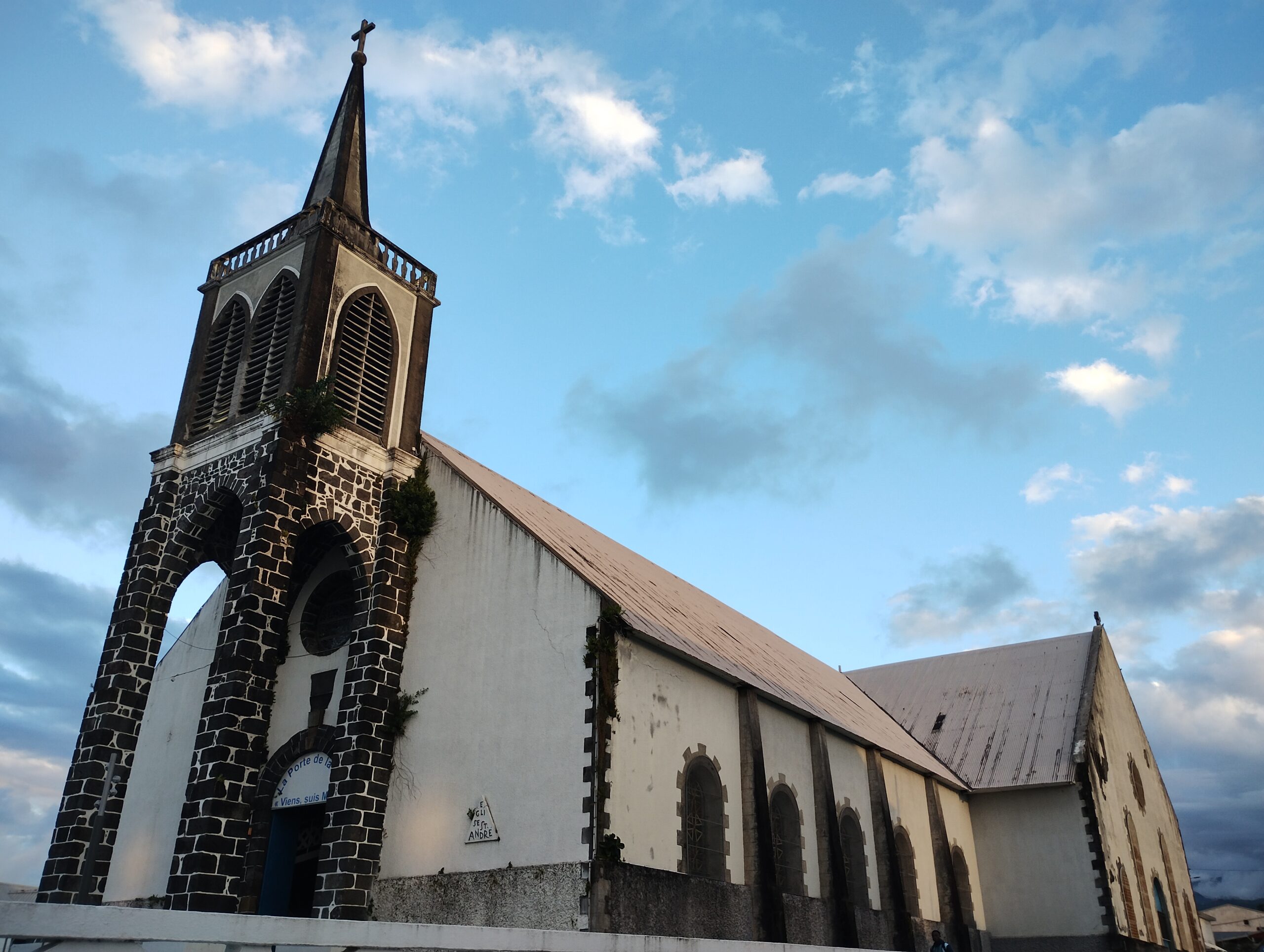
Saint- André keeps his Catholic church in the city center. The selected photo, taken in 2024 and published with a free license, allows the building to be displayed exactly. It is not claimed that custody, host or any material object of 1902 are kept there, as no source has been found to document it.
World map classification
Saint-André is incorporated as "historical Eucharistic apparition without a located decree." This category the difference of preserved relics, phenomena formally investigated and traditions with verifiable decree. The marker points to the church identified by name and geolocation.
Location and visit
Church of Saint Andrew, Saint Andrew, La Reunión. The marker uses the coordinates -20.960968, 55.64884097, from the WGS-84 geolocalization of an exact picture of the building. The time and conditions of access should be consulted with the diocese or the parish before attending.
Spiritual feeling
The face attributed to the host leads to the mystery of Christ who gives himself and shares human pain. Mature devotion does not seek impressions, but a look capable of discovering Jesus in the Eucharist and serving him in those who suffer.
The community gathered for hours recalls the value of persevering prayer. Even if historical documentation is incomplete, a valid invitation remains: to worship with humility, to discern with prudence and to make life a response of mercy.
Sources consulted
- Catholic Church in La Reunion, territorial institutional reference; currently protected by automated access control.
- International exhibition associated with San Carlo Acutis: Saint-André de La Reunion, fuente narrative amused by contrast.
Para orar
Lord Jesus, hidden and present in the Eucharist, teach us to seek your face without curiosity and to recognize you in every wounded person. Give us love for worship, prudence to discern and courage to serve. Amen.
Image credit
Church of Saint- André, The Meeting. Pradigue / Wikimedia Commons, CC BY-SA 4.0. File and license in Wikimedia Commons.
.jpg)