
Documented history of the Eucharistic tradition of Stiphout: the fire of 1342, the rescue attributed to Jan Balloys, the two hosts, the pilgrimage, its likely loss in 1633 and the medieval tower that points to the place.
The Stifout Fire
The tradition places in 1342 a fire in the ancient church of San Trudon in Stiphout. A storm would have unloaded over the village and a lightning lit the building.
The year was meteorologically extreme in various regions of Europe, but this coincidence does not in itself prove the local event. The parish source uses it as a context for the story.
Jan Balloys in his field
Jan Balloys, a farmer of Stiphout, worked the land when he saw the flames. He ran to the church and met the priest and other neighbors.
The narrative highlights the contrast between the pastor's caution and the peasant's decision. With the permission of the priest, Jan prepared to enter to recover the Most Holy.
The flames that turn away
According to tradition, the fire was opened before Jan as the waters before Moses. He went out with two consecrated, unharmed, and without damage to his clothes.
The story adds that, on returning home, he found the field already plowed inexplicable. This motive is similar to that in the later Meerssen tradition.
Of conserved hostiles
The two forms were kept in a tabernacle decorated with an image of the rescue. They were exposed to the veneration of the faithful for generations.
To speak of "two harlots" is important: it is not a matter of visible blood, a stained body or an empty custody, but of consecrated forms associated with the salvation of the fire.
The birth of a pilgrimage
Stiphout became famous as a place of pilgrimage. The stories attributed to the Sacrament cures of fever, plague, deafness, blindness and mobility problems.
These news shows the hopes of those who came to the sanctuary. They are not clinical stories verified with contemporary medical documentation.
Testimonials of the late 16th century
The parish priest Jan van Roy made written statements by three inhabitants. According to these testimonies, hundreds of people considered "possessed" had come to Stiphout.
The temporary distance from 1342 requires caution. The statements document the strength of veneration and local memory, not an eye-to-face observation of the medieval fire.
Exorcism practices
The sources describe tours around the church, use of holy water, penance, surveillance and nine-day periods. They must be understood in their ancient religious and medical context.
Today a person with physical or psychological symptoms needs adequate health care and responsible pastoral support. The tab does not recommend reproducing historical practices without discernment.
The list of cures
Tradition retains a list of 25 cases. One of the last reports that a blind teenager from Helmond began to see during the return of a pilgrimage.
The phrase attributed to the young man and the detail of the way are part of the narrative memory. Its historical value does not amount to a modern ophthalmological diagnosis.
La crisis de 1587
A fire and religious transformations damaged the tabernacle and altered the life of the church. However, the veneration did not end immediately.
Texts from the early 17th century still speak of visitors and people who came to contemplate the exposed Sacrament.
The 1620 check
In 1620 the dean of the district of Helmond ordered to enable two confessionaries to attend to the pilgrims who continued to arrive.
This provision provides administrative proof that the cult continued almost three centuries after the date attributed to the fire.
Wichmans and the Hosts in 1632
Augustinus Wichmans wrote in 1632 that he had seen and venerated the host on several occasions. His testimony is the last firm point for the existence of the cultual object.
It does not prove its material identity since 1342 without interruptions, but it does document that at that time two forms of the account were shown.
El saqueo de 1633
The following year, Croatian soldiers looted and burned the church again. The harms could have been lost then, for then there is no longer a safe chain of custody.
The tab uses "probably" and does not claim an exact date of destruction. The absence of subsequent news does not allow for the reconstruction of their destiny.
Devotion after 1648
Catholic public veneration was no longer possible, but expressions continued in a clandestine church or schuurkerk. A painting of the origin of the miracle was moved there.
In 1758 a crowd was still gathering during the Sacrament feast and a market was organized. The devotional dimension colived with social and economic activity.
The decline of the pilgrimage
During the 18th century interest decreased and in the 19th century the great pilgrimage disappeared. Attempts to recover in the twentieth century failed to restore it in a lasting way.
Therefore Stiphout is not classified as an active sanctuary or as an existing ecclesial cult comparable to Meerssen or Boxmeer.
The old missing church
The town's core moved and the temple was small. In the 19th century a new church was built in another location and the old ship was demolished.
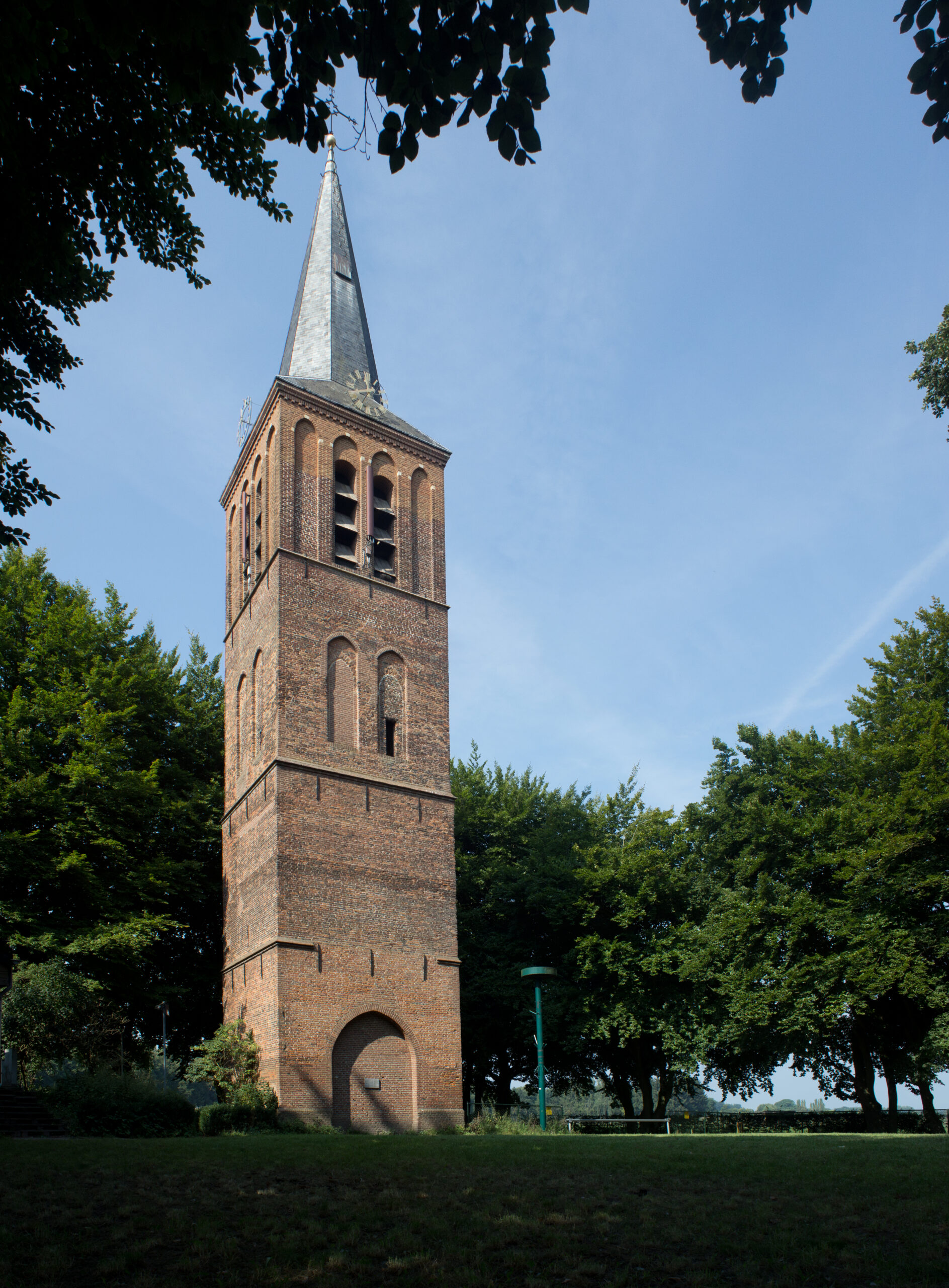
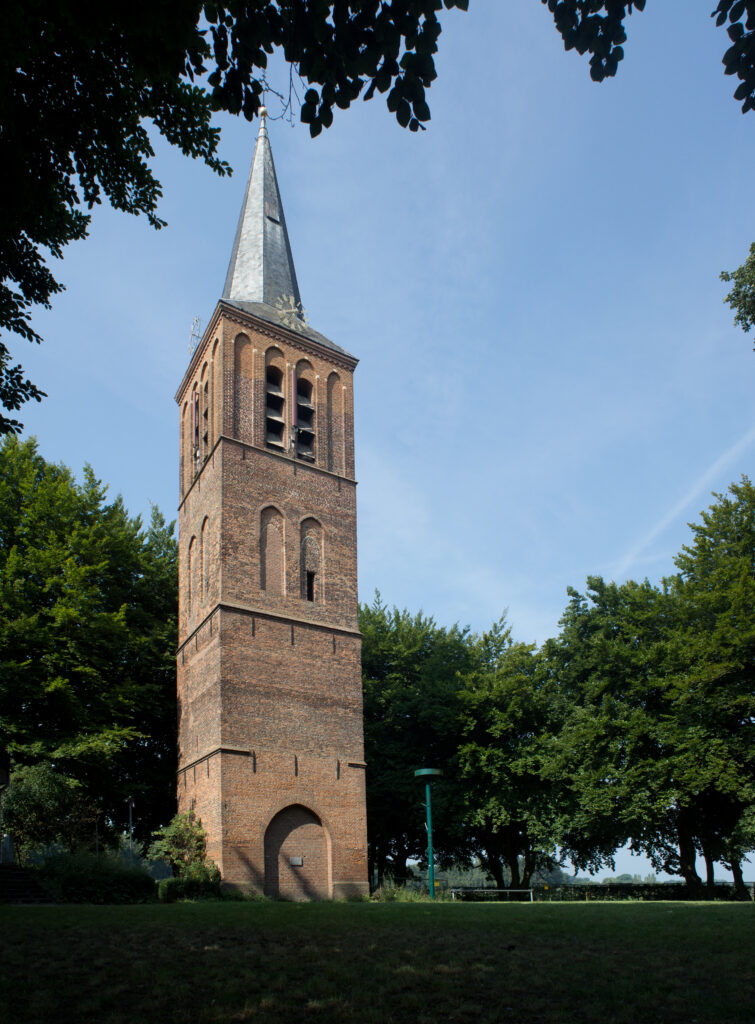
The tower stood as an isolated vestige. Its preservation allows to accurately set the church's site linked to 1342.
The medieval tower on the map
The main marker is in Oude Torenstraat, coordinates 51.4914552, 5.6131724. It points to the tower and the old cemetery.
It should not be interpreted as the location of a preserved relic. It is a historical marker of the missing building and the landscape where the cult was developed.
The modern church of San Trudon
The current Sint-Trudokerk was built in 1883-1884 in Dorpsstraat, coordinates 51.4861597, 5.6179942.
His windows remember Jan Balloys and the fire. This temple is a second place of memory, but not the material stage of the medieval story.
The imagen will mute the torre
A photograph of the modern temple might lead the reader to think that the fire happened there. The outstanding image shows the exact vestige of the historical place.
The credit identifies author and license. The present tower has been restored and does not reproduce the entire architecture of 1342 intact, but it retains the most honest spatial continuity.
How to visit both places
The tower can be seen on the old site. To know the windows of the modern temple, you have to consult the parish hours.
There is no promise of the exposure of hostile, ancient tabernacles or relics: these objects are not preserved with a documented chain.
A responsible reading of the fire
The narrative highlights courage, but it does not allow you to enter a burning building today. The practical priority must be to evacuate, warn emergencies and protect lives.
Spiritual sense can be found in availability, faith and service, without literally imitating a dangerous action.
Faith, health and dignity
The ancient language about possession grouped very different suffering. A contemporary page should avoid stigmatizing people with neurological or mental diseases.
Prayer may accompany, but does not replace diagnosis or professional treatment. The dignity of each person is above the curiosity of extraordinary stories.
The Eucharist without relic
The loss of the two hosts does not put an end to the Eucharistic faith. The Eucharist is celebrated in the present community without the need to recover those objects.
The tower and the windows invite you to remember; the Mass calls you to live the surrender of Christ through reconciliation, charity and care of the vulnerable.
Comparison with Meerssen
The tradition of Meerssen of 1465 shares with Stiphout the motive of a peasant who leaves his work, enters a church on fire and then finds the field worked in a supernatural way. This similarity must be declared, because it may indicate the transmission and adaptation of narrative motives.
It does not require the conclusion that one of the stories is a complete copy of the other, but it does advise not to treat every detail as an independent observation. Stiphout places his episode at 1342, more than a century before, while the written sources that develop it are later.
The comparison enriches the history of regional Eucharistic devotion and helps to study how communities expressed the protection of the Sacrament by means of images that are understandable to an agricultural society.
What remains and what does not remain
The tower, the ancient site, documentation on pilgrims, the testimonies of the 16th and 17th centuries and the commemorative windows of the modern temple remain. The ordinary celebration of the Eucharist in the parish also remains.
The medieval ship, the described tabernacle, the two hosts and a stable organized pilgrimage do not remain. There is also no contemporary test to physically check the action of the fire or the assigned cures.
This explicit relationship protects the visitor from the wrong expectations and allows to value each vestige for what it really is: architecture, written memory, art and parish life.
Sources consulted
- Brabants Historisch Informatie Centrum: antigua iglesia de Stiphout, tower, fire, pilgrimage and transfer of the temple.
- Damiaan Parish of Veuster: tradition of the Sacrament of Stiphout, account, testimony, harlot, plunder and memory in glass windows.
- Repertorio asociado a san Carlo Acutis: Stiphout, initial reference compared to local sources.
Para orar
Lord Jesus, Bread of life, give us courage to serve and prudence to protect each person. Sage our wounds, deliver us from fear and make Stiphout's memory lead us to a compassionate, true and responsible faith. Amen.
Image credit
The medieval tower of Stiphout, the only main vestige of the church where the fire of 1342 is located. Johan Bakker / Wikimedia Commons, CC BY-SA 4.0. File and license in Wikimedia Commons.
