
Marian devotion
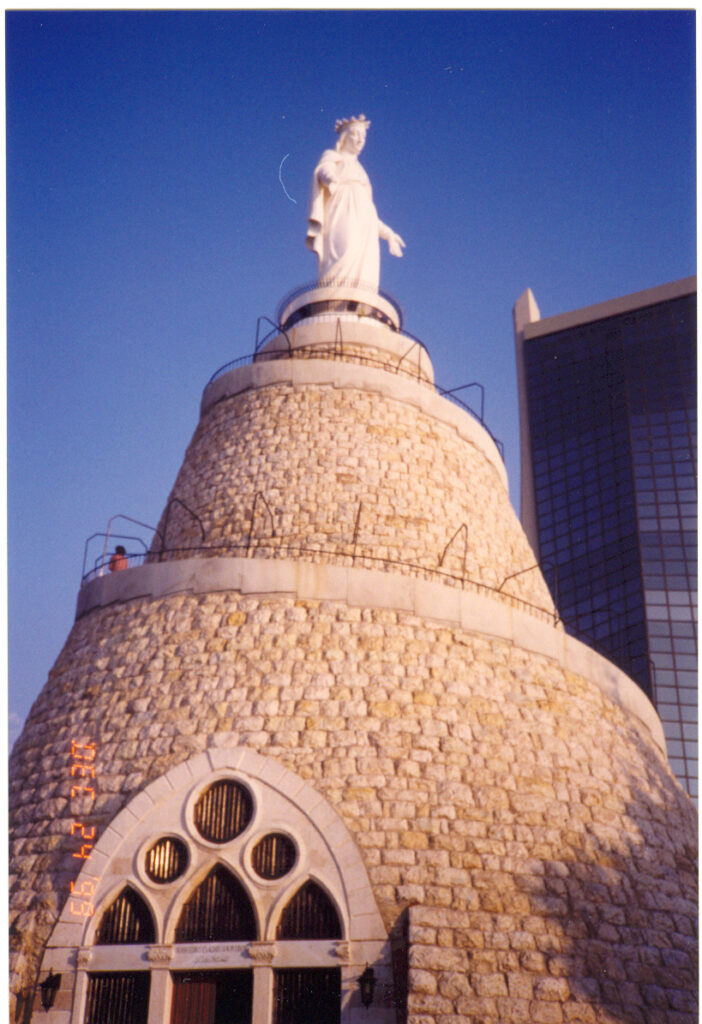
Our Lady of Lebanon of Harissa; great white statue of the Virgin, with open arms to Jounieh Bay, the main Marian sanctuary of Lebanon and symbol of the country, crowned in 1908. Rite Maronite Catholic.
Marian vocation of Harissa (Lebanon)
Documented history. In the late 19th century it was decided to erect a great Marian sanctuary in the Harissa hills, on Jounieh Bay, Lebanon. The statue of Our Lady of Lebanon was founded in France and taken to the country to be placed on a stone pedestal on the hill. The opening of the sanctuary and the erection of the statue were held first Sunday of May 1908which has since been associated with the feast of Our Lady of Lebanon in the churches of the country.
Main data
Origin and history
Documented history. In the late 19th century it was decided to erect a great Marian sanctuary in the Harissa hills, on Jounieh Bay, Lebanon. The statue of Our Lady of Lebanon was founded in France and taken to the country to be placed on a stone pedestal on the hill. The opening of the sanctuary and the erection of the statue were held first Sunday of May 1908which has since been associated with the feast of Our Lady of Lebanon in the churches of the country.
In the inaugural mass, the Maronite Patriarchate proclaimed the Blessed Virgin Mary as “Reina del Líbano”, a title that embodies the recognition of Our Lady of Lebanon as country pattern. Since the beginning of the 20th century, Harissa has been established as the main Lebanese Marian sanctuary and a place of pilgrimage for Maronite faithful, other Eastern Catholic, Orthodox and numerous Muslims, giving this sanctuary a marked character of encounter between communities.
Tradition and spiritual reading. Devotional sources emphasize that the Lebanese people "have chosen the Virgin Mary as their Queen" and resort to her to invoke her protection in the midst of the trials of history. In local spirituality, the construction of the Harissa shrine and the entronization of the image are interpreted as a response of love between the Virgin and the Lebanese people, who are known to be entrusted to their maternal amparo. These readings are of a spiritual and traditional nature, and do not correspond to an account of apparitions or to a documented miraculous fact.
The image and the sanctuary
La image of Our Lady of Lebanon in Harissa is a great bronze statue painted in white, with an approximate weight of 10-15 tonnes and a height of 9 meters. It is represented on its feet, with the arms extended in a gesture of welcome and intercession, looking to the Mediterranean Sea and Junieh Bay. The Virgin bears a crown and a simple robe, and her attitude expresses protection over the country; various testimonies describe her hands extended to Beirut, as a sign of maternal care over the capital.
The sculpture rises on a conical pedestal of natural stone, of around 20 meters high, formed by a broad base and a higher platform from which pilgrims can be located at the foot of the image. To reach the top it is necessary to climb an inner circular staircase 103 steps.
The set forms the Sanctuary of Our Lady of Lebanon in Harissa, also known as Notre Dame du Liban, recognized as the main Marian sanctuary of Lebanon and a religious and national symbol visible from much of the coast. The sanctuary is located within the territory of the Maronite Patriarchate and is closely linked to the Maronite Catholic Church.
Next to the statue is a sanctuarial complex, with church and spaces for the liturgy and the reception of pilgrims; the documentation consulted does not explicitly mention the title of minor basilica, for which No official such recognition.
Sponsorship and coronation
The title of Our Lady of Lebanon is associated with National patronage: various sources point out that the Virgin, under this advocation, is considered "patron saint of the country". The proclamation of Mary as Queen of Lebanon on the part of the Maronite Patriarchate, at the opening of the sanctuary in 1908, reinforces this character as patron and protector of the nation.
As for a canonical coronation in a strict sense (a pontifical act or his delegate with a formal decree), the sources consulted on the sanctuary and the history of Harissa do not record an event clearly identified with date, name of the Pope or the coronator delegate that meets the criteria of classical canonical coronation. Therefore, with the available data: does not contain a documented canonical coronation.
Party and devotion
From 1908the churches of Lebanon commemorate the Our Lady of Lebanon Day on the first Sunday of Mayin memory of the opening of the sanctuary and the erection of the statue in Harissa. Some sources also point out that the Catholic Church commemorates this advocation of 31 Maywithin the framework of the Marian month, although the Lebanese celebration itself is firmly linked to the first Sunday of May.
On this date, the shrine of Harissa receives a great influx of pilgrims from all over the country and from the Lebanese diaspora, who come to participate in the Divine Liturgy, processions, consecration to the Immaculate Heart of Mary and acts of prayer for peace and national unity. The devotion to Our Lady of Lebanon is characterized by:
– la Mary's invocation as Queen and protector of Lebanon, – la presencia de fieles de diversas Iglesias y también de musulmanes que suben al santuario para rezar en silencio o encender velas, – la costumbre de family and community pilgrimages during May, considered Marian month.
The Harissa shrine operates throughout the year as a place of spiritual refuge, with Maronite liturgical celebrations, confessions, worship and numerous acts of consecration of families, parishes and communities to the protection of the Virgin.
Link to the Rosary
The specific sources about Our Lady of Lebanon in Harissa do not describe a fact of foundation explicitly linked to the prayer of the Rosarynor a rosarian fellowship of the sanctuary that is historically determinant of the advocation; therefore, does not contain a particular and exclusive historical relationship with the Rosary.
However, in the daily devotional practice of the sanctuary and the Maronite Church, the Rosario occupies an important place as universal Marian prayer of the Catholic Church, especially during the month of May and during the vigil and pilgrimage to Harissa. The meditative prayer of the mysteries of Christ's life together with Mary deeply harmonizes with the spirituality of Our Lady of Lebanon, who is seen as Mother of God, Queen of Lebanon and sign of hope in the midst of the conflicts and suffering of the country.
In this way, even though the advocation has not emerged from a revelation linked to the Rosary, the Rosary becomes a privileged channel para vivir esta devoción: – permitiendo confiar a María la historia y el futuro del pueblo libanés, – intercediendo por la paz y la reconciliación en la región, – y uniéndose a la alabanza de todas las generaciones que la proclaman bienaventurada, tal como se expresa en la tradición mariana de la Iglesia.
A flower for the Virgin
It offers a simple prayer to this advocation. Pray a Hail Mary for Lebanon and for world peace.
Pray Hail MaryIs the advocation of the Virgin Mary of your people missing?
Si no encuentras la advocación mariana de tu ciudad o pueblo, cuéntanosla: la investigaremos para ubicarla y darla a conocer en este mapa del amor de la Madre por el mundo.
Propose an apvocation →