
Marian devotion
Our Lady of the Most Holy Rosary of the Naval of Manila
Patroness of Quezon City
According to tradition, the image would have been sent to the end of the 16th century or early 17th century by a Spanish governor or a benefactor devotee, as a vote of gratitude to the Virgin of the Rosary; this pious tradition, which presents it as an ancient "protector of the islands," is not fully supported by continuous documentation. People's piety also gives their intercession special protection over the Philippines through national invasions and crises, considering it "the Great Lady of the Philippines."
Main data
Origin and history
According to tradition, the image would have been sent to the end of the 16th century or early 17th century by a Spanish governor or a benefactor devotee, as a vote of gratitude to the Virgin of the Rosary; this pious tradition, which presents it as an ancient "protector of the islands," is not fully supported by continuous documentation. People's piety also gives their intercession special protection over the Philippines through national invasions and crises, considering it "the Great Lady of the Philippines."
In documented history, devotion was consolidated in the context of the calls Battle of La Naval de Manila of 1646, a series of five naval clashes in which Hispanic-Catholic Filipino forces faced Protestant Dutch squads. Before each fight, following the advice of the Dominicans, the defenders prayed the Holy Rosary and were explicitly entrusted to the Virgin of the Most Holy Rosary; after the unexpected victory and Dutch withdrawal (15 October - 4 October 1646), a first great feast and procession was organized in thanksgiving, the origin of the feast of La Naval in Manila. Subsequently, the image, guarded by the Order of Preachers, was the subject of numerous exvotes and narrations of miracles collected in devotional publications such as the ancient "Miracles and Ninth of the Blessed Virgin of the Rosary, the universal patron of the Philippines, which is venerated in the Temple of Santo Domingo in Manila."
During World War II, the ancient Sunday temple in Intramuros, Manila, was destroyed; the image was saved and later moved to the new Santo Domingo temple in Quezon City, where it continues its veneration. In 2009, the Philippine government declared the advocation and its temple as National Cultural Treasury, recognizing its historical and religious importance for the country.
The image and the sanctuary
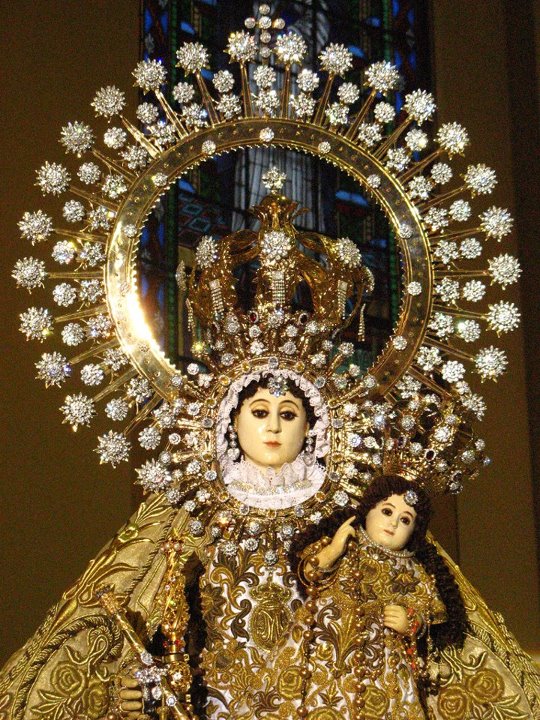
The image of Our Lady of the Most Holy Rosary of La Naval of Manila is a Marian procedural standard of a Latvian type, tallada en ivory and wood of the 16th century, richly dressed and crowned, popularly known as the "Holy Rosary" or "The Great Lady." Iconographically represents the Virgin with the Child Jesus in arms, both covered with embroidered robes and blankets, bearing crown and often scepter and rosary, according to the classical iconography of the Virgin of the Rosary; these elements are described in a general way in devotional sources, although not always in technical detail. The set stands out for the delicacy of the ivory size and for the numerous exvotes and jewels that have been offered over the centuries.
The image is currently venerated in the iglesia de Santo Domingo, officially Sanctuary of Our Lady of the Most Holy Rosary of the Naval of ManilaQuezon City, Luzon Island. The temple, served by the Dominicans, is recognized as National Sanctuary of Our Lady of the Holy Rosary and is one of the main Marian pilgrimage centres in the country. The present sanctuary was completed in the 1950s (the foundation of the current building in 1954) and presents a modern architecture of wide scope, with a wide presbytery where the image, as well as lateral chapels, vitrals and spaces intended for devotion and internal processions, is intertwined. It is not recorded in the consulted sources that the church has the title of a minor basilica; it is primarily designated as a National sanctuary o National Shrine.
Sponsorship and coronation
Our Lady of the Most Holy Rosary of La Naval Manila has a strong patronage on Quezon City and a special link with the Philippine nation. In 1973, the Quezon City government officially declared it Patron of the city by Resolution No 9645-S73. That same year, the Pope Pablo VI She proclaimed her patron of Quezon City, thus confirming civil patronage with ecclesial recognition. In 1975, Archbishop Mariano Gaviola declared it Patron of the Philippine Navy, consolidating its relationship with the defense of the country and the memory of the naval victories of 1646.
As for the coronation, the image was the object of canonical coronation. The Pope Pío X authorized the coronation in 1906, and the solemn canonical coronation took place 5 October 1907being conferred on behalf of the Pontiff by the Apostolic Delegate mons. Ambrose Agius. The sources recognize it as one of the first canonical coronations of a Marian image in Asia, stressing the importance of this advocation for the Philippine Church.
Party and devotion
La main party of Our Lady of the Most Holy Rosary of the Naval of Manila is celebrated the second octubre Sundayin relation to the month of the Rosary and in memory of the naval victories of 1646. The celebration includes a solemn ninth and, as a culmination, the famous Grand Procession of the Naval, in which the image is carried in a monumental triumphant car on the streets of Quezon City. This procession brings together thousands of faithful each year, and some chronicles speak of the assistance of "billions" of devotees over the years, making it one of the most massive Marian manifestations in the Philippines.
The feast explicitly recalls the victory of the Hispanic-Filipino forces against the Dutch army in 1646, and attributes it to the intercession of the Virgin of the Rosary, invoked by the prayer of the Holy Rosary before each battle. Since the first Thanksgiving procession in the 17th century, devotion has remained alive, with traditions such as walking barefoot to the sanctuary (ancient practice which, according to the sources, evolved into the present Great procession), offering flowers, candles and devotees, and the participation of co-fradies, religious and faithful orders from all over the country. The sanctuary remains open throughout the year as a place of pilgrimage, with masses, confessions and prayers of the Rosary, especially intense in October.
Link to the Rosary
The link of this advocation with the Rosary is essential and explicit. The official title is Our Lady of the Most Holy Rosary of the Naval of Manila, and the memory of the battles of 1646 is attached to the prayer of the Rosary, then recommended by the Dominican friars and assumed by the crews and the population as a spiritual weapon in defense of the faith and the city. The devotional chronicles point out that before each fight the Rosary was prayed and the intercession of the Virgin was requested, and that the victories were interpreted as a response to that perseverant plea.
Today, devotion is expressed in a privileged way through the Community rezo of the Holy Rosaryespecially during the ninth and the month of October, and in the procession in which the people accompany the image by meditating on the mysteries of Christ's life with Mary. In this advocation, the Rosary appears as a school of faith in the midst of the trial, a grateful memory of the historical protection attributed to the Virgin and a path of subsidiary trust for the present of the Church in the Philippines.
A flower for the Virgin
Offer a simple prayer to this Marian devotion. Pray a Hail Mary for the Philippines and for world peace.
Pray Hail MaryIs the advocation of the Virgin Mary of your people missing?
Si no encuentras la advocación mariana de tu ciudad o pueblo, cuéntanosla: la investigaremos para ubicarla y darla a conocer en este mapa del amor de la Madre por el mundo.
Propose an apvocation →