
Marian devotion
Our Lady of Măng Đen
Marian vocation of Măng Đen (Kon Tum)
About Nuestra Señora de Black Sunday (The Black Mother) The information available and verified is very limited in international and ecclesial sources of reference; most of the data comes from local level and is not systematically documented in general Marian directories or in repertories of best-known shrines in Vietnam, which often focus on La Vang, Trà Kiğ or other centres.
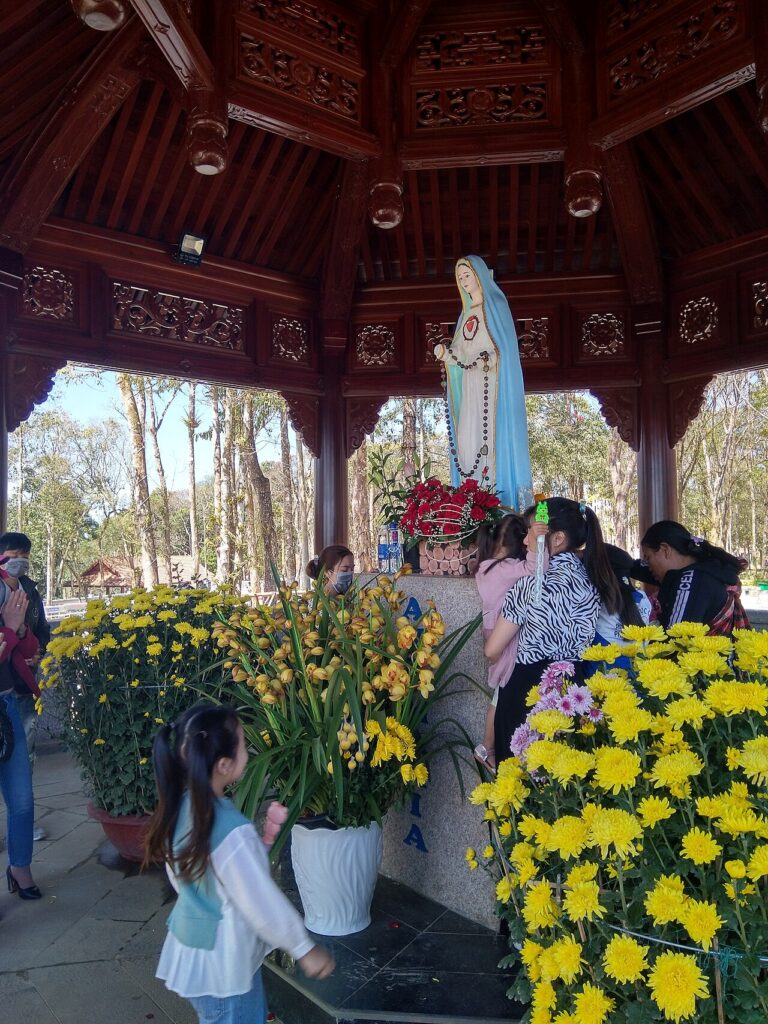
Main data
Origin and history
About Nuestra Señora de Black Sunday (The Black Mother) The information available and verified is very limited in international and ecclesial sources of reference; most of the data comes from local level and is not systematically documented in general Marian directories or in repertories of best-known shrines in Vietnam, which often focus on La Vang, Trà Kiğ or other centres.
Tradition / local legend According to the tradition spread in the Kon Tum central highlands area, a image of the Immaculate would have been damaged during the Vietnam war, losing both hands. With the passage of time, the statue would have been abandoned or lost in the jungle near the current Măng Đen. Time after, it would have been rediscovered by locals or by Catholic communities in the region, interpreting this finding as a sign of comfort in the midst of the wounds of war and social difficulties. This Virgin "without hands" would have become, in the believer memory, a symbol of the Virgin who wants to "need" the hands of her children to perform works of peace and charity. There are no precise dates of discovery, specific protagonists or canonical documentation in accessible official sources that support this narrative as a historically proven fact; it is therefore a matter of local pious tradition and not a recognized apparition.
Documented history En la diócesis de Kon TumIn the region of the Central Highlands of Vietnam, the presence of ancient indigenous evangelized peoples, the existence of several Marian shrines and the rise of pilgrimages to places linked to the Virgin are clearly documented. However, in Marian repertories of national scope and in historical synthesis about the great shrines of Vietnam, the advocation that appears with official relief as national sanctuary is Our Lady of La VangNot Măng Đen. In case of Our Lady of Măng Đen, no published episcopal decrees, statutes of the sanctuary, specific recognition by the Episcopal Conference of Vietnam and no references in the documentation of the Holy See have been found in the sources consulted. To date, with the information available, it can only be said that this is a local Marian devotion in the diocese of Kon Tum, linked to an image of the Immaculate damaged by war; the rest belongs to the scope of oral tradition and popular piety, without official chronology or recognition as an apparition.
The image and the sanctuary
The image The oral testimonies described in the tradition speak of a image of the Immaculate (Virgin Mary standing, with mantle, in a praying attitude or with extended arms) who would have lost his hands during the war. It is often understood as a representation of the Immaculate Conceptionin line with the strong imprint of this truth of faith in Vietnamese mariology (also present, for example, in The Vang). No precise data on author, exact size date, specific material (wood, plaster, resin or other) or on the detailed iconography (mantle colors, crown, added symbols, etc.). Any more specific description cannot be given as historically safe and, by rigour, it must be said: No documented.
The sanctuary Devotion is honored in a Marian sanctuary located in Darkin the Kon Tum region of the Central Highlands of Vietnam. According to local tradition, this place has become a point of prayer, reconciliation and conversion for communities, especially indigenous peoples of the region. As for their ecclesial status, the accessible documentation of the Church in Vietnam, the Holy See and international Marian repertories does not include Măng Đen listed as lower basilica, national sanctuary or comparable to centres such as La Vang or Trà Kiņu. As a result, with the available data it can only be said that this is a local / diocesan Marian sanctuary; there is no title of a minor basilica or recognition as a national sanctuary.
Sponsorship and coronation
Patronage There have been no official decrees of the diocese of Kon Tum or documents of the Episcopal Conference of Vietnam that formally proclaim the Our Lady of Măng Đen patron of a city, municipality, diocese or nation. Therefore, with rigour, it can only be said that this is a devoción local much appreciated, according to tradition, by the faithful of the region and in particular by indigenous groups; but no consta a canonically proclaimed patron's title.
Canonical coronation In the repertory of Marian coronations in Vietnam and in the most widespread ecclesial chronicles, there are references to recognitions and celebrations in honor of Our Lady of La Vang and other sanctuaries, but no mention of a canonical coronation of Our Lady of Măng Đen. Since a canonical coronation requires a formal decree (of the Holy See or of the bishop with delegation), and no such document has been found, it must be stated: does not contain a documented canonical coronation.
Party and devotion
Date of party While other Vietnamese Marian advocates have well-established festive dates (for example, La Vang held on August 15 in many communities), Our Lady of Măng Đen no references to a litigation fiesta propia approved for the diocese or the national calendar. There may be local celebrations (triduous, novena, anniversaries of the image finding), but in the absence of official confirmation or mention consisting of public sources, it should be indicated: does not contain an officially documented main party date.
Pilgrimage and devotional features The tradition generally collected indicates that Măng Đen has become a place where many faithful come in search of comfort, inner healing and conversionespecially people marked by the wounds of war and suffering. The image of Our Lady without hands would favour a spirituality of confidence and commitmentinviting pilgrims to "lend their hands" to the Virgin in works of charity, reconciliation and service to the poorest. However, no reliable statistical data of influx (annual number of pilgrims, large national meetings, etc.) or official descriptions of their own rituals (specific processions, popular promises or unique ways of wearing the image) have been found. Any particular number or rite that is not attested in clear sources should be considered no documentado for the purposes of this document.
Link to the Rosary
No official documents, diocesan or chronic rules of pilgrimage describing a specific and own relationship of Our Lady of Măng Đen with the prayer of the Rosary (such as the express recommendation to pray in recognized apparitions or the institutionalization of a particular Rosary). It must therefore be stated that there is no documented unique link between this specific advocation and the Rosary, beyond the usual practice of the Catholic people.
From a general mariological perspective, the Rosary is naturally integrated in devotion to Our Lady of Măng Đen for various theological and pastoral reasons:
– El Rosario es una Christ's school of contemplation with Marywhich helps to read the mysteries of the life, death and resurrection of the Lord in the light of faith; this contemplation is particularly significant in contexts marked by war and historical wounds, such as the Central Highlands d
A flower for the Virgin
It offers a simple prayer to this advocation. Pray a Hail Mary for Vietnam and for world peace.
Pray Hail MaryIs the advocation of the Virgin Mary of your people missing?
Si no encuentras la advocación mariana de tu ciudad o pueblo, cuéntanosla: la investigaremos para ubicarla y darla a conocer en este mapa del amor de la Madre por el mundo.
Propose an apvocation →