
Marian devotion
Maria Kannon
Advocación maria de Nagasaki, Shimbara y Gotō (Kaki)
After the arrival of Christianity in Japan in 1549 with San Francisco Javier, faith spread quickly, especially in the south of Kyūshū and in Nagasakiwho had hundreds of thousands of Christians and was called "the little Rome." At the beginning of the 17th century, there were an estimated 150,000 to 300,000 Christians in Japan, with numerous churches and chapels.
Main data
Origin and history
After the arrival of Christianity in Japan in 1549 with San Francisco Javier, faith spread quickly, especially in the south of Kyūshū and in Nagasakiwho had hundreds of thousands of Christians and was called "the little Rome." At the beginning of the 17th century, there were an estimated 150,000 to 300,000 Christians in Japan, with numerous churches and chapels.
La persecution It was systematically triggered with the edicts of the Tokugawa shogunate: in 1612-1614 Christianity was prohibited, missionaries were expelled and the faithful were forced to bet or live in hiding. To detect Christians the practice of fumi‑eI mean, trampling on images of Christ or the Virgin; who refused was subjected to torture or death. In this context, many Christians took refuge in isolated areas of Nagasaki, Shimbara y las islands Gotō, where communities of kakure kirishitan who kept faith secret for over 250 years.
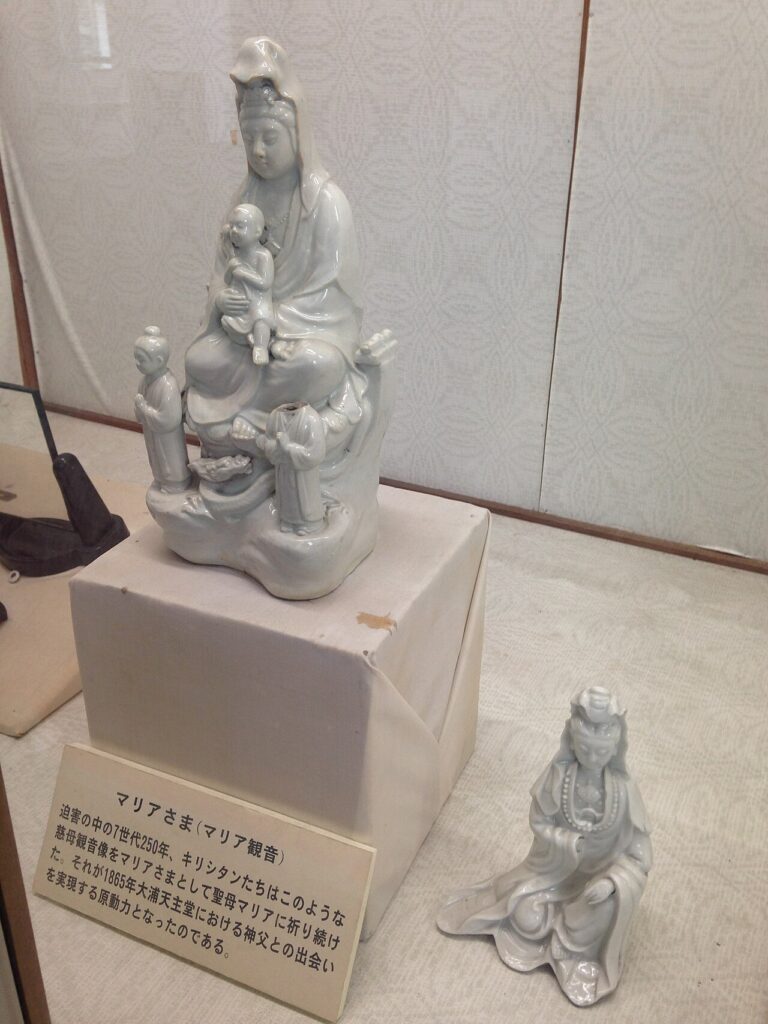
The devotion to Mary Kannon: the hidden Christians began to use images of Kannon, a Buddhist figure of compassion, who reminded the Virgin Mary of her mercy and sometimes of her iconography with a child in her arms. By small statues placed in Buddhist temples or in private houses, which looked like images of Kannon, the faithful They actually venerated the Virgin with the Child. And they kept praying Christian prayers. The prayers and formulas of faith were transmitted orally, often adapted in form and sound to look like Buddhist songs, creating a sincere religiosity but focused on Christ and Mary.
# # Tradition / legend
Different local traditions report that some of these camouflaged objects were carved by anonymous Christian artisans or benevolent Buddhists, but their names and biographies not documented. Pious stories are also told about images that would have miraculously protected entire families during records or delations; these stories belong to the scope of the devotional memorywithout precise historical confirmation.
♪ documented history ♪
Historically they do, by historical and museum research, Kannon statues identified as "Maria Kannon", used by Christians hidden during the Edo era (1603-1868) in the Edo region and, in particular, in Nagasaki and its surroundings. A significant example is retained in the Shinpuku-ji temple, founded in 1522 south of the former Edo (Tokyo), where a statue called Maria Kannon is maintained, considered a testimony of the clandestine Christian presence. Museums dedicated to the history of Christianity in Nagasaki also show articles of veneration in disguise, including Marian images with the appearance of Kannon, as part of the culture of kakure kirishitan.
In 1873, the prohibition of Christianity was officially lifted, and thousands of hidden Christians "came to light" in the Nagasaki region, a phenomenon known as the "discovery of hidden Christians." Since then, many churches have been built, many today World Heritage, which also remember the memory of those who venerated Mary in hidden forms. Maria Kannon.
The image and the sanctuary
There is no only canonical model of an official Marian sanctuary under the title of Mary Kannon recognized by the Catholic Church; it is rather a set of small domestic or temple images used illegally.
Las statues by Maria Kannon:
– Solían ser small sculptures de Kannon, generalmente en madera, piedra u otros materiales tradicionales japoneses (material concreto variable según el lugar). – Presentaban a Kannon con aspecto sereno y compasivo, a veces de pie, a veces sentada, siguiendo modelos budistas locales. – En algunos casos, la figura he held a child or discreetly incorporated a cruz diminuta, elements that for the initiated Christian referred to the Virgin and the Child Jesus, but passed unnoticed as ornamental motives for the authorities.
Many of these images were placed within local Buddhist temples or in small domestic altars; outward were simple images of Kannon, while for Christian families they were true Marian icons.
As for a specific sanctuarycan be noted:
– El templo budista Shanguji, a unos 80 km al sur de la antigua Edo (Tokio), que conserva una estatua denominada María Kannon y es citado por la historiografía como ejemplo de esta práctica clandestina. – En la región de Nagasaki, Shimbara y las islands Gotōtoday there are churches, museums and monuments that remember the hidden Christians and their Marian devotion, but does not contain an official Catholic sanctuary with the canonical title "Maria Kannon"neither the minor basilica nor the national sanctuary under this apvocation.
Therefore, Maria Kannon is more linked to scattered images and historical memory that to a Marian sanctuary formally erected under this name.
Sponsorship and coronation
– Patronage: does not know that the advocation of Mary Kannon has a canonically proclaimed patronage (city, diocese or nation). It is historically associated with the hidden Christians from the Nagasaki region, Shimabara and the Gotō Islandsbut no official statement of patronage by the Church.
– Canon coronation: there is no documented canonical coronation.
This historical devotion should be distinguished from other Marian images of the Nagasaki area, such as certain great contemporary statues dedicated to the memory of the martyrs of Shimabara, who can receive pontifical blessings, but no specific canonical coronation under the title of Maria Kannon is documented.
Party and devotion
No consta una Fecha liturgica propia in the Roman calendar not an officially established holiday for "Mary Kannon" in the universal Church or in the Dioceses of Japan. The devotion is more integrated into the memory of martyrs and hidden Christians of Nagasaki and its surroundings, commemorated in various local celebrations and in the pastoral life of the region.
Today the memory of Maria Kannon is maintained:
– En la catechesis on kakure kirishitan, especialmente en museos e iniciativas culturales y religiosas de Nagasaki y las islas Gotō, donde se explican las estrategias de ocultamiento de la fe, incluida la creación de estas imágenes camufladas. – En la popular pietythrough stories, artistic representations and prayers that evoke the fidelity of these communities to the Virgin and to the Gospel despite persecution.
No official figures of pilgrim
A flower for the Virgin
It offers a simple prayer to this advocation. Pray a Hail Mary for Japan and for world peace.
Pray Hail MaryIs the advocation of the Virgin Mary of your people missing?
Si no encuentras la advocación mariana de tu ciudad o pueblo, cuéntanosla: la investigaremos para ubicarla y darla a conocer en este mapa del amor de la Madre por el mundo.
Propose an apvocation →