
Marian devotion
Our Lady of Nagasaki
Marian vocation of Nagasaki (Japan)
Devotion is closely linked to the Cathedral of Santa Maria of the Immaculate Conception of Urakamiin Nagasaki, which before World War II was the main temple of the Catholic community of the city and center of a region marked by centuries of persecution and martyrdom of Japanese Christians. The church of Urakami, rebuilt after the legalization of Christianity in Japan, became the visible heart of a people who kept faith in hiding for generations.
Main data
Origin and history
Devotion is closely linked to the Cathedral of Santa Maria of the Immaculate Conception of Urakamiin Nagasaki, which before World War II was the main temple of the Catholic community of the city and center of a region marked by centuries of persecution and martyrdom of Japanese Christians. The church of Urakami, rebuilt after the legalization of Christianity in Japan, became the visible heart of a people who kept faith in hiding for generations.
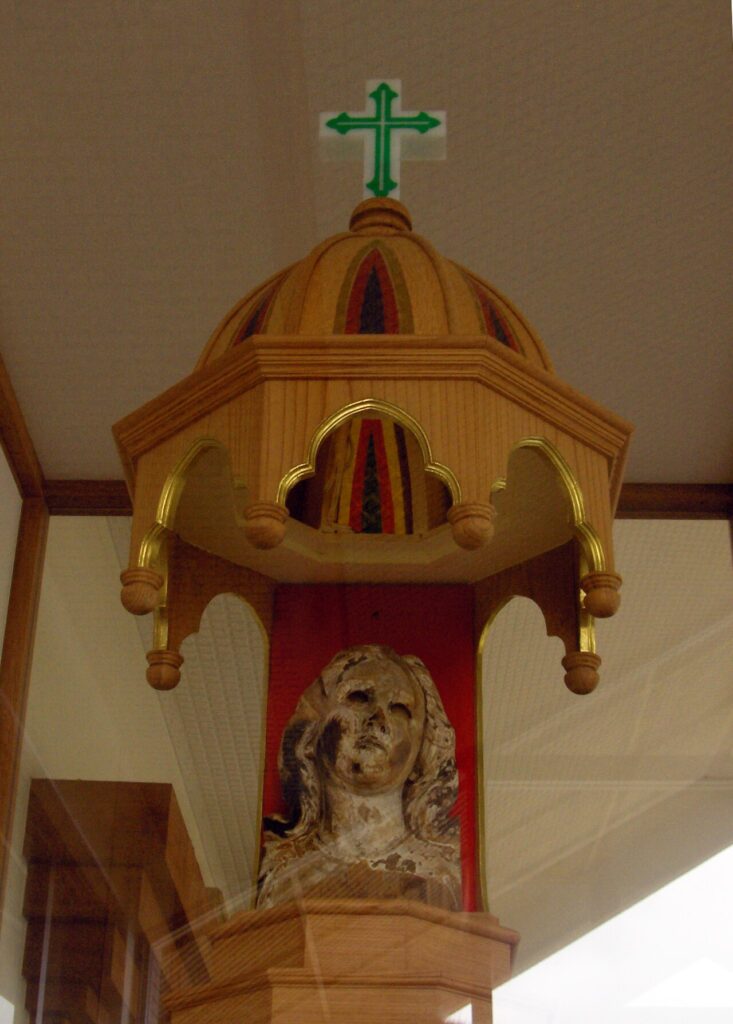
On August 9, 1945, the atomic bomb exploded near the cathedral, destroying it almost completely and causing thousands of deaths, including many faithful gathered in the area. Among the remains of the temple was seriously damaged, the of a statue of the Virginthat over time would be known as Hibaku no Maria ("Mary bombed"). The documented story refers that the image was collected and preserved for years as a silent testimony to the horror and faith that survived the destruction. According to testimonies collected in the Catholic press, a trapense monk would have kept her secret for about 30 years before she could be exposed again to veneration.
In the plan of the spiritual memory and interpretationcontemporary tradition has seen in this image a presence of the Virgin who accompanies the suffering of the victims of the bomb and the martyrs of Nagasaki, as a sign of hope and a call for world peace. This devotional reading is a interpretation of faith and recent traditionnot a historical data in a strictly documentary sense.
The image and the sanctuary
The so-called Our Lady of Nagasaki / Hibaku no Mary is, in origin, a image of the Virgin Mary of round, wooden, with glass eyes, belonging to the cathedral of Urakami. After the atomic explosion, the image remained mainly the head, blackened and shrouded, with glass eyes damaged or absent, which has given rise to its popularly known as the "Virgen sin ojos de Nagasaki". The current appearance of the head, cracked and darkened by fire, is deliberately preserved without aesthetic restorations, to maintain its witness force over nuclear tragedy and human suffering.
The image is venerated in relation to the Urakami Cathedral (Holy Mary of the Immaculate Conception), in Nagasaki, within the diocese of Nagasaki, Latin rite. The cathedral, destroyed by the bomb, was later rebuilt in a sober style, and is today a place of memory and prayer for the small Japanese Catholic community and for pilgrims from all over the world. Various journalistic and ecclesial testimonies present the whole (cathedral and "Our Lady bombed") as a Marian and Peace Sanctuary, raised in a place "of horror" that has become a sign of reconciliation and hope. It is not clear from the sources consulted that the cathedral of Urakami has officially received the title of minor basilica nor that there is a formal decree declaring it National sanctuary; rather, its importance is recognized as place of great significance for Japanese Catholicism and for the memory of the atomic bomb.
Sponsorship and coronation
The available sources present Our Lady of Nagasaki / Hibaku no Mary as spiritual symbol of the Catholic community of Nagasaki and the persecuted and martyred Christians in Japan, así as a Christian emblem of la for peace and the abolition of nuclear weapons. However, no consta in the sources consulted a official decree of canonical patronage (for example, as principal patron of the diocese of Nagasaki or of a specific civil constituency) under the specific title "Our Lady of Nagasaki / Hibaku no Mary."
As for the canonical coronationno reliable reference has been found to an act of canonical coronation approved by or executed on behalf of the Holy See, with clearly documented date and pontifical authority. Therefore, according to available sources, does not contain a documented canonical coronation.
Party and devotion
In the documentation consulted does not contain a liturgical feast of its own and universally established under the title of Our Lady of Nagasaki / Hibaku not Mary. The memory of the image and of what it represents is integrated, above all, into the annual memory of August 9the date of the bombing of Nagasaki, the day when the local Church and many faithful of the world remember the victims and pray for peace. In those days, liturgical acts, prayers and processions are held, in particular from the Urakami Cathedral to Peace Park, linking Marian devotion to the memory of tragedy.
News sources describe processions with torches and acts of homage in which the image of the bombed Virgin is carried with veneration by Christians of Nagasaki, as "a symbol of the resilience of the Christian community in Japan." These demonstrations often bring together local, religious, lay people committed to peace and visitors from other countries, although no precise official flow figures. Devotion is characterized by a strong emphasis on:
– la prayer for world peace and the conversion of hearts; – la grateful and painful memory de los mártires y de las víctimas de la bomba; – la reconciliation between peoples, especially between Japan and the nations involved in the war.
Link to the Rosary
In the specific sources about Hibaku no Maria does not contain an exclusive practice or a particular privilege of the prayer of the Rosary formally linked to this advocationas in other recognized Marian shrines. However, the Marian life of the Church of Nagasaki is deeply rooted in the spirituality of the Rosary and the fidelity of "hidden" Christians (kakure kirishitan)who for centuries kept faith by transmitting Marian prayers and devotions in the underground.
In this context, the Rosary is presented in a natural way as one of the most significant prayers to the image of the bombed Virgin: it looks at the mysteries of Christ next to Mary in scenarios of joy, pain and glory, and allows to unite the historical pain of Nagasaki con los painful mysteries and the hope of glorious mysteries. Thus, even if there is no specific regulation, the prayer of the Rosary before Our Lady of Nagasaki is understood as a privileged form of:
– and reconciliation among peoples; – to accompany the victims of violence and war; – to keep alive the memory of martyrs and witnesses to the faith in Japan, under Mary's eyes.
A flower for the Virgin
It offers a simple prayer to this advocation. Pray a Hail Mary for Japan and for world peace.
Pray Hail MaryIs the advocation of the Virgin Mary of your people missing?
Si no encuentras la advocación mariana de tu ciudad o pueblo, cuéntanosla: la investigaremos para ubicarla y darla a conocer en este mapa del amor de la Madre por el mundo.
Propose an apvocation →