
Marian devotion
Our Lady of Namacpacan
Marian Luna (The Union) (Luzon)
According to the local traditionthe image of the Virgin who is now being venerated on Luna was originally commissioned by religious recollects to be sent to another locality, identified in the accounts as the people of Babang (The Union). When the image reached the coast, the pious chronicles refer that, inexplicably, it could not be moved to its destination: the sea was haunted or the transport failed, while the image remained safe in Namacpacan. This fact was interpreted as a sign that the Virgin "I chose" to stay in Namacpacan, and the people welcomed her as patron and protector, especially of walkers and travelers.
Main data
Origin and history
According to the local traditionthe image of the Virgin who is now being venerated on Luna was originally commissioned by religious recollects to be sent to another locality, identified in the accounts as the people of Babang (The Union). When the image reached the coast, the pious chronicles refer that, inexplicably, it could not be moved to its destination: the sea was haunted or the transport failed, while the image remained safe in Namacpacan. This fact was interpreted as a sign that the Virgin "I chose" to stay in Namacpacan, and the people welcomed her as patron and protector, especially of walkers and travelers.
As for the documented history, it is noted that Namacpacan (current Moon) was evangelized in Hispanic times and that the parish under the title of Saint Catherine of Alexandria was firmly established; in this parish church the Marian image was enthroned which, over time, would be known as Our Lady of Namacpacan. The image is from 19th centuryAccording to the cataloguing of the Church itself and of photographic archives that identify it as "original and canonically crowned image of the 19th century." Throughout the 19th and 20th centuries, devotion spread throughout the region of Ilocos and La Unión, with a constant cult attested by pilgrimages and diocesan recognition of their sanctuary.
The image and the sanctuary
The image of Our Lady of Namaccacan is a round package size large size: is indicated to measure approximately 1.92 m (6 feet and 4 inches), which places it among the highest-high Marian images venerated and canonically crowned in the Philippines. This is a dress up image, placed on a peana, with rich blankets and crowns, following the baroque-Hispanic canon of the great Marian processing images. He holds the Child Jesus and he wears regal ruffles, reflecting his condition of Queen and Mother; iconography highlights its proximity to the Inocano people and its role as protector of those who travel and are on their way. The specific material of the size (type of wood or other) no consta explicitly in the sources consulted.
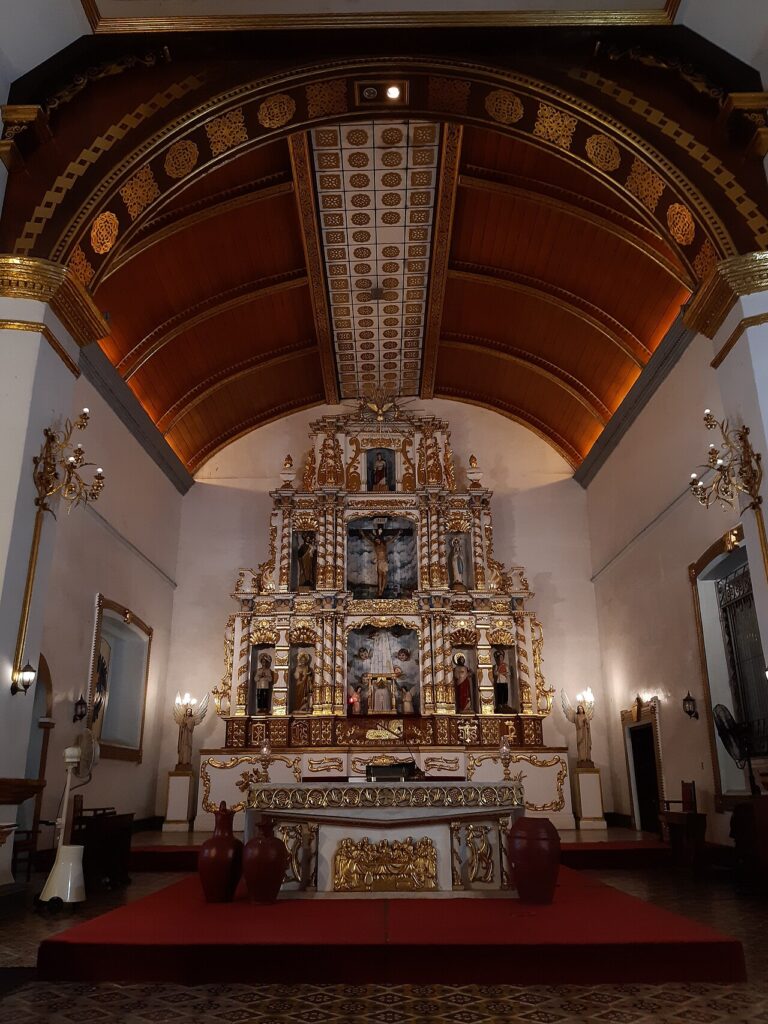
The sanctuary where it is venerated is the Church of Santa Catalina of Alexandria, popularly known as Namacpacan Church, Catholic parish of Latin rite located in Luna, The Union. It is a colonial-era temple, typical of the Filipino churches of the Inocana strip, with a solid structure and stone façade, which has been identified in guides and testimonies as one of the main religious attractions of the area, along with the shrine of Our Lady of Namaccacan that it houses. Various sources explicitly mention it as "Sanctuary of Our Lady of Nampacan" within the parish of Santa Catalina de Alexandria. It is not recorded in the consulted sources that the temple has been elevated to minor basilica or declared National sanctuary; its recognition is essentially diocesan and regional.
Sponsorship and coronation
Our Lady of Namacpacan is patron of the city / municipality of Luna (La Union)which is known as the "pilgrim people" due precisely to the presence of their Marian sanctuary. In local ecclesial life it is also invoked as "patron of Inocane travellers" or "patron of the walkers," given the traditional link of this advocation with protection on the roads and displacements.
As for the coronation, the sources point out that the image of Our Lady of Namaccacan is "canonically cropped" (canonically crowned) and include it in the list of Marian claims canonically crowned in the Philippines. However, in the documentation consulted is not sure the exact date of the coronation or the name of the Pontiff or Pontifical Delegate who carried it out. Therefore, as requested: does not contain a documented canonical coronation in terms of year and coronating authority, although the sources do describe it as canonically crowned.
Party and devotion
La main party of Our Lady of Namaccacan is celebrated the 24 November. On that day and in the near days, the people of Luna receive numerous pilgrims from the Ilocos region, from other parts of Luzon, Metro Manila and from different areas of the Philippine archipelago, who come to participate in liturgical celebrations, processions and acts of popular piety. The municipality is described as "pilgrim people" precisely because of the constant flow of faithful who approach the sanctuary.
Between the Devotional features the diocesan and regional pilgrimages, such as the diocesan Marian pilgrimages promoted from the diocese of San Fernando de La Unión, in which it is expressly invoked as "Ina, Queen and Patron" of the diocese. Devotion is nourished by numerous testimonies of graces and favors, interpreted as Our Lady's intercessions for the sick, families and travelersand a strong identification of the people with the "feeding" and accompanying Mother, which is why it is sometimes also called "The Lady Who Feeds" ("The Feeding Lady"). Precise annual flow data no constan in official figures, but sources repeatedly describe a significant flow of pilgrims around your party and throughout the year.
Link to the Rosary
The sources consulted about Our Lady of Namaccacan do not explicitly mention a particular or own practice of the Rosary prayer associated with this advocation (as specific co-fradies of the Rosary, formal promises linked to the Rosary or unique rosarian festivities). Therefore, no consta a historical-documentary link between this image and a form of devotion to the Rosary.
However, as in most Marian shrines in the Philippines, the Rosario is part of ordinary devotional life of the pilgrims and of the parish: processions, vigils, novies and visits to the sanctuary are usually accompanied by the recitation of the Rosary, which unites the meditation of the mysteries of Christ with the intercession of Mary. In the case of Our Lady of Namacpacan, implored as patron of the walkers and travellersthe Rosary can be understood spiritually as "fellow on the way": when it is disgraced, the faithful is set in motion with Mary, contemplating the path of salvation and asking for its protection for the concrete ways of life, for the material displacements of the travellers and for the spiritual "journeys" of conversion and perseverance in the faith.
A flower for the Virgin
Offer a simple prayer to this Marian devotion. Pray a Hail Mary for the Philippines and for world peace.
Pray Hail MaryIs the advocation of the Virgin Mary of your people missing?
Si no encuentras la advocación mariana de tu ciudad o pueblo, cuéntanosla: la investigaremos para ubicarla y darla a conocer en este mapa del amor de la Madre por el mundo.
Propose an apvocation →