
Marian devotion
Our Lady of the Pilar of Zamboanga
Marian Advocation of Zamboanga (Mindanao)
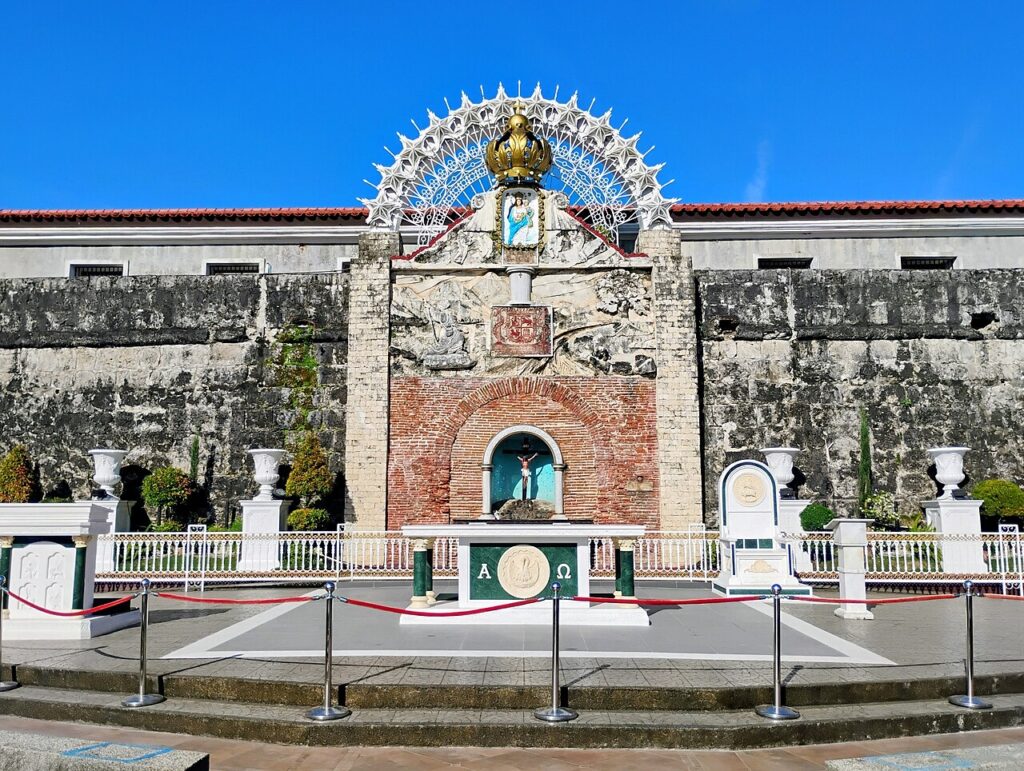
As for the documented history, the Fort of the Pilar (Real Fort of Our Lady of the Pilar of Zaragoza) was built in the 17th century by the Spanish government, around 1635, to defend Zamboanga and the region against the attacks of pirates and the sultanates of Mindanao and Joló. In 1734 a relief of Our Lady of the Pilar on the eastern wall of the fort, turning that sector into an outdoor sanctuary with altar for prayer. From that moment on Marian devotion was linked to the military bastion and the title of the Pilar of Zaragoza, in continuity with the Hispanic tradition.
Main data
Origin and history
As for the documented history, the Fort of the Pilar (Real Fort of Our Lady of the Pilar of Zaragoza) was built in the 17th century by the Spanish government, around 1635, to defend Zamboanga and the region against the attacks of pirates and the sultanates of Mindanao and Joló. In 1734 a relief of Our Lady of the Pilar on the eastern wall of the fort, turning that sector into an outdoor sanctuary with altar for prayer. From that moment on Marian devotion was linked to the military bastion and the title of the Pilar of Zaragoza, in continuity with the Hispanic tradition.
In time the fort, and in particular the outer sanctuary, became a religious and cultural symbol of the city of Zamboanga, now integrated into the historical heritage of the Philippines and linked to the National Museum. The devotion to the Virgin of the Pilar has accompanied the historic avatars of the city, both in the colonial period and after independence, and its patronage on Zamboanga is recognized in civil and ecclesial life.
En el ámbito de la tradition and legendvarious miraculous interventions are remembered. One of the most widespread reports a apparition of the Virgin to a soldier on December 6, 1734, at the door of the city, shortly after the relief was placed, interpreted as a sign of special protection. Another well-established tradition reports that on September 21, 1897, during a strong earthquake, the Virgin was seen on the Strait of Basilan stopping the waves and releasing the city from a possible tsunami. These stories are part of popular piety and local devotional memory, not equated to dogmatic definitions.
The image and the sanctuary
The venerated image in Zamboanga is, according to available sources, a relief of Our Lady of the Pilar placed on the eastern wall of the fort, setting up an open-air Marian sanctuary. This is a representation linked iconographically to the title of the Pilar of Zaragoza, that is, the Virgin Mary linked to the pillar that symbolizes firmness in faith and protection; the sources consulted, however, do not need with safety the material (does not contain) or describe in detail the particular iconographic elements (does not contain).
The sanctuary is known as Sanctuary of Our Lady of the Pilar of Zaragoza at the Fort Pilar, often simply called Fort Pilar. It is integrated into the whole of the old fort, which today is an important historical and cultural symbol of Zamboanga, and is an open-air prayer place where the faithful gather in front of the wall that houses the image. The sources consulted mention it as Marian sanctuary and pilgrimage site, but no consta in the accessible documentation that has been erected as a minor basilica or a national sanctuary; its recognition is first and foremost local and diocesan.
Sponsorship and coronation
Our Lady of Pilar is recognized as patron of the city of Zamboangawhere his veneration is deeply rooted. The sources also point to their relevance to the western area of Mindanao, although no explicit statement has been found that formalizes a wider diocesan or regional patronage; therefore, beyond the city, no consta in a documentary way a higher official title (for example, patron of an ecclesiastical province or of all Western Mindanao).
As for the canonical coronation, a source points out that the Virgin of the Pilar of Zamboanga, "an image in relief in a fort bearing its name," was on 12 October 1960. The name of the pontiff who granted the privilege or the pontifical delegate who made the rite is not indicated in that source; since this is an isolated and without more documentary precision, the mention to coronation can only be stated with certainty on that date. On the other details (pontifical document, celebrating authority) no consta secure information from the sources consulted.
Party and devotion
The fiesta principal de Our Lady of the Pilar of Zamboanga se celebra el October 12, in tune with the feast of the Pilar of Zaragoza, and is the culminating moment of the religious and cultural life of the city. During these days, liturgical celebrations, processions, cultural and festive events are organized in honor of the Virgin, integrating the religious and the civic.
The devotion attracts many faithful to the shrine of the Fort of the Pilar, both in the city and in other areas of Mindanao; although the sources consulted do not offer exact numbers of influx (not recorded), they do speak of a great tradition of veneration and the importance of the place as a spiritual center for the population. The Virgin is particularly invoked as a protector of the dangers of the sea, conflicts and natural calamities, in continuity with the traditions about her intervention in defense of the city.
In the context of the parties of the Pilar in Zamboanga, elements of local culture are combined with features inherited from the Hispanic tradition, including hymns, dances and public expressions of veneration to the Virgin. The sanctuary, being integrated into an old military fort, symbolically underlines the dimension of amparo and defence which the people attribute to the intercession of Mary.
Link to the Rosary
The specific sources on Our Lady of the Pilar of Zamboanga do not highlight a unique practice of the Rosary of this advocation (for example, a fellowship of the Rosary officially linked to the sanctuary); therefore, no consta a particular or exclusive link to the title of the Pilar of Zamboanga with a specific form of the prayer of the Rosary.
However, in the Marian life of the Church, the Rosary It naturally accompanies the great local devotions. In a sanctuary like that of the Fort of the Pilar, where the Virgin is seen as a pillar of faith and protection of the city, the Rosary becomes a privileged way to meditate on the mysteries of Christ's life with Mary, and to beg her intercession for peace, protection from dangers and fidelity to faith. Thus, even if there are no documented unique characteristics, the prayer of the Rosary is deeply aligned with the spirit of trust and protection that characterizes the devotion to Our Lady of the Pilar of Zamboanga.
A flower for the Virgin
Offer a simple prayer to this Marian devotion. Pray a Hail Mary for the Philippines and for world peace.
Pray Hail MaryIs the advocation of the Virgin Mary of your people missing?
Si no encuentras la advocación mariana de tu ciudad o pueblo, cuéntanosla: la investigaremos para ubicarla y darla a conocer en este mapa del amor de la Madre por el mundo.
Propose an apvocation →