
The tradition of Moncada tells that, during the Christmas of 1392, a girl named Inés distinguished the Child Jesus in the consecrated host and an unconsecrated form. The Archdiocese of Valencia collects the story as a tradition; it does not contain a material relic or a specific decree on its supernatural.
What the Moncada tradition tells
The story places the event in Moncada, in the current province of Valencia, during the Christmas of 1392. The protagonist is a five-year-old girl named Inés, daughter of Angela Alpicat. The little girl would have come to Mass with her mother and, during the elevation, would have considered the Child Jesus where the other faithful saw the host.
The scene belongs to the genus of the Eucharistic visions: it does not describe blood, flesh, extraordinary conservation in a form or relic that has come to this day. The sign consists of what the girl claimed to see and the comfort that the priest and the community attributed to that vision.
The context of the Western Cysm
In 1378 the Chism of the West began, a painful period in which different obedience recognized rival pontiffs. The confusion affected kingdoms, dioceses and Christian communities. The repertoire associated with San Carlo Acutis places in this framework the restlessness of a priest from Moncada called Jaime Carros mosen.
According to that narrative, Carros feared that his ordination would not be valid because the bishop who had ordered him was linked to Avignon's obedience. It should be made clear that the sacramental validity of an ordination does not depend on the political or canonical legitimacy of the Pontiff recognized by a bishop. The fact sheet recounts the anguish attributed to the priest; it does not make it a doctrinal formulation.
The first vision of Inés
At the end of a mass, Inés would have asked to stay in the church to play with the beautiful child who, according to her, the priest had held in his hands. His mother didn't immediately understand those words. On returning another day and repeating the vision during the elevation, Angela told the priest what her daughter said.
The story presents child spontaneity as a central element. Inés does not pronounce a treaty on the Eucharist: he expresses in the language of a child who sees Jesus. This simplicity explains the catechetical force that tradition acquired, but it does not allow for the reconstruction of historical circumstances by itself with notarial precision.
The test of both forms
The divulgative panel shows that the priest wanted to discern what happened. He had two forms and consecrated only one. In showing the consecrated, Inés would have said that he saw the Child Jesus; before the unconsecrated, he would have responded that he only saw a small white record.
This comparison is the devotional outcome of the story: the vision would have dissipated the doubts of Carros and provoked joy in the assembly. It is not presented here as a repeatable experiment or as a scientific test. It is a narrative of faith in the real presence of Christ and of discernment within a medieval community.
What the Archdiocese of Valencia affirms
La obra institucional The Church in Valencia. Historical synthesis includes Moncada among the main "Eucharistic miracles" recorded in the history of the archdiocese. His formulation is prudent: "according to another tradition," the Inés girl saw the consecrated host transformed into the Child Jesus, and that vision faded the doubts of the priest who celebrated the Mass about the validity of the consecration.
This reference shows that tradition is part of the historical memory presented by the archdiocese itself. The publication does not provide in this passage a particular decree of supernatural, a preserved relic or a scientific record. That is why these elements are not attributed to the case.
What the repertoire of Carlo Acutis provides
The Moncada panel expands the narrative with names, age, Christmas date, context of the swan and dialogue of both forms. It is used as a secondary source of repertoire, compared to diocesan synthesis. Its value is to explain how the story has been transmitted, not to replace an original medieval document that has not been located online.
The panel mentions documents kept in the city and the Ecclesiastical wings from Odorico Raynaldi. As long as a complete archival reference is not examined, the file avoids stating that contemporary reports of the episode or of a paperless documentary chain are available.
Ines and subsequent tradition
Devotional versions describe a later life of prayer and penance, linked to the valley of Lullen and the so-called cave of the Rhenus. These data belong to the local hagiographic memory. The title of saint is not used here, nor is a canonization that has not been documented in the sources consulted.
The figure of Ines can be seen as a witness to a simple and Christ-centered faith. Historical prudence does not diminish that spiritual sense: it helps to distinguish the pious building from the canonical titles and the certainties that would require specific documentation.
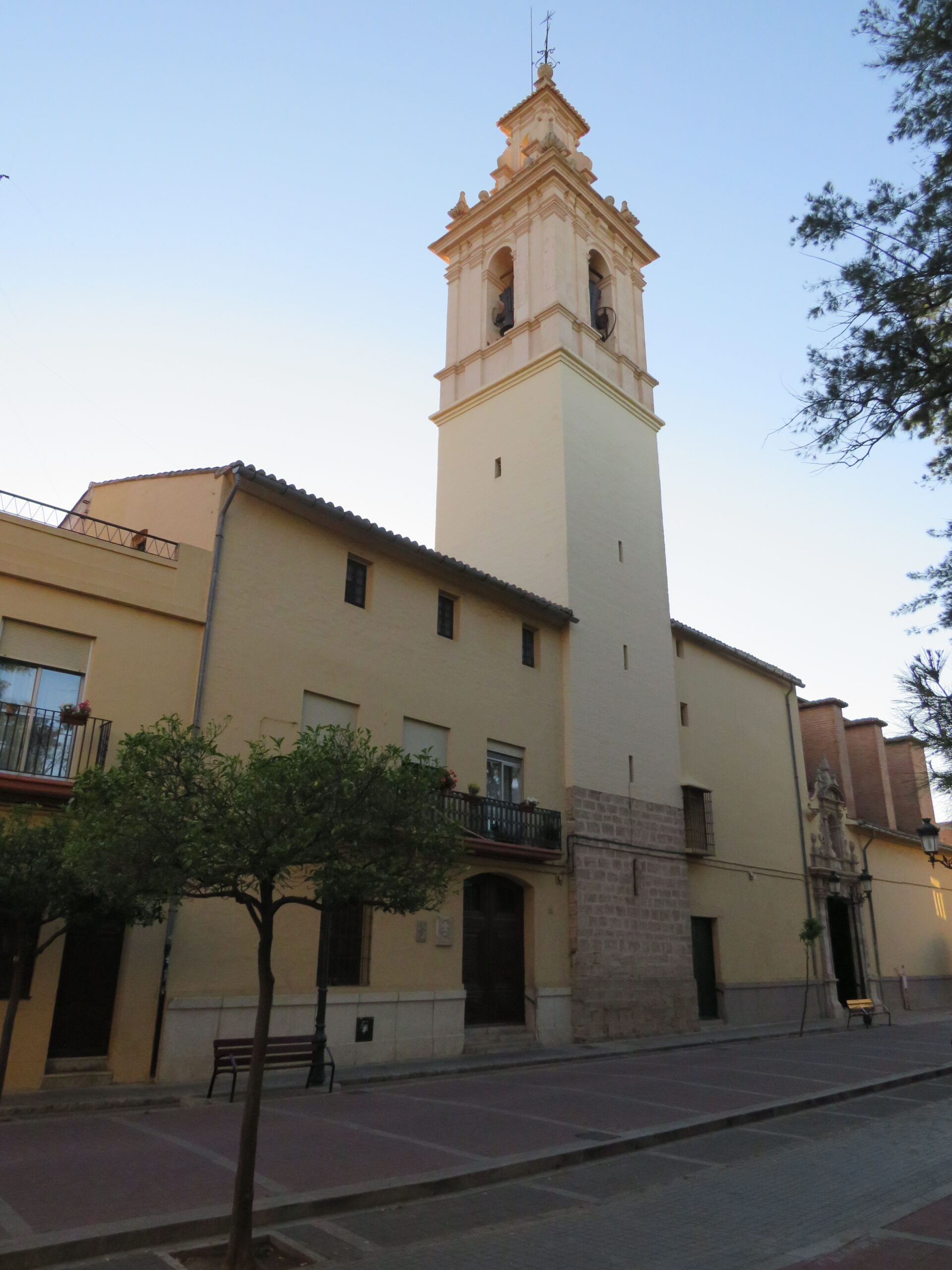
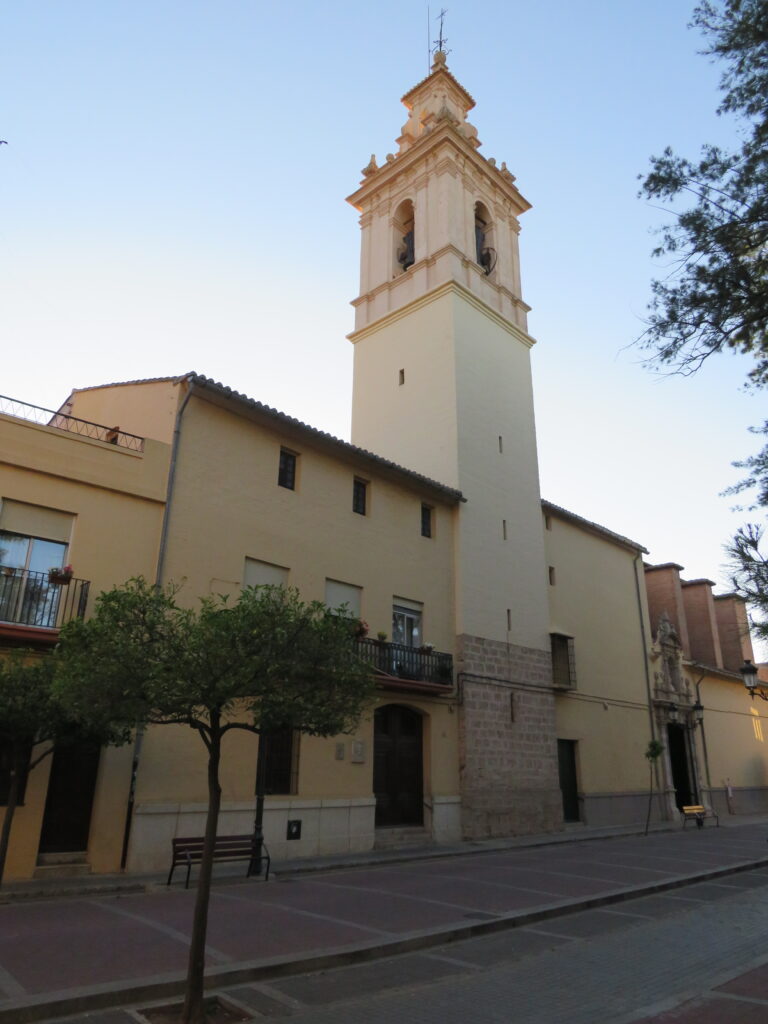
La iglesia de Sant Jaume
The image and the marker show the parish church of Sant Jaume de Moncada, located in the historical core of the population. It is the most concrete current parish reference to contextualize tradition. The photograph does not aim to reproduce the building as it was in 1392 or to show that each part of the present temple occupies exactly the space of medieval celebration.
The building's coordinate is 39.5434582, -0.3934726, obtained from the mapping of OpenStreetMap. Precision is labeled as "present parish temple of historical context": it locates a visitable reference and avoids making it the certified physical point of vision.
Why is it classified as vision without relic
On the world map, Moncada appears as "hagiographic Eucharistic vision without relic." This category separates it from cases with preserved forms, material analysis, relicary sanctuaries or specific decrees. It also distinguishes it from the stories that describe a transformation visible to an entire assembly.
The classification helps the pilgrim know what he will find: a spiritual memory linked to a locality and his parish life, not a historical host exposed to veneration. The map must guide with truth, not homogenize very different traditions under the same promise.
How to approach this memory
Anyone who visits Moncada can go to the temple with respect, first check the parish schedules and participate in the Eucharist. The tab does not guarantee that there is a chapel, painting or public celebration dedicated specifically to Inés today. Any visit must respect the ordinary worship and the indications of the parish.
The center of devotion is not the curiosity of an extraordinary experience, but the presence of Christ celebrated by the Church. Tradition invites the renewal of faith, overcoming doubts with formation and prayer, and receiving the sacraments without confusing private experience with common doctrine.
Spiritual feeling
The look of Inés expresses a deeply Christian intuition: under the humble signs of bread and wine, faith recognizes Jesus Christ. Spiritual childhood is not naive, but availability to receive the gift without turning it into possession or spectacle.
The tribulated priest recalls that also those who celebrate and serve the community are in doubt. The pastoral response is not to hide them or to feed them with reckless statements, but to seek truth, ecclesial communion and trust in God's action.
Sources consulted
- Archdiocese of Valencia, The Church in Valencia. Historical synthesis, section of Eucharistic spirituality, p. 96.
- Exhibition associated with San Carlo Acutis: Moncada panel, used as a secondary repertoire.
- Wikimedia Commons: photo and license of the church of Sant Jaume.

Para orar
Jesus the Eucharist, give us a humble and true faith. Hold those who are in doubt, teach us to seek the truth in communion with your Church and make us recognize you on the altar and on every brother. Amen.
Image credit
Iglesia de Sant Jaume de Moncada. Pacopac / Wikimedia Commons, CC BY-SA 4.0. File and license in Wikimedia Commons.