
This document documents a tradition and its pictorial memory; it does not present as proven facts the accusations it contains. The catalogue of the Municipal Archive of Zaragoza confirms that two canvases of the chapel of Santo Dominguito del Val represent an event located in 1427. However, the so-called medieval writing that the panel associated with San Carlo Acutis attributed to an Archedian called "Don Dorner" has not been located in the catalogue. The distinction is essential.
What the Acutis Repertoire Panel Affirms
The panel placed in Zaragoza in 1427 a story about a married woman who sought to change her husband's violent behaviour. According to this news source, he consulted a Muslim sorcerer, who would have asked him for a consecrated host to prepare a remedy or malefficiency. The woman went to the church of San Miguel, gathered and hid the form in a small chest.
In opening it, the story continues, the host would have appeared as the Child Jesus surrounded by light. The sorcerer asked to burn the chest, but the figure remained. They then went to the bishop, confessed and requested baptism. A procession would have taken the Child to the cathedral; during the mass of the following day, a host would have occupied his place and the Child would have disappeared.
The attribution to "Don Dorner"
The text of the panel states that an Archedian from the city called "Don Dorner" left a written report. It also ensures that this document is kept in the municipal file. It does not offer any symbol, title, date of copy, language, support, archival origin or critical editing. Without such data it is not possible to check the manuscript to which it refers.
The searches carried out on 20 August 2026 in the official catalogue of the Municipal Archive by "Dorner," "hostia," "malerio," "eucharistic 1427," "eucharisía 1427," "moro hostia" and other combinations did not return that document. An absence in the search engine does not prove that it has never existed: it can be described with other words, remain uncatalogued or preserved in another background. It does not prevent you from presenting it as a localized and consulted piece.
The finding in the municipal catalogue
The search "miracle 1427" provides two relevant results. These are two photographs of the Arribas Archive, dated 1950-1959, of the chapel of Santo Dominguito del Val. Your references are ES.50297.AM 04.01.02.01 About 002077 y About 002078. Both files describe the architecture, the altarpiece and the side walls.
The cataloguing description says that the two large oil-painted canvas represent a miraculous event in La Seo in 1427. This confirms a concrete artistic memory and allows to identify the place where it was preserved. He does not identify the painter of the canvas, does not transcribe an inscription, does not reproduce the alleged "Don Dorner" report and does not verify each element of the narrative.
What does a painting prove and what does not prove
A work of art can prove that a community knew, transmitted or wanted to represent a story. It also allows the study of iconography, patronage and uses of sacred space. It alone does not show that the event represented happened exactly as the image tells it. The date of the table can also be very later than 1427.
The catalogue does not call the canvases contemporary documentation of the episode. It places them in a baroque chapel formed centuries later. This is why this page speaks of "pictorial memory" and not of "ocular record." The existence of the tables corrects the old claim that nothing had been verified, but does not fill the gaps in the alleged manuscript.
La Capilla de Santo Dominguito del Val
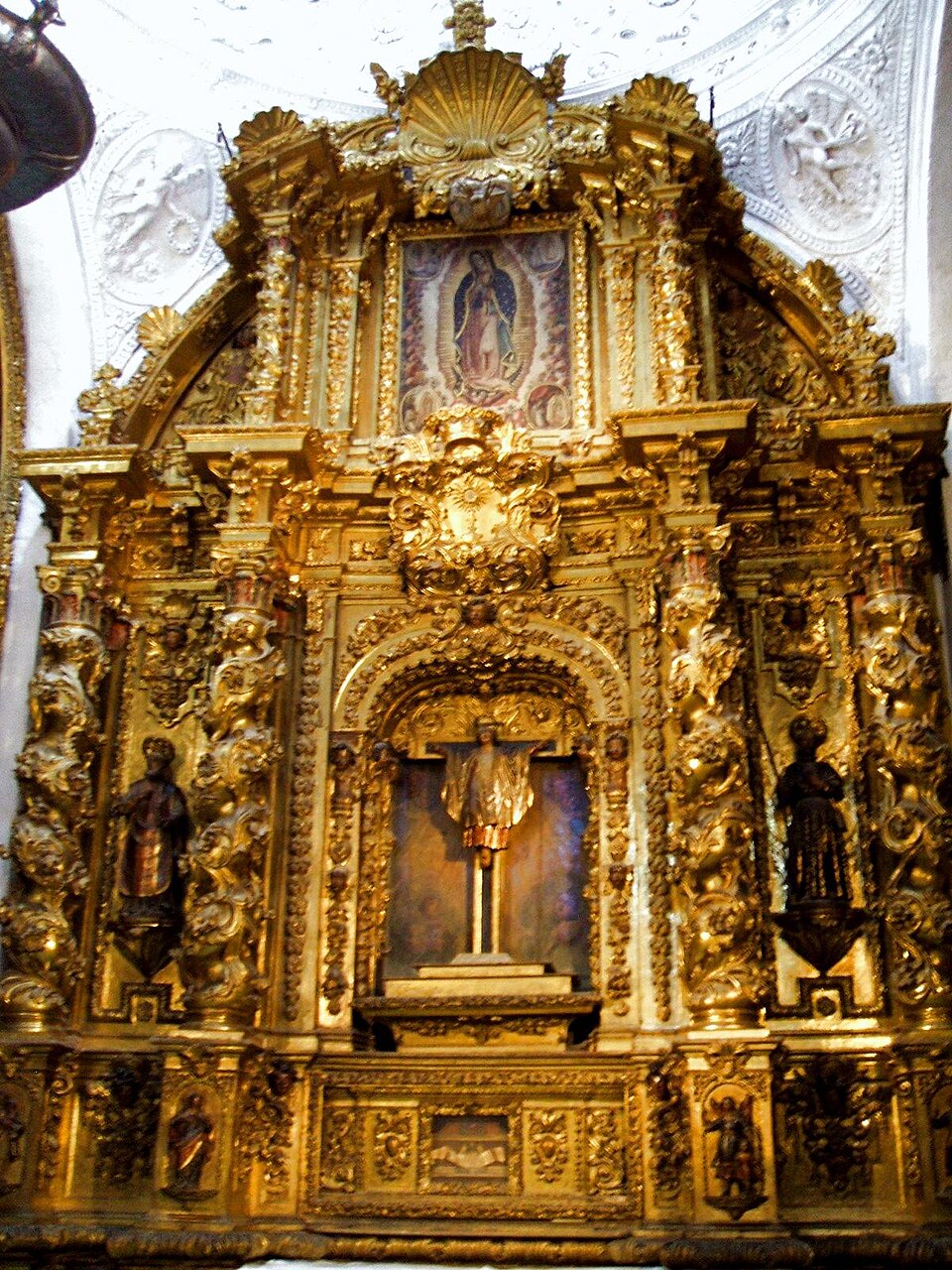
The chapel is located in the Cathedral of El Salvador, La Seo. The municipal description presents an oval dome, a churrigueresque altarpiece and an arquette linked to the devotion of Santo Dominguito. The chosen free photo shows the altar and helps to recognize the current enclosure.
The Archdiocese of Zaragoza attributes to Saint Dominguito another tradition, located in 1250 and directed against members of the Jewish community. That narrative is not the Eucharistic account of 1427. Sharing chapel does not allow to mix them. This file separates dates, protagonists, objects and types of charges so as not to create a non-existent hybrid history.
An anti-Muslim stereotype
The panel characterizes the Muslim character as a sorcerer who requests a host for an evil. This reason belongs to a long family of European stories in which religious minorities appear as enemies of the sacrament. To repeat it today as historical news without primary source would help to preserve prejudice and could unjustly hurt Muslim people.
Christian responsibility demands truth and charity. A tradition can be studied without turning a collective accusation into doctrine or using it to despise another religion. The story speaks of a particular person and, even about him, we lack the document that would allow us to know how it was built. Nothing allows the image of the Muslims of Zaragoza, the past or the present to be projected.
The woman of the story and the marital violence
The story begins with a woman who wants her husband to stop acting violently. This detail should not be buried under the prodigy. Violence against a wife is not corrected by magic, religious manipulation or guilt of the victim. A current pastoral reading must affirm its right to protection and help.
The panel calls it superstitious and dishonest for hiding the host. The sacrilegious sense that tradition attributes to the act can be explained without reducing the whole person to a label. The page does not turn its suffering into a dramatic resource, nor does it propose history as a advice for real situations of abuse.
Communion and the hidden host
The reason for withdrawing the form after comulgar appears in several medieval legends. It expresses the fear of desecration of the Eucharist and teaches that communion is not a magical object available for any purpose. In this case, the visible Child represents the identity between Christ and the sacrament.
This theological meaning can be studied even if the chronology remains uncertain. Catechesis does not need to present each narrative element as a proven data. The Eucharist leads to communion, truth and care of others; it does not justify suspicions against minorities or superstitious practices.
Bishop Alonso de Argüello
The panel appoints Don Alonso de Argüello as the bishop of the city. This data still requires specific prosopographic and chronological contrast. The tab does not use it as a probative anchor or build an episcopal recognition chain from the name. Nor has a decree of approval of the alleged prodigy been located.
The procession, the consultation of theologians and the final mass are part of the story transmitted by the panel. They are always attributed to that source. The existence of a painted scene in the cathedral documents later reception, but does not automatically amount to a canonical process with modern reach.
La ausencia de una reliquia eucarística
There has been no identification of a host, an Eucharistic relic or a public exhibition linked to the event today. The archet that the catalogue mentions on the altar contains remains attributed to Saint Dominguito, belonging to the devotion of 1250, not the form of the account of 1427. Confusion would alter two different stories.
The lack of relic alone does not decide the historicity, but determines the category of the map and what a visitor can find. The Seo retains the chapel and artistic memory; it does not present here as an active Eucharistic sanctuary born of this episode.
The coordinate is contextual
The marker corresponds to La Seo de Zaragoza, in 41.6546531, -0.8756609. It indicates the building where the municipal catalogue places the canvas. It is not intended to point to the woman's house, the church of San Miguel, the place of the alleged consultation or the exact point of the procession.
The map appears as a critical historical memory and remains outside the affirmative layer of Eucharistic miracles. This differentiation allows to locate the heritage without transforming a contextual reference into an episode certificate.
Status of the investigation
There are three levels of evidence. First, a contemporary panel offers the narrative and attributes a writing to "Don Dorner." Second, the municipal catalogue confirms two photographs and two canvases concerning an event of 1427, with specific symbols. Third, the symbol and consultation of the so-called medieval document, the dating and authorship of the paintings and a study that reconstructs how tradition came to the chapel are missing.
The right conclusion is not to say that everything is false or that everything is proven. We can prove the existence of a memory; we cannot yet prove all the facts that that memory narrates. If the file or the cabildo provides new documentation, this file must be extended without deleting the history of the causation.
Open questions for future research
A complete archival investigation should first identify the Archedian cited by the panel. It would be necessary to compare the forms "Dorner," "Dornen," "Dornier" or other possible readings with the capitular and episcopal records of the 15th century. The oldest source that links its name to the story would then have to be found and whether it is an original, a later copy, a chronicle or an inscription.
The canvases should also be studied: author, date, manager, restorations, iconographic program and relationship with the union of the former chapels of the Holy Spirit and Corpus Christi in the 17th century. The photo sheets of the mid-20th century prove that they were there then, but do not explain when they arrived. Finally, a paleographical reading of the alleged document would allow us to know what words it really uses to designate the woman, the Muslim character, the bishop and the prodigy.
These questions remain published so that future contributions can be assessed with clear criteria. A new reference shall include file, background, series, symbol, folio, dating and, where possible, reproduction or transcription. Transparency prevents a circular quote - a panel that refers to a file without reference and subsequent pages that refer to the panel - from getting confused with a proven primary source.
Why is it published as a critical memory
Hide the case would leave only acritical versions circulating. Publish it as a fully accredited miracle would reproduce an accusation without localized basis. Critical memory offers a third way: it retains the repertoire, links the verifiable sources, explains its limits and disables prejudice.
This methodology already applies to other European accounts against minorities. It does not seek to weaken the Eucharistic faith, but to prevent devotion from being dependent on historical statements that we cannot sustain. The reverence to the sacrament is compatible with honest research and respect for Muslims and Jews.
Sources consulted
- Zaragoza Municipal Archives, About 002077, picture of the chapel and reference to the canvas.
- Zaragoza Municipal Archive, About 002078Second photograph.
- Official search for documentary funds, catalogue consulted on 20 August 2026.
- Archdiocese of Zaragoza: diocesan history, context of the chapel and the different tradition of Saint Dominguito.
- Repertoire associated with San Carlo Acutis: Zaragoza 1427, source of the revised narrative.
- Wikimedia Commons: picture of the chapel, authorship and CC0 license.

Para orar
Lord Jesus, present in the Eucharist, give us love for the truth and a heart free from prejudice. Protect those who suffer violence, teach us to correct superstition without humiliating anyone and make our communities meeting places. May the memory of the past move us to conversion, justice and peace. Amen.
Image credit
Chapel of Santo Dominguito del Val in La Seo de Zaragoza. Zarateman / Wikimedia Commons, CC0 1.0. File and license.