
Marian devotion
Mary in the Baltic countries
Faith that survives the Soviet winter - Latvia, Estonia and the devotion that did not give in
Three countries, three stories, one faith
When we talk about the Baltic countries - Estonia, Latvia and Lithuania - we usually talk about them together, as if they were a homogeneous block. And in some ways they are: the three suffered the same Soviet occupation, the same deportations to Siberia, the same attempt to erase their national identities. The three regained independence in 1991, the three became countries of the European Union, the three have been stable democracies on the eastern border of free Europe over the last decades.
But with regard to Marian faith and devotion, all three countries have very different stories. Lithuania is almost unanimously Catholic - nine out of ten Lithuanians identify with Catholicism, although religious practice is variable. Latvia is divided between the historical Lutheranism of the north and the Catholicism of the south, in a region called Latgale which is one of the most fervent Catholic communities in all of Europe. And Estonia is, in statistical terms, the least religious country in Europe: the majority of its population declares themselves without religion, and the small Catholic community - just a few thousand faithful - has been a minority within a minority for centuries.
And yet, in all three countries, there are stories of Marian devotion that communism could not erase. Stories that talk about something that goes beyond statistics, beyond the percentage of practitioners or open churches. Stories of specific people who in limited situations clung to Mary because they had nothing else to cling to.
Latvia: the land of Latgale and the sanctuary of Aglona
We must go to the south-east of Latvia to find the heart of the Latvian Marian devotion. The region is called Latgale - a historical territory that for centuries was under the Polish-Lithuanian influence rather than the German-Lutheran that marked the north of the country - and is different from the rest of Latvia. He speaks a dialect of his own. He has a culture of his own. And it's deeply, intensely Catholic in a way that doesn't look like anywhere else in the Baltic.
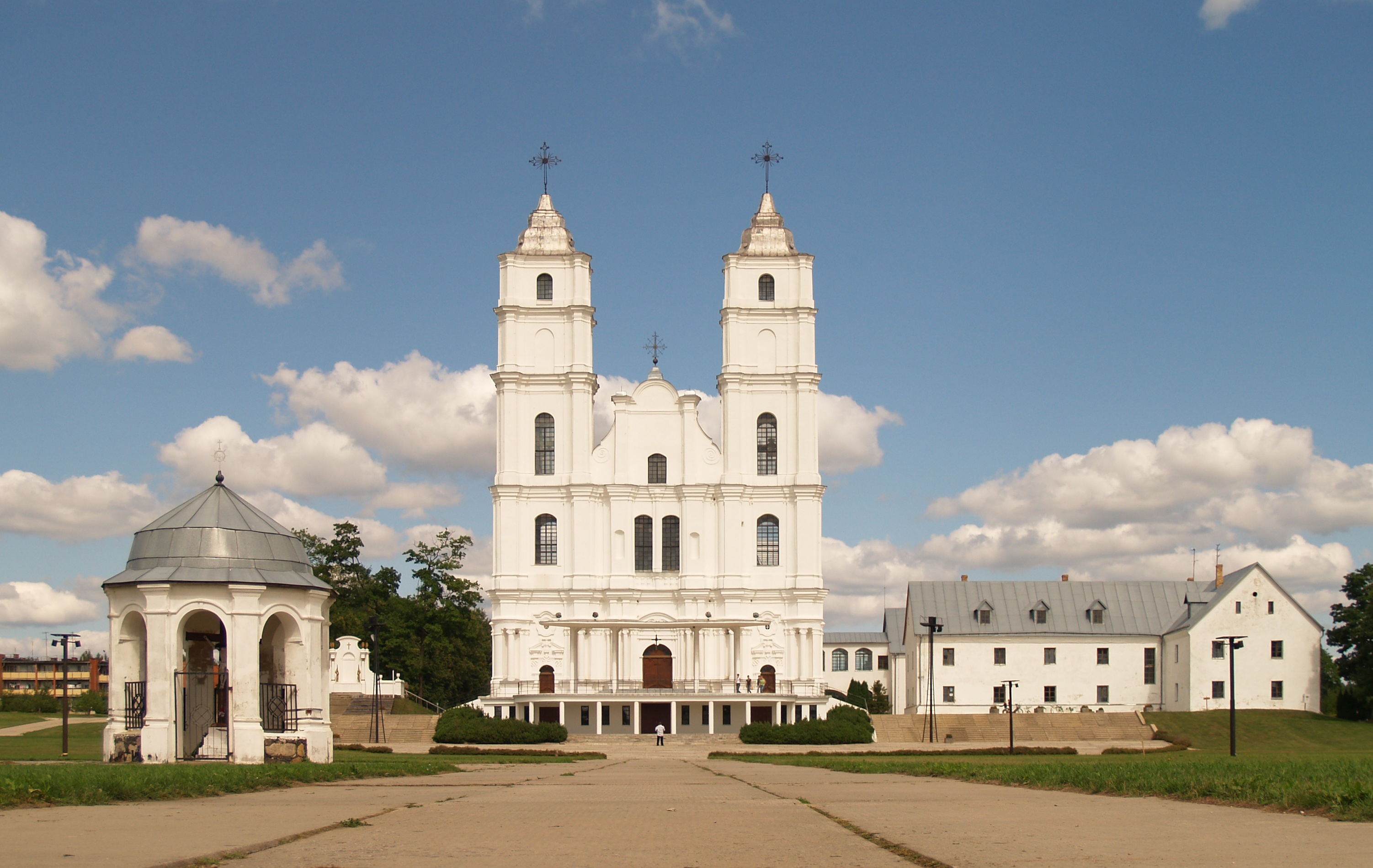
In the heart of Latgale is Aglona: a small, discreet town that most of the year seems like a place like any other in rural Europe. But Aglona has something that no other place in the Baltic countries has: a white Baroque basilica lying on a blue lake, which was built in the 18th century by the Polish Dominicans who evangelized the region, and which houses an image of the Virgin that the Latvian call Aglona Our Lady - the Mother of God of Aglona.
The image is a painting on canvas, in late baroque style, that shows the Virgin with the Child. According to tradition, it was brought to Aglona in the early 18th century by the Dominicans, although its previous history is uncertain. What is indisputable is what happens every 15 August: the Assumption of Mary.
August 15 in Aglona: two hundred thousand people
On August 15, each year, the small town of Aglona becomes the spiritual center of Latvia. The pilgrims begin to arrive days before: by car, by bus, on foot. From Riga, from the border with Belarus, from the communities of the Latvian diaspora abroad. The number of pilgrims who meet in Aglona on that day can reach two hundred thousand people - an extraordinary figure for a country of less than two million inhabitants.
The pilgrimage of Aglona has something that distinguishes it from many other Marian pilgrimages of Europe: the intensity of silence. The pilgrims who make the last step of the road on foot - several kilometers, often in the early morning - do so in complete silence, praying the rosary mentally or in a very low voice. When they arrive at the lake around the basilica and see the white towers reflected in the dark water of the morning, many break to cry without knowing exactly why.
"Aglona is the place where Latvia remembers what it is. Not only the religious - also the human. The ability to be silent together before something bigger than us."
- Latvian writer, collected in an interview about national identity
During the Soviet years, the pilgrimage of Aglona was prohibited. The authorities placed road controls on access to the city. They seized documents, questioned the pilgrims, threatened with labor consequences to those who insisted. And yet - as in Zarvanytsya, as in the Hill of the Cruises of Lithuania - the Latvian continued to go. They crossed the fields at night, avoiding the main roads, reaching Aglona on roads that Soviet agents could not all watch.
- 18th centuryThe Polish Dominicans build the Baroque Basilica of Aglona and bring the image of the Virgin who is soon venerated as miraculous.
- 1940The USSR occupies Latvia. Mass deportations begin: more than 35,000 Latvian are sent to Siberia only in 1941.
- 1941–1990The pilgrimage of Aglona is forbidden. The Latvian go anyway, crossing the fields at night, risking the job and freedom.
- 1993John Paul II visited Aglona on 9 September during his trip to the Baltic countries. Celebrate the Mass before hundreds of thousands of faithful.
- 2006Pope Benedict XVI visits Aglona during his trip to Latvia. "This land is consecrated by suffering," he says.
- CurrentEvery August 15, 150,000-200,000 pilgrims gather in Aglona for the pilgrimage of the Assumption, the most multitudinary of the Baltic.
John Paul II in Aglona: "This land is consecrated by suffering"
On 9 September 1993, John Paul II arrived in Aglona. It was the culminating moment of his visit to the three Baltic countries, and the Pope knew it: he had chosen Aglona as the place to say something he had to say about what those peoples had suffered and about the role of faith in that suffering.
He celebrated the mass in the open to a number of faithful that the organizers calculated in more than three hundred thousand people - the greatest event in modern Latvia history. And before that crowd that wept and sang in Latvian the Marian hymns that had learned in secret, the Pope said words that the Latvian still remember: "This land is consecrated for the suffering of their people. The Virgin of Aglona is the testimony that God does not abandon those who suffer."
It was a time when history and liturgy melted. The Pope who was born in an also occupied Poland, who had seen how communism was trying to erase the identity of the peoples, was in Latvia, before the image of the Virgin that the Latvian had secretly venerated for fifty years. And he told them that their suffering had not been in vain. That the faith they had preserved at such a cost was the most precious good they had.
Estonia: the country the Soviets left with almost no faith
Estonia is different. Very different. While Lithuania and Latvia (especially Latgale) have an entrenched and visible Marian devotion, Estonia is the country of the three where the Catholic Church was never a majority and where communism had the greatest success in erasing the religious practice of daily life.
The story is complex. Estonia was Lutheran since the 16th century Reform, when German feudal lords - the country's ruling class - adopted Lutheranism and imposed it on the population. Catholicism was a tradition of a small minority, mainly linked to Poles and Lithuanians living in the country. When communism came, that small Catholic community was further marginalized.
Today, Catholics in Estonia are less than ten thousand people in a country of one million three hundred thousand inhabitants. It is a tiny community, but of a remarkable devotional intensity. And they have their own Marian history: the image of Our Lady of the Dolores in Tallinn Cathedral.
Our Lady of the Dolores of Tallinn: the image that survived the Soviets
The story of this image is one of those stories that seem to be invented but that are true, and that say something deep about the nature of devotion and the mysterious ways for which the sacred sometimes survives.
The image of Our Lady of the Dolores - a baroque sculpture that represents the Virgin with the seven daggers nailed to the chest, according to the iconographic tradition of the Seven Dolores - was in the Catholic Cathedral of Tallinn when the Soviets arrived. The authorities, as everywhere, confiscated or destroyed the objects of worship. But this image had something that complicated its destiny: it was considered a work of art of historical value.
And then something unexpected happened: those responsible for Soviet culture decided to use it in an antilerical play. A satire on religious superstition, the kind of entertainment that the regime promoted to "educate" the people in scientific atheism. The image of the Virgin would appear on stage as a symbol of what the Soviet people were leaving behind.
The result was the opposite of the expected. The audience who saw the work - people who in many cases had never entered a church, young Soviets educated in atheism - was strangely moved to the image. There was something in that woman figure with the nailed daggers that came to a place that ideology could not completely cover. And those responsible for the work, uncomfortable with that reaction they had not planned, decided to remove the image of the production.
And they didn't dare destroy it.
The image was stored in a warehouse, then forgotten, then found again. When the Soviet authorities left and the Catholic community was able to recover their property, the image was intact. Today he presides over the small Catholic cathedral of Tallinn, venerated by the few Catholic faithful of Estonia and visited with curiosity by tourists from all over the world who find in it something they do not know exactly how to name.
The small Catholic cathedral of Tallin - the only one in Estonia - was built in the 19th century for the Catholic community of the city, consisting mainly of Polonese and Lithuanian. During the Soviet era it was closed and used as a store and concert room. It was returned to the Catholic Church in 1989. The image of Our Lady of the Dolores remains its main object of veneration.
The Baltic diaspora: devotion in exile
One of the most notable phenomena in the Marian history of the Baltic countries is that of communities in exile. When the Soviets occupied the three countries in 1940, thousands fled to the West: Germany, Sweden, the United Kingdom, and especially the United States, Canada and Australia, where there were already communities of Baltic migrants from previous waves.
These exiles - who in many cases knew that they would never see their country again, or that it would take decades to do so - built churches, schools, cultural associations in their host countries. And they built Marian shrines. In Chicago, Toronto, Melbourne, Buenos Aires: there are Lithuanian, Latvian and Estonian churches where the image of the Virgin occupies the central place and where the faithful pray in their ancestral languages to images that are copies of the icons and paintings left in their occupied country.
Marian devotion was for the Baltic diaspora what it was for communities within the occupied countries: a thread of identity that no one could cut. To pray the rosary in Lithuanian in a church in Chicago was to remain Lithuanian even if the Hill of the Cruces had never been seen. Saving the image of the Virgin of Aglona in a Toronto chapel was to remain Latvian even if the lake around the basilica had not been seen.
When Lithuania, Latvia and Estonia regained independence in 1991, the diaspora was one of the first groups to return. They came with their images, their traditions, their memories of a devotion held for fifty years in exile. And they found that, despite everything, the faith they had preserved outside was still alive inside.
"I grew up in Toronto knowing it was Latvian. Not only because my mother told me: also because every Sunday we went to the Latvian church and prayed to the Virgin of Aglona. When I was finally able to go to Aglona in 1992, it was like completing a circle that had taken my whole life to close."
- Testimony of a second-generation Latvian migrant, Toronto
Mary as the root of identity: what the Baltic countries teach the world
There is something that the Marian history of the Baltic countries - with their differences, their particularities, their nuances from country to country - teaches about the nature of popular devotion. It is not just a story of religious faith in the strict sense: it is a story of what happens to a people when they take away everything else.
Soviet communism tried, with a degree of systematiicity and violence that still impress when read carefully, to erase from the memory of the Baltic peoples their religious identity, their cultural identity and their national identity. He had the means to do so: the control of the State, the police, the army, the education system, the media, the economy. It was all in his hands.
And yet it failed. Not completely, not in all cases - there are generations of baltics that grew in Soviet atheism and never came out of it - but in essence, the three countries remained recognisably themselves, with their languages, with their traditions, with their particular devotions. And when independence came, the first thing many baltics did was go to church.
Why? Sociologists have their explanations. But perhaps the simplest is also the most true: devotion to Mary - to the woman who in the Gospel says Yes. when everything asks him to say no, that he is at the foot of the cross when they have all fled, that he remains present when the world seems to have collapsed - it resonated in a special way with the experience of peoples who had said yes to their own identity when all asked them to abandon it, that they had been at the foot of their own cross for fifty years, and that they had remained present when the world seemed to have forgotten them.
Is the advocation of the Virgin Mary of your people missing?
Si no encuentras la advocación mariana de tu ciudad o pueblo, cuéntanosla: la investigaremos para ubicarla y darla a conocer en este mapa del amor de la Madre por el mundo.
Propose an apvocation →