
Marian devotion
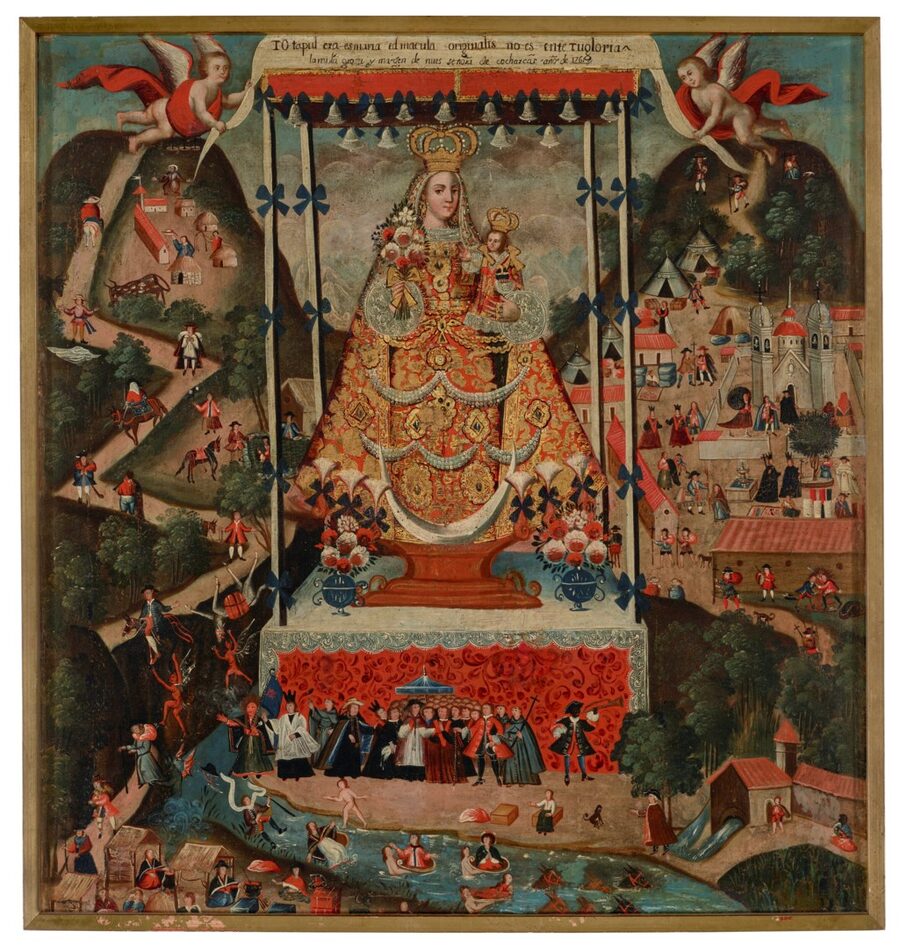
Our Lady of Cocharcas, "Mamacha Cocharcas," venerated in the Sanctuary of Our Lady of Cocharcas
Marian Advocation of Cocharcas (Apurimac)
Documented history. According to historical studies and the tradition collected in academic sources, the cult of Our Lady of Cocharcas is formed at the end of the 16th century, in the territory of the old chankas, in the current region of Apurímac (Peru). The image is from Copacaban typefrom the sanctuary of Copacabana (now Bolivia), and was brought to 1598 by a poor indigenous called Sebastian Quimichiwho obtained authorization from the bishop of Cuzco for his veneration and for the foundation of a fellowship in his honor. The sanctuary was quickly consolidated as one of the first great Marian shrines of the Andes, with influence on the formation of popular piety within and outside Apurimac.
Main data
Origin and history
Documented history. According to historical studies and the tradition collected in academic sources, the cult of Our Lady of Cocharcas is formed at the end of the 16th century, in the territory of the old chankas, in the current region of Apurímac (Peru). The image is from Copacaban typefrom the sanctuary of Copacabana (now Bolivia), and was brought to 1598 by a poor indigenous called Sebastian Quimichiwho obtained authorization from the bishop of Cuzco for his veneration and for the foundation of a fellowship in his honor. The sanctuary was quickly consolidated as one of the first great Marian shrines of the Andes, with influence on the formation of popular piety within and outside Apurimac.
The construction of Sanctuary of Our Lady of Cocharcas It begins precisely as a result of this devotion, around the end of the 16th and early 17th century, becoming over time one of the oldest and most important Marian shrines in South America. From the vireinal period, devotion radiated to other Andean regions, giving rise to replicas in various towns and cities, especially in the central mountains of Peru.
Tradition and legend. The Andean popular memory collects the story of Sebastian Quimichi as a humble indigenous who, moved by faith and after pilgrimage to Copacabana, would have promised to bring an image of the Virgin to her land and promote her veneration among her own. Around this fact, we have written oral accounts of arduous journeys, cures, favors received and special protection of the Virgin over the Chanka region, which are part of the devotional traditionbut they are not always documented in detail in written sources. This tradition has helped to shape the affectionate image of the Virgin as "Mamacha Cocharcas", mother close and protective of the pilgrims.
The image and the sanctuary
The image. The effigy of Our Lady of Cocharcas is a polychrome wood size, de Copacaban type, closely related to the famous Virgin of Copacabana. This is a regular size, standing image that supports the Child Jesus on the left armwhile in the right hand it carries the candela and the basket, characteristic elements of the original iconography related to the Virgin of Candelaria / Copacabana. The Virgin saw a wide mantle and richly embroidered dress, according to the Andean Baroque taste, and is presented as a queen and mother, framed by the festive and colorful aesthetics of the Andes. Some popular sources also point out that the Child holds the world in his hands and blesses the faithful, although this detail is more clearly collected in a journalistic synthesis than in academic documentation.
The sanctuary. El Sanctuary of Our Lady of Cocharcas is a Catholic temple built in the town of Cocharcas, Chincheros province, department of Apurímac (Peru), dedicated specifically to this Marian advocation. It is located on a plateau near the Pampas River, and is described as a Marian monumental sanctuary, one of the first great Marian pilgrimage centers of the Andes. Architectural, it responds to the model of the great Andean church of colonial times, with successive amplifications and remodeling; however, in the sources consulted it is not known that the sanctuary has been elevated to the title of minor basilica nor that it has a specific recognition as a national sanctuary by the Episcopal Conference; it is mentioned above all as diocesan and regional sanctuary of pilgrimage within the diocese of Abancay.
Sponsorship and coronation
Patronage. The diocese of Abancay expressly recognizes Our Lady of Cocharcas as Patron and Protector of the Diocese of Abancay. In addition, its devotional influence covers the entire region of Apurímac, where it is popularly known as "Queen of the Peruvian Andes" and where its feast is the religious and cultural axis of the province of Chincheros. There is no national patronage for Peru, but there is a strong regional and diocesan identification.
Canon coronation. The historical sources indicate that the 8 September 1946 se celebró la canonical coronation of the image of Our Lady of Cocharcas in her sanctuary. This coronation was preceded by a Marian assembly in Ayacucho and followed by a Marian Congress around the sanctuary. The sources consulted do not clearly specify the name of the pontiff who formally authorized the coronation or the pontifical delegate who made it; since the year corresponds to the pontificate of Pius XIIit can be inferred that the concession was made during its pontificate, but this accuracy does not appear expressly in the available texts, so, in strict fidelity to the sources, it is only with certainty that the year 1946 and the realization of canonical coronation.
Party and devotion
La main party of Our Lady of Cocharcas is celebrated the September 8, coinciding with the Nativity of the Virgin Mary. In the diócesis de Abancay, this party is celebrated as Solemnidad. The Regional Government of Apurímac has declared this day as feriado regional, stressing the centrality of the celebration for the cultural and religious identity of the area.
The sanctuary of Cocharcas is described as a great center of interregional pilgrimage: thousands of faithful from all over Apurímac and other Andean regions go to the feast of the "Mamacha Cocharcas," each year, forming one of the largest Marian devotional concentrations of southern Peru. The inflow of pilgrims, processions, solemn masses and expressions of popular piety - dances, songs, offerings, promises and they - are the heart of the festivity, which has been described as the "soul" of the department of Apurimac.
The devotion to Our Lady of Cocharcas has spread beyond her original sanctuary, with replicas of the imagen in various places; its presence in Sapallaga and Orcotuna (Junín region), as well as a temple of this advocation in Barrios Altos (Lima), of virreinal origin, is clearly documented. In all these places, the figure of the "Mamacha Cockarcas" is associated with the protection of families, peasants and mountain travelers, maintaining a strong popular and inter-ethnic character.
Link to the Rosary
The sources consulted about Our Lady of Cocharcas do not specifically document a own rosarian fellowshipnor a particular historical link between this advocation and the spread of the Rosary, beyond the general practice of Marian prayer in the sanctuaries. Therefore, no consta a unique and explicit relationship between the history of this advocation and a concrete rosarian movement.
However, as in most Marian shrines of the Andes, the Rosary is a regular part of the piety of the per
A flower for the Virgin
Offer a simple prayer to this Marian devotion. Pray a Hail Mary for Peru and for all of America.
Pray Hail MaryIs the advocation of the Virgin Mary of your people missing?
Si no encuentras la advocación mariana de tu ciudad o pueblo, cuéntanosla: la investigaremos para ubicarla y darla a conocer en este mapa del amor de la Madre por el mundo.
Propose an apvocation →