
Marian devotion
Our Lady Llorosa of Győr
Marian title of Győr (West)
According to the traditionthe painting was taken from Ireland to Hungary by Irish bishop Walter Lynch, Bishop of Clonfert, who fled his homeland because of the hard anti-atomic persecution driven by Oliver Cromwell. The canvas was originally known as Our Lady Consoladora de los Afligidos and presented the Virgin in a praying attitude with the Child Jesus, being for Lynch a sign of protection and comfort in exile.
Main data
Origin and history
According to the traditionthe painting was taken from Ireland to Hungary by Irish bishop Walter Lynch, Bishop of Clonfert, who fled his homeland because of the hard anti-atomic persecution driven by Oliver Cromwell. The canvas was originally known as Our Lady Consoladora de los Afligidos and presented the Virgin in a praying attitude with the Child Jesus, being for Lynch a sign of protection and comfort in exile.
As for the documented historythe chronicles of the diocese and testimonies gathered in the near time of the events indicate that the 17 March 1697, feast of Saint Patrick, during the Mass of 6: 00 in the morning in the Cathedral of Győr, the image spilled tears of bleeding for approximately three hoursThis phenomenon is witnessed by many faithful present. It is not clear that scientific analyses were then carried out in the modern sense, but reports were drawn up and testimonies were collected that set the date, place and duration of the prodigy. The image has since remained in the cathedral of Győr, where it is still venerated today, spiritually associated with the history of the suffering of Catholicism in Ireland and the welcome that Hungary offered to that exiled bishop.
The image and the sanctuary
The image of Our Lady Llorosa of Győr es un lie (painting on cloth) of Irish origin, of a devotional iconographic type. Sample to the Virgin Mary with her hands crossed in prayer, looking at Child Jesuswhich appears lying on a small bed or stretcher, accentuating the bond of tenderness and contemplation between the Mother and the Son. The table is currently protected in a urn / glass and silver displayvisible to the faithful within the cathedral.
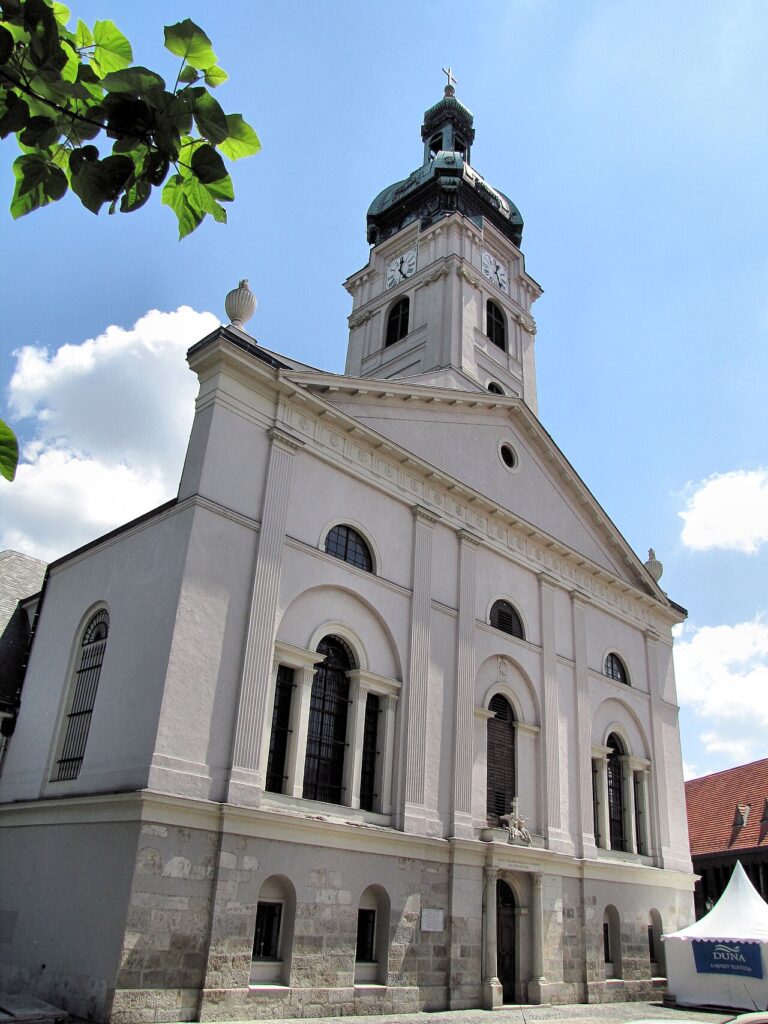
The sanctuary of this advocation is the Basilica Cathedral of the Assumption of the Virgin in Győr (Hungarian: The Blessed Virgin Mary Cathedral), which is at once diocesan cathedral and minor basilica. He gets up in the oldest part of the city, in the call Chapter Hill (Káptalandomb)and is the seat of the diócesis de Győr. The temple has Roman origins in the 11th century, was rebuilt between the 13th and 15th centuries, and its interior was redesigned in style early baroque between 1635 and 1650 by the Italian architect Giovanni Battista Rava; the tower was finished in 1680. The set of works lasted until the 1770s, and the last great restoration took place between 1968 and 1972. In 1997 it formally received the title of minor basilica, given by John Paul II, who also visited the Basilica on 7 September 1996.
Sponsorship and coronation
The image is especially venerated in the city of Győr y en la diócesis de Győrwhere it is considered a sign of the protection of the Virgin in times of trial and a particular bond with the Church in Ireland. Various Catholic press articles emphasize their importance for Hungarian and Irish faithful, but no consta which has been officially proclaimed as the principal patron of the city, of the diocese or of the nation, nor has it been named the national patron of Ireland or Hungary in recent magisterial documents.
As regards a possible canonical coronation of the icon of Our Lady Llorosa of Győr, does not contain a documented canonical coronation in the sources consulted (diocese, information on the basilica, Catholic press and historical reviews). The main dignity that is mentioned linked to the place of worship is the elevation of the cathedral to the rank of lower basilica, but without reference to a specific canonical coronation of the painting.
Party and devotion
La central date of devotion to Our Lady Llorosa of Győr is the 17 March, anniversary of the prodigy of 1697 and liturgical feast of san Patricio, which reinforces the spiritual bond with Ireland. On this day special celebrations are organized in the cathedral-basilica, with solemn mass and acts of veneration of the icon, which bring together the faithful of the diocese and pilgrims from other places, including Irish groups. There are no reliable and current flow figures available in accessible sources, and no consta a safe numerical date of pilgrims.
Devotion is characterized by a strong emphasis on the comfort in persecution, en la fidelity to the Catholic faith y en la solidarity between local churches: the memory of the exiled bishop and the suffering of Irish Catholics is linked to the proven history of the Church in Hungary. It is common for the Catholic press to present the image as a sign of the closeness of the Virgin to those who suffer, especially those who experience discrimination because of faith. The presence of the canvas in a cathedral-basilica of historical relevance also favours Marian pilgrimages within Hungary itself.
Link to the Rosary
In the sources consulted on the Virgin Llorosa of Győr no consta una specific and documented relationship of this advocation with a fellowship of the Rosary, a particular promise linked to the prayer of the Rosary or an official title that links it in a unique way to this prayer. It is not mentioned, for example, that the prodigy of tears was directly associated with a ninth of the Rosary or with a specific rosarian institution.
However, from a general Marian perspective, the figure of Our Lady Consoladora and Llorosa is deeply harmonized with the Rosarywhich is contemplation of the mysteries of Christ with Mary. In this advocation, the Virgin appears in a praying and attentive attitude to the Child, which invites us to contemplate the joyful mysteries and, at the same time, his blood cry refers to the painful mysterieswhere Mary participates in the redeeming suffering of her Son. For the faithful who come to the Basilica of Győr, the prayer of the Rosary to this image can be understood as a way of:
– presentar a la Virgen los sufrimientos de la Iglesia perseguida y de los cristianos que viven hoy situaciones análogas; – unirse espiritualmente a la fe probada de Irlanda y Hungría, meditando la Pasión del Señor con María; – acoger la intercesión de la Madre como Consolador de los Afligidos, the original title of the icon, while the joys, pains and glories of Christ are on the Rosary.
Although there is no concrete historical-legal link with the Rosary, this advocation naturally aligns itself to accompany the persistent prayer of the Rosary, especially for the peace, religious freedom and strength of the persecuted Christians.
A flower for the Virgin
Offer a simple prayer to this Marian devotion. Pray a Hail Mary for Hungary and for world peace.
Pray Hail MaryIs the advocation of the Virgin Mary of your people missing?
Si no encuentras la advocación mariana de tu ciudad o pueblo, cuéntanosla: la investigaremos para ubicarla y darla a conocer en este mapa del amor de la Madre por el mundo.
Propose an apvocation →