
Marian devotion
Our Lady of Kursk- Root
Marian vocation of Kursk (Russia)
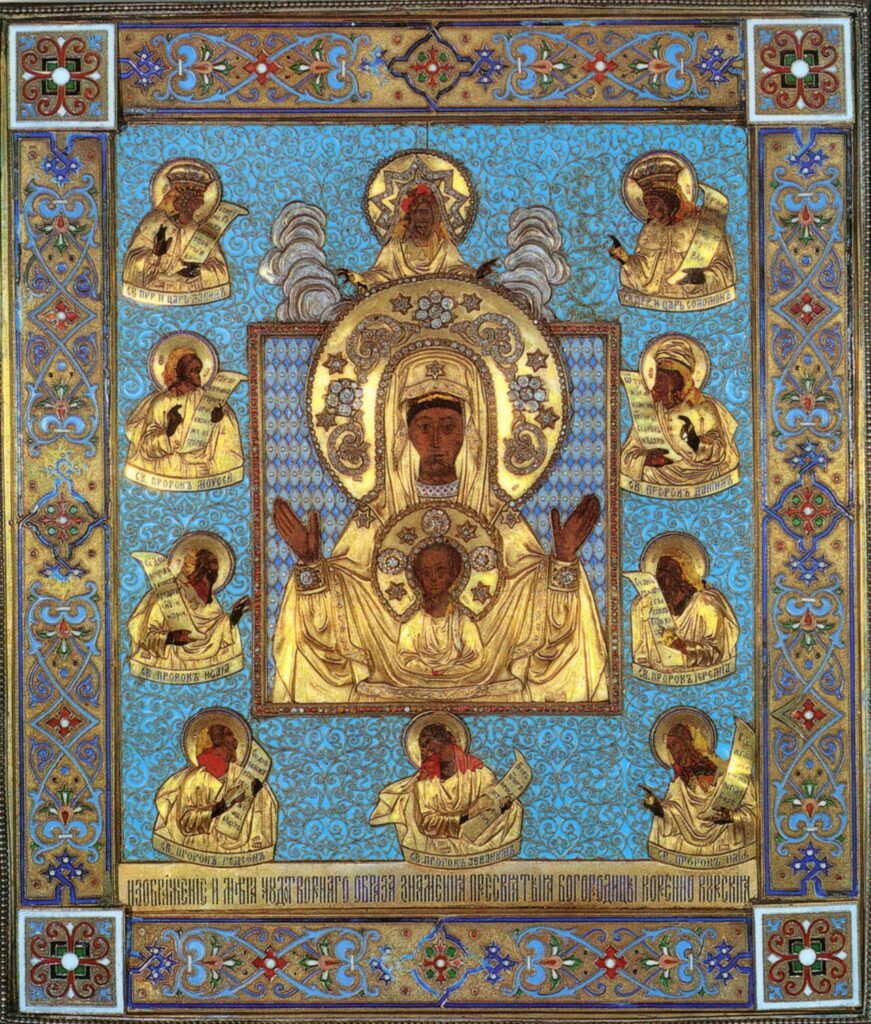
According to the tradition of the Russian Orthodox Church, the icon of the Mother of God of the "Sign" of Kursk-Raiz (Kurskaya Korennáya) was found 8 September 1295the feast of the Nativity of the Virgin Mary, next to the root of a tree in a forest near Kursk. The image would have been found by a hunter, and from the location of the find it would have become a source of numerous miracles and a focus of pilgrimage. This tradition is firmly rooted, but it is transmitted in a hagiographical and legendary key.
Main data
Origin and history
According to the tradition of the Russian Orthodox Church, the icon of the Mother of God of the "Sign" of Kursk-Raiz (Kurskaya Korennáya) was found 8 September 1295the feast of the Nativity of the Virgin Mary, next to the root of a tree in a forest near Kursk. The image would have been found by a hunter, and from the location of the find it would have become a source of numerous miracles and a focus of pilgrimage. This tradition is firmly rooted, but it is transmitted in a hagiographical and legendary key.
From the perspective of the documented historythe icon is considered one of the main relics of Russian orthodoxy and is located around the 13th century. Over the centuries, he was transferred on several occasions to the city of Kursk and other places in Russia, and was particularly associated with the spiritual life of St Serafin of Sarov, who had a special devotion to this image (data widely collected in the Russian spiritual tradition, although the sources consulted in Spanish do not give critical details).
In the 20th century, after the Russian Revolution, the icon came out of Russia and joined the life of the Russian Orthodox Church Abroad (ROCOR). Currently, the original image is venerated in the Známenski Cathedral of the Mother of God of the "Sign" in New York, Manhattanwhere it is the main relic and symbol of the Russian diaspora, very venerated by the faithful scattered around the world. In Kursk copies are venerated and the memory of the icon found next to the root is kept alive.
The image and the sanctuary
The Kursk-Root icon is an icon orthodox of the Mother of God of the type called “Lord” (in Greek) Platyterain Russian Sign): the Virgin is represented frontin a prayer attitude, with his arms raised, and in his chest, within a medallion or circle, is shown to Child Jesus blessing, symbolizing the Incarnation and the presence of the Word within Mary. The sources consulted in Spanish do not detail the material original (usually these icons are painted at the temple on a wooden table, but for this particular case does not explicitly appear in the Spanish sources), so it is simply indicated that it is a traditional painted icon.
Invocation is known as "Miraculous icon of the Mother of God of the Kursk Sign of the Root" (Kursko-Korennaya). The place of current custody is the Cathedral of the Icon of the Century (Známenski) of the Russian Orthodox Church abroad in New Yorkwhere it is preserved as the main relic and is shown for the veneration of the faithful. In Russia, in the Kursk region, there is an important center of devotion around this icon, but the sources consulted in Spanish do not specify in detail the canon name or the rank (minor basilica, national sanctuary, etc.) of the main Orthodox temple linked to the icon; therefore, not accurately recorded in these sources the official title of the main sanctuary in Kursk.
Sponsorship and coronation
The icon of the Mother of God of the Century of Kursk-Root is considered main patron of the Russian Orthodox Church abroad and its most important relic, especially as symbol and sanctuary of the Russians in the diaspora. In addition, he is venerated as a protector of the Kursk region and, in general, as one of the great protective images of the Russian people, although the Spanish sources do not detail a specific legal proclamation of patronage over a particular diocese or city, beyond this role of patronage in the ROCOR.
It does not contain, in the sources consulted, a canonical coronation in the Catholic way (with pontifical decree and liturgical crowns imposed by a delegate of the Pope); in the orthodox context, the icon is solemnly venerated and often richly adorned, but does not contain a documented canonical coronation according to the use of the Latin Catholic Church.
Party and devotion
According to the tradition associated with the finding, the main party linked to the icon of Kursk-Root is held the September 8, memory of the Nativity of the Mother of God in the Byzantine liturgical calendar, when the discovery of the icon next to the root of the tree is remembered in 1295. This date has remained a day of special celebration and thanksgiving for the miracles attributed to the intercession of the Mother of God before this icon.
The devotion to the icon has been historically linked to pleas by the protection in times of war, disaster and internal conflictas well as requests for treatment of diseases, especially of the eye, and epidemics such as cholera. Before the icon is prayed for the the liberation of inner struggles, for protection from invasions and for the blessing of the compatriots forced to wander around the world. In the diaspora, the icon regularly travels Russian Orthodox communities outside Russia, and where it is exposed it congregates miles de fieles in long rows of veneration and prayer, according to testimonies collected in means and devotional accounts.
Link to the Rosary
The sources consulted do not indicate a specific or historical relationship between the orthodox icon of the Mother of God of the Kursk-Root Century and the prayer of Rosary in the Catholic sense; it is mainly a devotion of Russian Orthodox tradition, focused on the veneration of the icon, the litany, the liturgical offices and the prayer of Jesus, rather than on the Rosary as it is prayed in the West.
However, from a Catholic Marian perspective, this advocation can be seen in deep harmony with the Rosary. The icon of the "Sign" presents Mary as Mother of the Incarnate Wordwith Christ in his womb: it is a visual image of the mystery of the Incarnationwhich occupies a central place in the joyful mysteries of the Rosary. For the Catholic faithful who venerate this advocation, the Rosary can be a way of to accompany Mary in the contemplation of her Son, joining spiritually the praying tradition of Eastern Christians, and asking, in meditating on the mysteries of Christ, for the same gifts that are implored before the icon of Kursk-Root: peace, conversion, protection of the believing people and comfort for those who live far from their homeland.
A flower for the Virgin
Offer a simple prayer to this Marian devotion. Pray a Hail Mary for Russia and for world peace.
Pray Hail MaryIs the advocation of the Virgin Mary of your people missing?
Si no encuentras la advocación mariana de tu ciudad o pueblo, cuéntanosla: la investigaremos para ubicarla y darla a conocer en este mapa del amor de la Madre por el mundo.
Propose an apvocation →