
Marian devotion
Our Lady of Candelaria, also invoked as Our Lady of Mercy, of the hill of La Popa in Cartagena de Indias
Marian devotion of Cartagena (Bolívar)
La devoción a Our Lady of La Popa Candelaria is part of the expansion, since the 17th century, of the advocation of the Candelaria, native to Tenerife (Canary Islands), very widespread in Spain and in various countries of America, including Colombia. In Cartagena de Indias, the arrival of the avocados recollected to the hill of La Popa at the beginning of the 17th century marked the beginning of the convent and the Marian cult in this elevated place that dominates the bay. The Sanctuary-Convent of La Popa, founded in 1606 according to the tradition of the sanctuary itself, has since been the centre of Marian spirituality for Cartagena and the Caribbean region.
Main data
Origin and history
La devoción a Our Lady of La Popa Candelaria is part of the expansion, since the 17th century, of the advocation of the Candelaria, native to Tenerife (Canary Islands), very widespread in Spain and in various countries of America, including Colombia. In Cartagena de Indias, the arrival of the avocados recollected to the hill of La Popa at the beginning of the 17th century marked the beginning of the convent and the Marian cult in this elevated place that dominates the bay. The Sanctuary-Convent of La Popa, founded in 1606 according to the tradition of the sanctuary itself, has since been the centre of Marian spirituality for Cartagena and the Caribbean region.
According to the tradition, un friar agostino recoleto, identificado como fray Alonso de la Cruz Paredes, habría recibido en espera la misión de aproximar un temple en la cualto del río para entronizar la imagación de la Virgen y "exerrar ancios cultos paganos." This tradition is reflected in the local memory as a symbolic explanation of the character of “faro de fe” of the convent over the city. However, the visionary details belong to the field of pious legend: the sources consulted speak of "historical tradition," without providing critical documentation of the specific mystical experience.
In the plan of the documented historythe presence of the avocados recoletos and the Convent of the Santa Cruz de La Popa since the early 17th century (it is indicated the year 1610 as a reference of consolidation of the convent), in charge of the custody of the image of Our Lady of the Candelaria. The city has officially recognized the Virgin of La Popa Candelaria as patrona espiritual de Cartagena, and the Sanctuary-Convent has been considered one of the pillars of the spiritual heritage of the city.
The image and the sanctuary
The main image of Our Lady of the Candelaria venerated in La Popa is recognized as the spiritual patron of the city and is enthroned in the Sanctuary - Convent of La Popa, governed by the Order of Agustinos Recoletos. A source of Marian outreach points out that in Cartagena "the Virgin of Candelaria is to be venerated in the convent of the Cerro de la Popa, where it rests a picture dating from the colonial era," which indicates at least the existence of an important pictorial representation of the vireinal period linked to this devotion. There is no detailed technical description (material, measurements, authorship) of the current main image (either painting or sculpture) in the sources consulted, nor any precise data on its particular iconography in this sanctuary; therefore, these details are considered. no constatados.
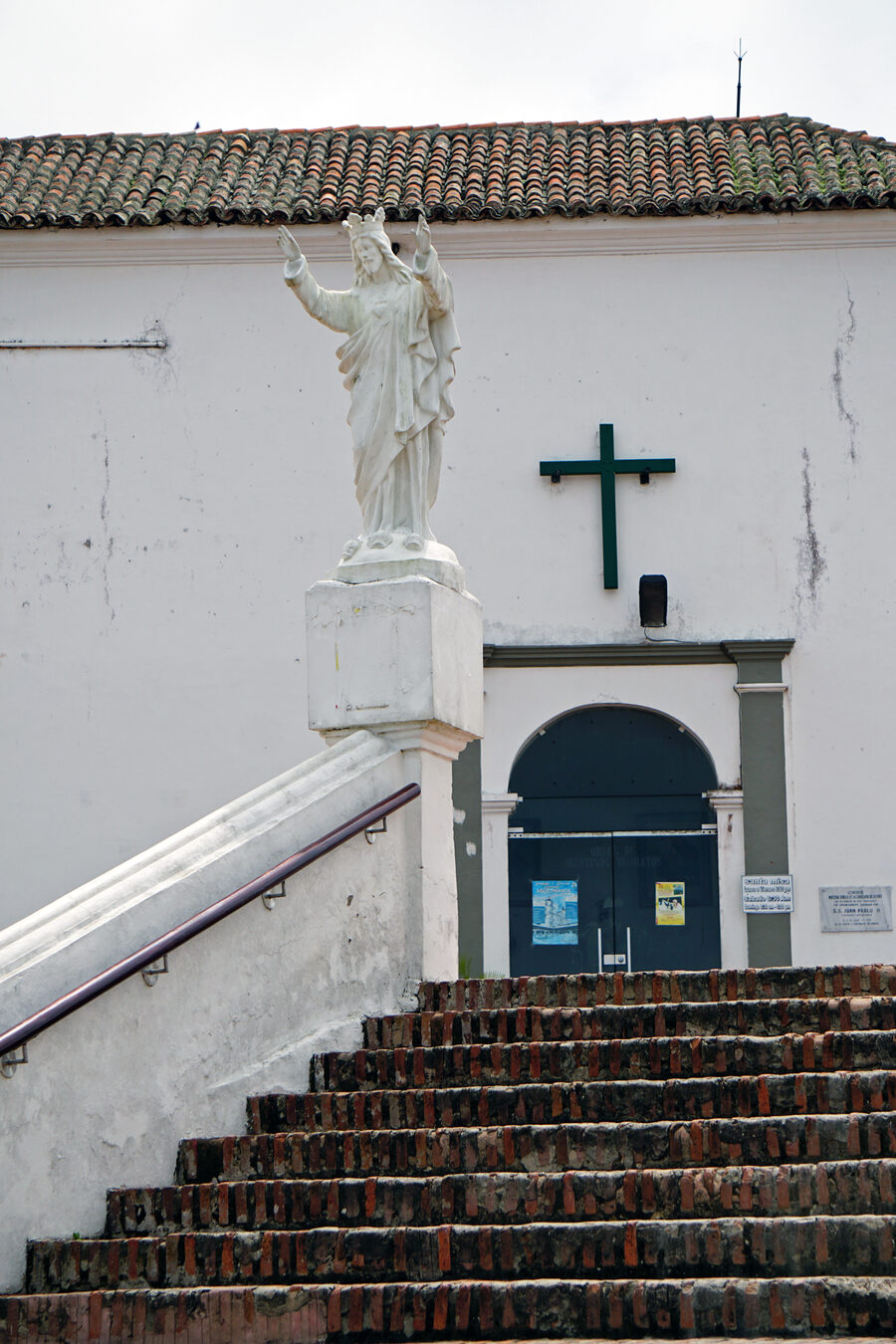
The place of worship is the Convent of the Holy Cross of La Popa and Sanctuary of Our Lady of the Candelarialocated on the summit of the hill of La Popa, which dominates the bay of Cartagena. The sanctuary itself is presented as the "center of the highest Marian spirituality of Cartagena de Indias and the Caribbean region," where the advocation of Our Lady of the Candelaria has been venerated since its foundation in 1606. Architectural, it is a conventual set and church of strong colonial imprint, also highly appreciated as the historical milestone and viewpoint of the city, although the sources consulted do not mention it with the title of minor basilica or National sanctuary; it is, in local language, a Marian sanctuary guarded by the agustines and very linked to the archdiocese of Cartagena. There is no specific declaration of "national sanctuary" or higher canonical category in the accessible documentation.
Sponsorship and coronation
The civil and ecclesial authorities of Cartagena recognize the Virgen de la Candelaria de La Popa how spiritual patron of Cartagena de Indias. Several chronicles and news notes confirm that the city celebrates its celebration as a patron celebration, with pilgrimages that call faithful from all over the Caribbean coast and even from neighbouring countries. This patronage is of a local nature (city of Cartagena); they do not contain, in the sources consulted, statements of diocesan or national patronage specifically linked to the image of La Popa.
As for the canonical coronationthe sources directly related to the sanctuary (official site) and the archdiocese do not provide data on a formal canonical coronation (with the decree of the Holy See and an act chaired by the pontifical delegate) of this image on a given date. Nor have clear references been found in ecclesial sources at national level. So, to this day, does not contain a documented canonical coronation for the image of Our Lady of La Popa Candelaria.
Party and devotion
La fiesta litúrgica de la Virgin of the Candelaria in the universal Church the 2 Februaryin relation to the Presentation of the Lord in the Temple and the Purification of the Virgin Mary. In Cartagena de Indias, this same date is the great patron party of the Candelaria de La Popa: authorities and faithful celebrate the novena and solemnity of February 2, with an intense participation of the city. The sanctuary indicates that the feast is celebrated "with all joy for 9 days," in a novena high school that ends on the 2nd.
During the novena, the Sanctuary of La Popa each day receives groups of civil society, apostolic movements and pilgrims from all the pastoral areas of the city. Regular programming in those days includes Holy Rosary and novena at 4: 30 a.m.followed by several Eucharist in the morning, and again Rosary and novena at 4: 30 p.m., with successive Eucharist in the evening and night. In addition, the Heritage route "The road to the Popa - The candil of the Virgin of the Candelaria", a guided tour that travels up the hill, narrating historical, geographical and cultural aspects of the holiday. There is also a significant influx of pilgrims from various parts of the Caribbean region and even from Venezuela, fulfilling promises and thanks, according to testimonies and chronicles of popular piety.
Link to the Rosary
The devotion to the Virgin of the Candelaria in the Sanctuary of La Popa presents a explicit link with the Rosary prayer in their daily life. During the novena day prior to 2 February, the official programme includes the Holy Rosary together with the novena, both in the morning and in the afternoon, before the Eucharist; the Marian community prayer is therefore a structural part of the preparation for the patron party. The same sanctuary is defined as the center of Marian spirituality of the region, which strengthens the place of the Rosary as a privileged prayer in the devotional life of pilgrims.
Although the sources consulted do not mention specific associations of this devotion with particular Rosary confraternities, the constant use of the Rosary in the novena and pilgrimages underscores the contemplative dimension of this devotion: by meditating on the mysteries of Christ with Mary, the image of Our Lady of Candelaria—a symbol of Christ's light—is naturally integrated into the spirituality of the Rosary. In contexts like La Popa, the Rosary becomes a school of Marian faith that accompanies the faithful on their ascent to the sanctuary, in the contemplation of the mysteries of the Lord's life, and in confident intercession under the protection of the patron saint of Cartagena.
A flower for the Virgin
It offers a simple prayer to this advocation. Pray a Hail Mary for Colombia and all over America.
Pray Hail MaryIs the advocation of the Virgin Mary of your people missing?
Si no encuentras la advocación mariana de tu ciudad o pueblo, cuéntanosla: la investigaremos para ubicarla y darla a conocer en este mapa del amor de la Madre por el mundo.
Propose an apvocation →