Marian devotion
Our Lady of Mátraverebély-Szentkút
Marian Advocation of Mátraverebély-Szentkút (North)
According to the traditionthe origin of the sanctuary of Mátraverebély-Szentkút dates back to the end of the 11th century, linked to Saint Ladislaus, king of Hungary. The legend tells us that, fleeing from his enemies, the king reached a dead end; in an almost desperate situation, he took a leap with his horse and, at that moment, he first sprung a fountain in that place, then seen as a miraculous gift of God through the intercession of the holy king, compared in Hungarian literature with Moses that causes water to sprout from the rock. This scene was linked to the character of "Holy Source"(Szentkút) which gives name to the sanctuary.
Main data
Origin and history
According to the traditionthe origin of the sanctuary of Mátraverebély-Szentkút dates back to the end of the 11th century, linked to Saint Ladislaus, king of Hungary. The legend tells us that, fleeing from his enemies, the king reached a dead end; in an almost desperate situation, he took a leap with his horse and, at that moment, he first sprung a fountain in that place, then seen as a miraculous gift of God through the intercession of the holy king, compared in Hungarian literature with Moses that causes water to sprout from the rock. This scene was linked to the character of "Holy Source"(Szentkút) which gives name to the sanctuary.
Other Marian tradition of the place He refers that, around the 12th century, the Virgin Mary appeared with the Child Jesus in the arms of a young mute pastor of Verebély. The Virgin sent him to dig on the ground and drink from the water that would sprout; in doing so, the boy regained the speech, and this fact began the fame of the source as a place of special healing and graces. Since then, the influx of pilgrims has increased significantly.
As for the documented history, it is attested that 1210 had to build a church in the nearby village of Mattress due to the increasing number of pilgrims who went in procession to the miraculous spring of the Szentkút valley. In 1258 the temple already enjoyed the privilege of granting plenary indulgence, and since the 15th century it was recognized with prerogatives specific to the great sanctuaries of pilgrimage. In 1700The pope. Clemente XI He had to investigate some of Szentkút's alleged miracles, which were recognized as authentic. The first stone chapel next to the fountain was raised in 1705. The present church with the convent annex was built between 1758 y 1763, largely on the initiative of the hermit Ádám Antal Bellágh, in thanks for the extraordinary healing of János Almary. The sanctuary was then attended by Cistercians and, since the time of Ottoman domination, with a strong Franciscan presence.
In recent times, the Cardinal Peter Forest proclamó Mátraverebély-Szentkut como National Shrine of Hungary (Nemzeti Kegyhely) and "the most important sanctuary in the country" in the solemnity of the Assumption of the year 2006. En 1970The pope. Pablo VI granted the church the title of minor basilica. En 2016the sanctuary was affiliated to the Basilica of St. Mary the Major of Rome, which gives it particular spiritual privileges. Today it is estimated that 200,000 people They go on a pilgrimage every year.
The image and the sanctuary
The advocation focuses on Our Lady of Mátraverebély-Szentkút, venerated in the framework of a Marian shrine of the "Holy Source" (Szentkút), in a wooded valley south-east of the town of Mátraverebély, in Nógrád County. The official website of the sanctuary highlights the apparition of Mary with the Child to the mute shepherd and the miraculous character of the source, but does not provide a detailed, technical and complete description of a single main image (material, author, measures, etc.). Therefore, no consta in a sufficiently precise way in accessible sources a detailed iconographic description of the main image under the title "Szentkúti Boldogságos SzŚz Mária." The devotional focus, on the other hand, combines the Marian image with the miraculous source and the set of altars and chapels of pilgrimage of the valley.
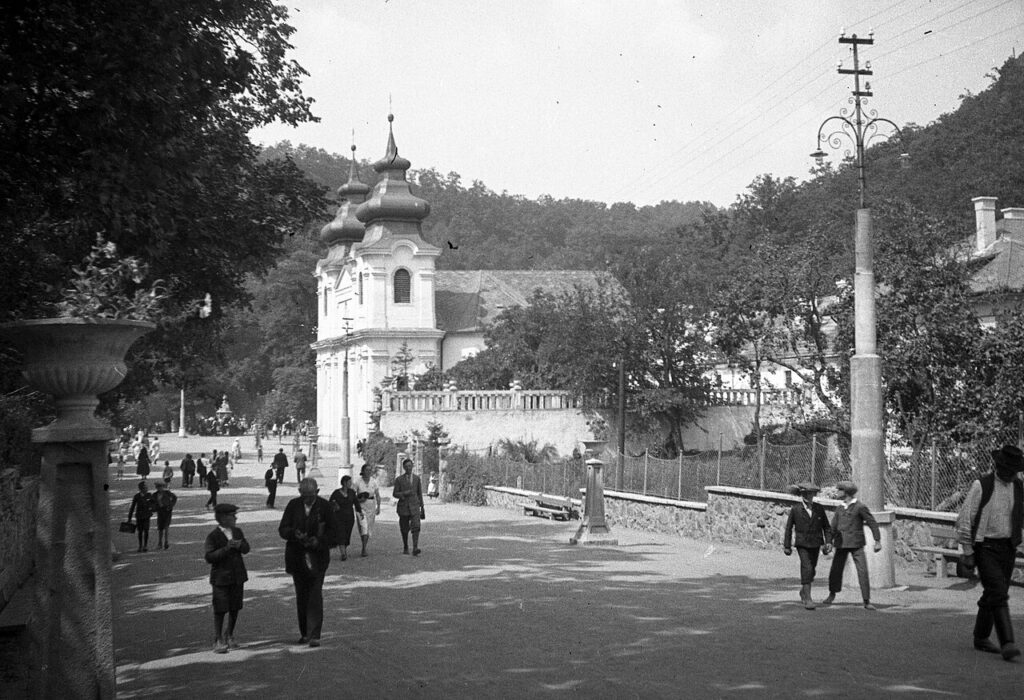
The sanctuary is articulated around the minor basilica and the Franciscan conventual complex, with a wide pilgrimage environment. The current churchbuilt between 1758 and 1763 in Central European Baroque style, it is located on a high terrace on the valley, next to the convent, forming the main architectural core. Various outdoor spaces allow the celebration of great liturgy, especially in summer, with areas prepared to receive thousands of pilgrims. At the bottom of the valley, a few hundred metres from the temple, are the miraculous source and annexed chapels, where the faithful collect water and participate in celebrations and acts of popular piety.
The whole has the official title of "Mátraverbút-Szentwell National Mercy" (National Shrine of Mátraverebély-Szentkút) of the Catholic Church in Hungary, entrusted to the Franciscan frailes. The sanctuary is also integrated into a protected natural environment (Cserhat area, linked to the Bükk National Park), which reinforces its character as "sacred valley" and spiritual retreat.
Sponsorship and coronation
Cardinal Péter Erdő, Archbishop of Esztergom- Budapest and Primate of Hungary, officially declared Mátraverbút - Szentmút how National Sanctuary and the main place of the Marian pilgrimage of the country 2006in the Solemnity of the Assumption. In this way, Our Lady venerated in Szentkút receives a national ownership as a primary Marian reference for the Church in Hungary. The sanctuary also serves as a spiritual centre for the northern region of the country and for communities of various nationalities living in the border area with Slovakia.
As regards a possible canonical coronation of the image of Our Lady of Mátraverebély-Szentkút, in the sources consulted (official site of the sanctuary, pages of religious tourism and reviews of the history of the place) does not contain a documented canonical coronation nor are mentioned date, pontiff or pontifical delegate related to a solemn rite of coronation.
Party and devotion
La fiesta patronal principal of the sanctuary is linked to the Solemnity of the Assumption of the Blessed Virgin Mary (August 15). The sanctuary itself indicates that the "day of the patron saint" is celebrated Nearest Sunday to the Feast of the Assumptionwith the main pilgrimages and liturgical celebrations around that date. Between 15-20 August an important Franciscan youth pilgrimage, with 200-250 young people walking near 150 km (90 millas inuna) to the sanctuary.
Throughout the year, Mátraverebély-Szentkút hosts numerous diocesan, parish, national and minority language pilgrimages, with groups coming both from neighbouring villages and from more distant places in Hungary and even abroad. The tradition of walking pilgrimages was strengthened from the 1990s and today is a characteristic feature of the sanctuary. Many pilgrims participate in processions, confessions, Eucharistic worship and outdoor celebrations, in addition to the central gesture of drinking or collecting water from the source, a sign of a request for spiritual and body health.
It is now estimated that the sanctuary receives around 200,000 pilgrims per year. Among the manifestations of popular piety, the misas en varias lenguas, las blessings with the water of the fountain, las personal promises and votesas well as various local traditions linked to Saint Ladislao and
A flower for the Virgin
Offer a simple prayer to this Marian devotion. Pray a Hail Mary for Hungary and for world peace.
Pray Hail MaryIs the advocation of the Virgin Mary of your people missing?
Si no encuentras la advocación mariana de tu ciudad o pueblo, cuéntanosla: la investigaremos para ubicarla y darla a conocer en este mapa del amor de la Madre por el mundo.
Propose an apvocation →