
Marian devotion
Our Lady of Pigs
Marian vocation in Vienna (Vienna)
Documented history
Main data
Origin and history
Documented history
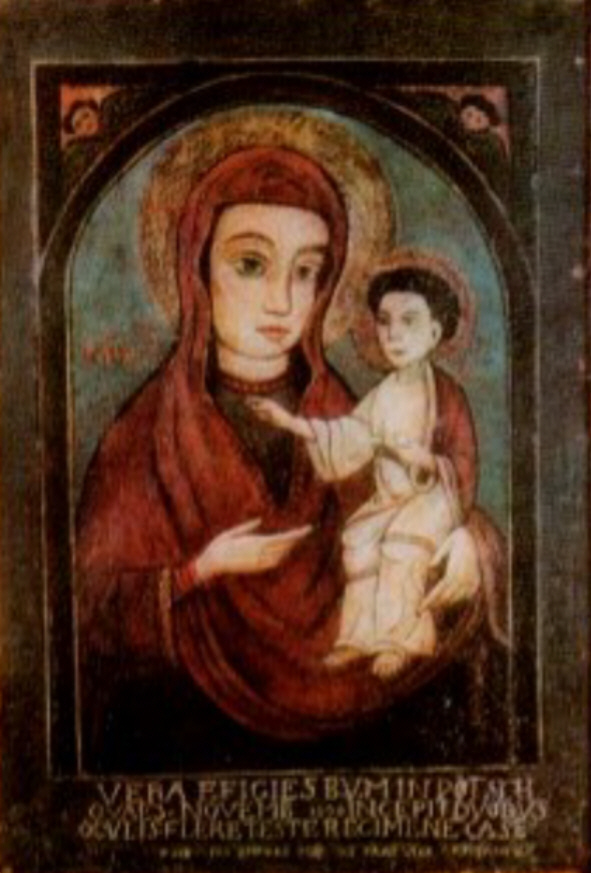
The original icon of Máriapercs was born in a Greek-Catholic (Ukrainian) environment in the small village of Pócs, on the eastern Hungarian plain, whose inhabitants belonged mostly to the Greek-Catholic Church. In 1696 there was the famous prodigy of the icon lacrimationwhen, during the Mass of November 4, tears were observed running through the face of the Virgin, a fact that was investigated and recognized by ecclesiastical and civil authorities.
In the face of the fame of the miracle and the historical context of the Ottoman threat, the emperor Leopold I of Habsburg ordered to move the icon to Vienna. The transfer took place in the late 17th century; some popular sources point to the date of the 1 March 1697 (others quote 1698), but in the divulgative literature the year does not always appear with full unanimity. It is clear that the icon was taken to the imperial capital and ended up receiving a stable place in the Cathedral of San Estebanwhere it became one of the most venerated images of the temple.
In Máriapercs, instead of the original, a copy of the icon, which also came to cry and was later recognized as a legitimate object of veneration. In the mid-18th century, a large Baroque church was built in Máriapercs and a monastery of the Greek-Catholic Basilian parents was erected to attend to the many pilgrims who came to the Hungarian sanctuary.
Tradition and devotional reading
The Hungarian and Austrian tradition presents Our Lady of Pigs how great protector of Austriain particular against the "mahometane danger," in the context of the wars against the Ottoman Empire. In the popular memory, the presence of the icon in Vienna is attributed to the protection of the city and the Empire at critical times, a devotional reading that has been consolidated over more than three centuries of history. This interpretation belongs to the field of piety and believing reading of events, not to that of strict historiography.
The image and the sanctuary
El icono de Our Lady of Pigs venerated in Vienna is a imagen de type Byzantinea simple invoice, which represents the Blessed Virgin with the Child Jesus. It is a painting on board (icon) with stylized features of the Eastern tradition: the Virgin in bust, with the Child in arms, in attitude of tenderness and gravity at the same time. The image is known as "Wept Virgin" by the miracle of tears in Máriapercs.
En la Cathedral of San Esteban (Stephansdom)the icon is in a side chapel: as you enter the temple, you see it on the right side, next to the door that leads to the chapel of the Most Holy Sacrament. It is framed under a Gothic marble baldaquine, which frames and enhances the small icon within the wide space of the cathedral. The Stephansdom, a Vienna symbol, is a monumental Gothic cathedral of over 700 years of history, the main church of the archdiocese of Vienna, although it does not have the title of a minor basilica in the sources consulted.
El Main shrine of this advocation in the strict sense is found in Máriapercs (Hungary)where the original icon was venerated and where today a successor image remains equally famous for new wonders of tears; in that locality a Greek-Catholic baroque sanctuary attended by Basilians, one of the most important places of pilgrimage in the north-east of Hungary. However, the concrete form "Maria Pötsch" / Our Lady of Pócs as patron of the House of Habsburg and Vienna refers mainly to the icon installed in the Cathedral of San Esteban.
Sponsorship and coronation
Devotional and cultural sources present Our Lady of Pigs as great protector of Austria and, in particular, the city of Vienna y de la Casa de Habsburgoin the context of the wars against the Turks and the religious history of the Empire. The advocation also maintains a strong identity link with the Hungarian peopleto venerate it as one of its most loved national icons, both in Máriapercs and Vienna.
As regards official titles (principal patron of a diocese, city or nation), the sources consulted insist on their character as protect and in its importance for Austria and Hungary, but they do not explicitly specify a formal decree of canonical patronage for Vienna or for the Austrian nation. It is therefore clear that the patronazgo devocional on Vienna, the House of Habsburg and the Hungarian people, without a universally recognized legal proclamation in the sources consulted.
On the canonical coronation of the icon venerated in the Stephansdom, the available sources (devotional articles, Catholic press and historical synthesis) do not provide a secure date or pontiff data. No clear reference to an officially recorded canonical coronation has been found in the usual repertory of Marian coronations. Therefore, following the indication given:
does not contain a documented canonical coronation.
Party and devotion
In the Hungarian context, the memory of Our Lady of Mariapócs is associated with the date of 4 November, anniversary of the miracle of the lacrimation of 1696, and in the sanctuary of Máriapercs are celebrated throughout the year numerous pilgrimages, especially in summer and on marked Marian dates. However, for the advocation as it is venerated in Austria and in many devotional calendars of Spanish language, there is the Marian feast linked to the Nativity of the Virgin, September 8as the main memory of Our Lady of Pócs / Mary Pötsch. This data appears in the devotional tradition, although no specific liturgical decree has been located in the sources consulted; therefore it is presented as devotional use, as universal legal date.
In the Hungarian shrine of Máriapercs, every year they come hundreds of thousands of pilgrims, which makes it one of the main pilgrimage centers in northeastern Hungary. There are regional, national and Greek-Catholic pilgrimages, with processions, confessions, celebrations of the Divine Liturgy and the Eucharist, and multiple gestures of popular piety.
En la St. Stephen's Cathedral of Vienna, the icon of Our Lady of Pöcs receives a constant flow of faithful who stop to pray before the image, lighting candles and making personal requests, in the context of the intense transit of visitors and devotees of the cathedral. Devotion is characterized by:
– Confianza en la protective intercession of the Virgin for the city
A flower for the Virgin
Offer a simple prayer to this Marian devotion. Pray a Hail Mary for Austria and for world peace.
Pray Hail MaryIs the advocation of the Virgin Mary of your people missing?
Si no encuentras la advocación mariana de tu ciudad o pueblo, cuéntanosla: la investigaremos para ubicarla y darla a conocer en este mapa del amor de la Madre por el mundo.
Propose an apvocation →