
Marian devotion
Our Lady of El Rocío
The White Paloma of the marshes
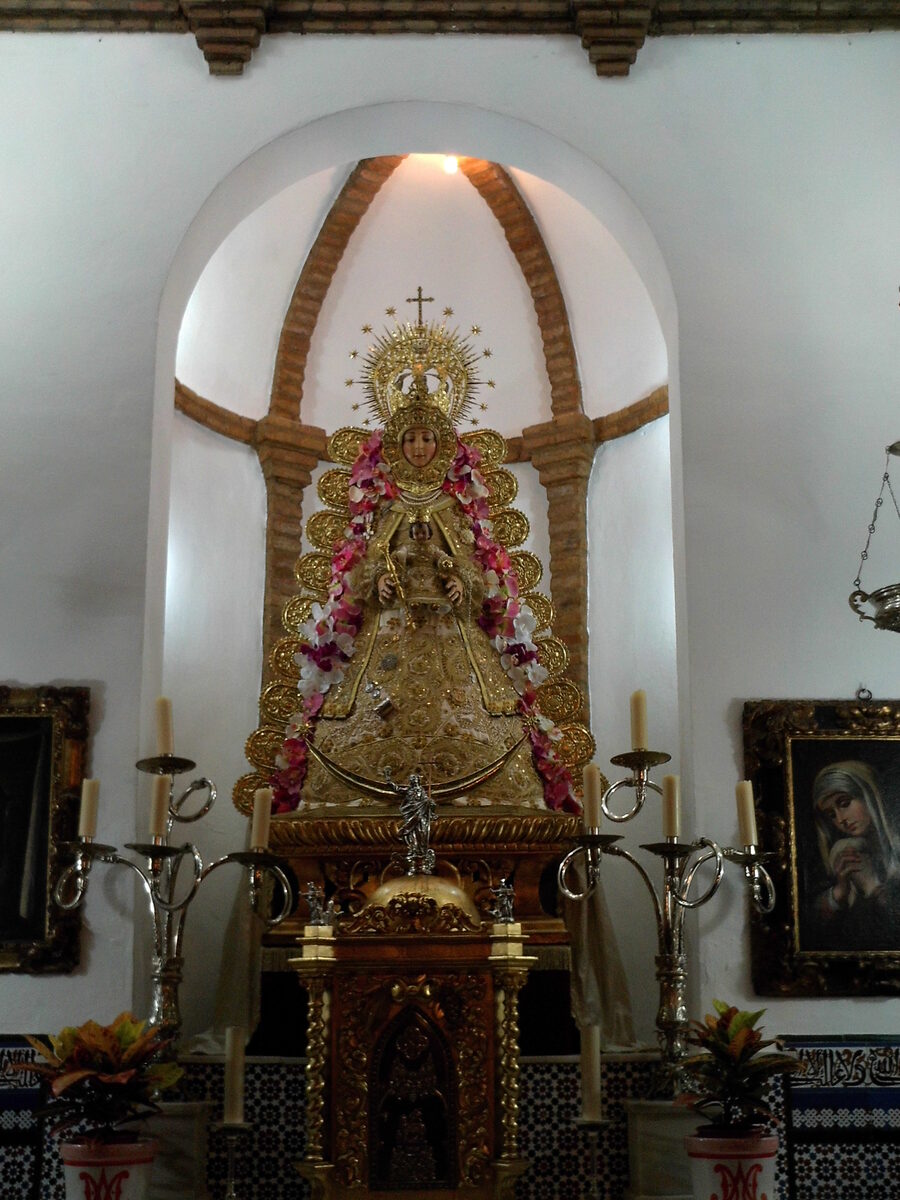
Our Lady of the Rocío, popularly known as the White Paloma o la Queen of the Marsh, is a Marian advocation that is venerated in the sanctuary of the village of El Rocío, in Almonte (Huelva), of which she is patron. Canonically crowned in 1919, it brings together every spring, around Pentecost, hundreds of thousands of devotees in one of the most multitudinary romaneries in Spain.
Main data
Central message: In the midst of the onubense marshal, the Virgin is the near Mother of a people who come to her in Romeria, joining faith to the feast, the path and the brotherhood of the hermandades.
Tradition and history: a necessary distinction
On the Rocío, as in so many ancient sanctuaries, two planes live together that should not be confused.
The tradition popular places the origin of devotion in the finding of an image of the Virgin in those places during the Middle Ages. It is a venerable account of the piety of the people of the marshes, but the details of the finding are not fixed by historical documentation with the way in which devotion retains them.
La documented historyOn the other hand, it testifies to a Marian hermitage already existing in the 14th century in the area known as Las Rocinaswith written mentions, chaplains, transfers, hermandades and, finally, the canonical coronation of 1919. The real and verifiable devotion to the White Paloma depends not on the legendary details of the finding, but on centuries of continued veneration.
History of the sanctuary
From the Rocinos to the Rocío (XIII- XIV centuries)
According to the academic Juan Infante Galan, he must have been the king Alfonso Xwho conquered Almonte in the second half of the 13th century, who raised a hermitage to the Virgin in the place called Las Rocinas. The first written reference to Santa María de las Rocinas is preserved in a 1335 line of the Ducal Archive of Medina Sidonia. The Book of the saddle of Alfonso XI (1342-1350) also mentions "a church that says Sancta Maria de las Rocinas," and in 1349 a neighbor of Nifturm left in her will two maravedis for a work in the hermitage. In 1388 there was already a co-fradia of Monteros around it.
The chaplains and the name of the Rocío (XVI-XVII centuries)
In 1574 the convent of the minimum friars was founded in Almonte, in charge of the veneration in the hermitage for years. The chaplaincy of "La Rosina" was established in 1598. The first time the image is referred to in writing with the word ‘Rocio’ is in a document of the City of Almonte of 25 April 1653:
A few months later, the 29 June 1653the council and clergy of Almonte signed the vow of patronage of the Virgin of the Rocío. The feast, held first in September, passed in 1670 to the Easter of the Holy Spirit, the root of the current celebration in Pentecost.
The hermitage and the hermandades (18th century)
In 1724 the hermandades of the Rocío de Almonte, Villamanrique de la Countess, Pilas, La Palma del Condado, Moguer and Sanlúcar de Barrameda signed a «concordia» who integrated them into a single fellowship, under the patronage of Almonte, establishing the order of preeminence for antiquity. That same year the hermitage was already called Royal Sanctuary. The Lisbon earthquake of 1755 left it in ruins; the new hermitage ended in 1760. In 1789 the first families were settled in the village of El Rocío.
Romry and coronation (XIX-XX centuries)
In the first third of the 19th century it began to be called "Romeria" the act of going to El Rocío at his party, and by 1840 he stopped talking about the Passover of the Holy Spirit to talk about Pentecost. Devotion grew rapidly: in 1850 there were between 10,000 and 20,000 people, and in 1858 some 40,000. On August 11, 1918 the Pope Benedict XV He gave the bull for the coronation, and the Virgin was canonically crowned on June 8, 1919 in the Real de El Rocío. In 1920 the Matrix Brotherhood of Almonte was named Pontifical by the Holy See and Royal by Alfonso XIII.
The Rocío today
The new white regionalist style hermitage, which today chairs the village, was built between 1964 and 1969. The Romeria was declared National Tourist Interest Party in 1965 and International in 1980. On 14 June 1993 San Juan Pablo II He visited the sanctuary, and in 2019 Pope Francis granted a Jubilee Year in honor of the Virgin of the Rocío. Every seven years, according to tradition, the image is transferred to the parish of Almonte, dressed as Pastora, where it remains about nine months.
The famous tradition of «salto de la reja» - the moment, in the early morning of the Monday of Pentecost, when the Almonds jump the gate of the presbytery to bring out the Virgin in procession - it is part of the popular fervor of the Romeria; the previous story is in line with the documented historical data collected by the consulted source.
Spiritual message of the Rocío
The devotion to the White Paloma continues to speak with simplicity today:
🕊️ Mary is Mother of the way. The rosemary does not seek a tourist destination, but a Mother who awaits him in the marshal.
📿 The faith of the people holds the sanctuary. Seven centuries of continued veneration say more than any legend.
🤝 The Rocío joins the hermandades. The "concord" teaches to walk together, in order and fraternity, towards the same Mother.
✝️ Mary always leads to the Son. In the midst of the feast, the Queen of the Marsh leads the people to meet God.
Prayer to Our Lady of the Roch
Mother of God and our Mother, Virgin Mary,
to whom we venerate with devotion in the affectionate vocation of the Rocío:
White Dove of the marshes, Queen of the roads,
welcome our pleas and take us to your Son Jesus.
Look at the sorrows and hopes of those who come to You,
and teach us to walk together, with simple faith and a clean heart,
until you get to the Father's house.
Amen.
Prayer in our section of Marian prayers.
A flower for the Virgin
It offers a simple prayer to the Virgin of the Rocío. Pray a Hail Mary for Andalusia and for all the rosemary.
Pray Hail MaryIs the advocation of the Virgin Mary of your people missing?
Si no encuentras la advocación mariana de tu ciudad o pueblo, cuéntanosla: la investigaremos para ubicarla y darla a conocer en este mapa del amor de la Madre por el mundo.
Propose an apvocation →