Marian devotion
Our Lady of the Rosary of St. Nicholas, patron of St. Nicholas of the Arroyos and his diocese
Patrona de San Nicolás de los Arroyos
En San Nicolás de los Arroyos, province of Buenos Aires (Argentina), there was a strong devotion to the Virgin Mary under the title of Our Lady of the Rosarywho was the first Patron of the "Curate of the Arroyos." In 1884 the parish temple of San Nicolás de Barito whom was moved an image of the Virgin of the Rosary brought from Rome and blessed by the Pope Lion XIII, especially for the felligression of St. Nicholas. Around this image worked the The Rosary's Brotherhoodwith a party and a novena annual in the 19th century.
Main data
Origin and history
En San Nicolás de los Arroyos, province of Buenos Aires (Argentina), there was a strong devotion to the Virgin Mary under the title of Our Lady of the Rosarywho was the first Patron of the "Curate of the Arroyos." In 1884 the parish temple of San Nicolás de Barito whom was moved an image of the Virgin of the Rosary brought from Rome and blessed by the Pope Lion XIII, especially for the felligression of St. Nicholas. Around this image worked the The Rosary's Brotherhoodwith a party and a novena annual in the 19th century.
La documented history of the apparitions the 25 September 1983, when Gladys Quiroga de Motta, married lay and mother of family, claims to see the Virgin in her room while praying the Rosary, in the city of San Nicolás de los Arroyos, on the banks of the Paraná River. Gladys claims that the Virgin manifests herself as the Our Lady of the Rosary, consistent with the old image that was relegated in the bell tower because of its deterioration. Through numerous messages, with an exhortive tone and accompanied by biblical quotes, the Virgin would ask for prayer, conversion, consecration and the construction of a temple in the place of apparitions.
On the strictly ecclesial level, the apparitions of the Virgin of the Rosary of Saint Nicholas have been recognized as having a supernatural character by the diocesan bishop, Mons. Hector Cardelli, en decreto del 22 May 2016, made public a few days later. The same process recognizes that the phenomenon has led to one of Argentina's most important Marian pilgrimage movements. The devotion was thus consolidated as the proper vocation of the diocese and the city, under the title of Our Lady of the Rosary of San Nicolás.
As regards tradition and pious experiencesmany faithful link the apparitions to a special protection of the Virgin over the city and over the families, attributing favors, conversions and graces received in response to the prayer of the Rosary and to the pilgrimage to the sanctuary. These testimonies are part of the devotional tradition and the collective memory of pilgrims, but they are not documented history in the critical-academic sense, but expression of popular faith.
The image and the sanctuary
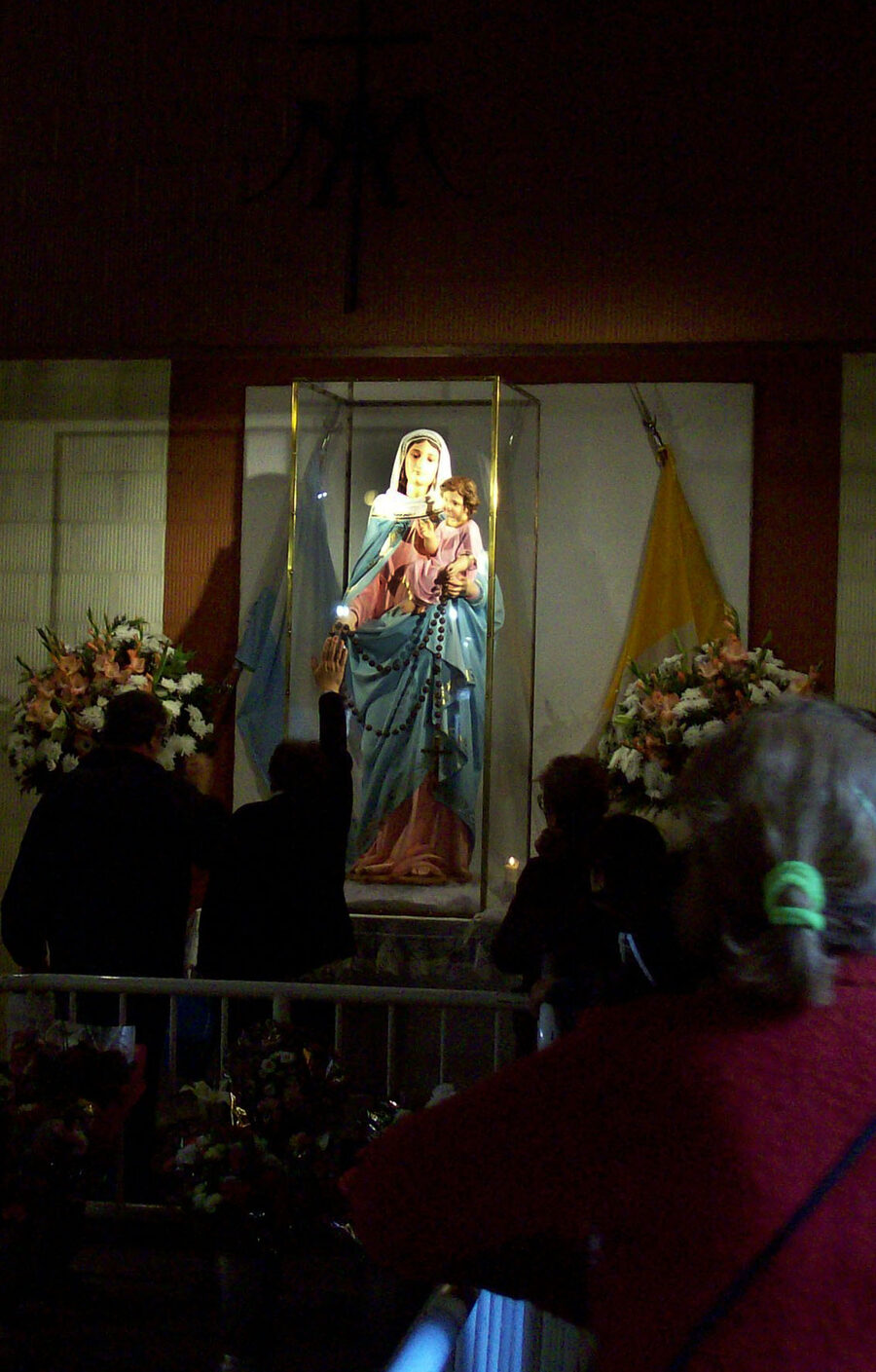
La image of Our Lady of the Rosary of St. Nicholas is a Marian sculpture that shows the Virgin sitting down, holding the Child Jesus, both with rosary and crown, following the classical iconography of the Virgin of the Rosary (type "Virgin with Child and Rosary"). The original size, from Rome and blessed by Leo XIII, is of the traditional European style of the 19th century; the sources spread do not require with certainty the material (is not safely recorded if it is polychrome wood, plaster or other material). In the iconography spread, the Virgin appears with blue mantle and clear robe, and the Child with an attitude to bless, underlining the role of Mary as Mother and mediator who presents Christ.
In response to the messages attributed to the Virgin, the construction of the Sanctuary of Mary of the Rosary of St. Nicholason the banks of the Paranah River, in the same city. The temple, of large dimensions, was projected with capacity to 8,000-9,000 persons standing on the main ship and interfloors, and wide terraces and outdoor explanades for mass acts. Its plant reaches approximately 80 m long by 50 m on the cruise, with a dome of 24–27 m de diámetro, consisting of 64 strands of reinforced concrete, covered in copper plates. The dome silhouette is distinguished from several parts of the city.
The sanctuary, commonly known as Sanctuary of the Virgin of the Rosary of St. Nicholas, left with its interior completely opened the 25 May 2014, although the general work continues to be developed according to the original projects. The sources consulted present it as diocesan sanctuary and a national Marian pilgrimage centre; it is not recorded in the revised sources with the title of minor basilica not specifically declared National sanctuary by the Argentine Episcopal Conference (not recorded).
Sponsorship and coronation
From the origins of the quirate, the Virgin of the Rosary was considered First Patron of the Curate of the Arroyos, antecedent of the present city and diocese of San Nicolás de los Arroyos. In contemporary pastoral practice, Our Lady of the Rosary of St. Nicholas is venerated as patron of the city of San Nicolás de los Arroyos and of the diocese of San Nicolás, reality that is reflected in the intense liturgical and pilgrim life of the place. At the national level, it is considered one of Argentina's most significant Marian advocates for the magnitude of devotion and pilgrimages.
As for the canonical coronation, la Virgin of the Rosary of St. Nicholas was crowned on May 25, 2009. The sources consulted indicate the date with precision, but do not clearly specify in the texts cited the name of the pontiff who authorized the rite or of the pontifical delegate who presided over it, beyond the general context (in 2009 the Pope was Benedict XVI), so that, in accordance with the criteria requested, only the document is indicated: canonical coronation in 2009; the name of the pontifical delegate is not recorded in these sources. It is added that the coronation is part of the recognition of the pastoral and devotional importance of this advocation for the Church in Argentina.
Party and devotion
La main party of Our Lady of the Rosary of St. Nicholas is celebrated the 25 September, in memory of the day of the first apparition to Gladys Quiroga de Motta in 1983. That day, the city receives hundreds of thousands of pilgrims and faithful, setting up one of the most important Catholic pilgrimage phenomena in the country. In addition, all days 25 of each month processions and devotional acts are carried out in the sanctuary, the most attended being that of 25 September of each year.
The devotion is articulated around the Eucharist, la procession with the imageCommunity tax Holy Rosary and various acts of consecration and offering to the Virgin. An intense popular pietywith pilgrimages on foot, in family or in parish groups from various regions of Argentina, and a constant flow of faithful who come to the sanctuary all year round to ask for thanks or thanks. Devotion also includes the reading of the messages attributed to the Virgin, always within the framework of the discernment and pastoral orientation of the diocese.
In daily devotional practice they have been spread novenasespecially the prayer of the Rosary in the form of a novena from the 17th to the 25th of each month, in honor of the Virgin of the Rosary of St. Nicholas. This structure of monthly novena reinforces the markedly rosarian character of the spirituality that is lived in the sanctuary.
Link to the Rosary
The link of this advocation with the Rosary It's essential. Our Lady presents herself explicitly as Maria del Rosario o Our Lady of the Rosary of San Nicolás, and the apparitions begin as the seer prayed the Rosary. From its historical origins in the parish of San Nicolás, Marian devotion was organized by The Rosary's Brotherhood, con fiest
A flower for the Virgin
Offer a simple prayer to this Marian devotion. Pray a Hail Mary for Argentina and for all of America.
Pray Hail MaryIs the advocation of the Virgin Mary of your people missing?
Si no encuentras la advocación mariana de tu ciudad o pueblo, cuéntanosla: la investigaremos para ubicarla y darla a conocer en este mapa del amor de la Madre por el mundo.
Propose an apvocation →