
Marian devotion
Our Lady of Caysasay
Marian Advocation of Taal (Luzon)
According to the traditionin 1603 a fisherman called Juan Maningcad (or Maningkad) found a small image of the Virgin Mary in her networks, on the Passipit River, which led her home as an object of devotion. In time, reports of apparitions and wonders linked to the image, considered among the first phenomena of this type in the Philippines of colonial times, and which led to a rapid expansion of devotion in the Taal area.
Main data
Origin and history
According to the traditionin 1603 a fisherman called Juan Maningcad (or Maningkad) found a small image of the Virgin Mary in her networks, on the Passipit River, which led her home as an object of devotion. In time, reports of apparitions and wonders linked to the image, considered among the first phenomena of this type in the Philippines of colonial times, and which led to a rapid expansion of devotion in the Taal area.
As for the documented historysources indicate that the image dates back to the early 17th century and that the Sanctuary of Our Lady of Caysasay It was built in 1639, near the place where the image was repeatedly found or where the wonders were associated. The devotion was consolidated under the authority of the Catholic Church in the Latin rite, and over time the Virgin of Caysasay became known as "Queen of the Archdiocese of Lipa". The sanctuary and the image have survived eruptions of the Taal volcano and other disasters, being restored and cared for over the centuries.
The image and the sanctuary
The image of Our Lady of Caysasay is a small size of wood de la Immaculate Conception, approximately 27.2 cm high. It is a Marian image dressed, in Spanish-Filipino style, representing the Virgin without the Child, standing, according to the iconography of the Immaculate, and is considered to retain its original aspect of the 17th century. Philippine historiography recognizes it as one of the older Marian images of the country.
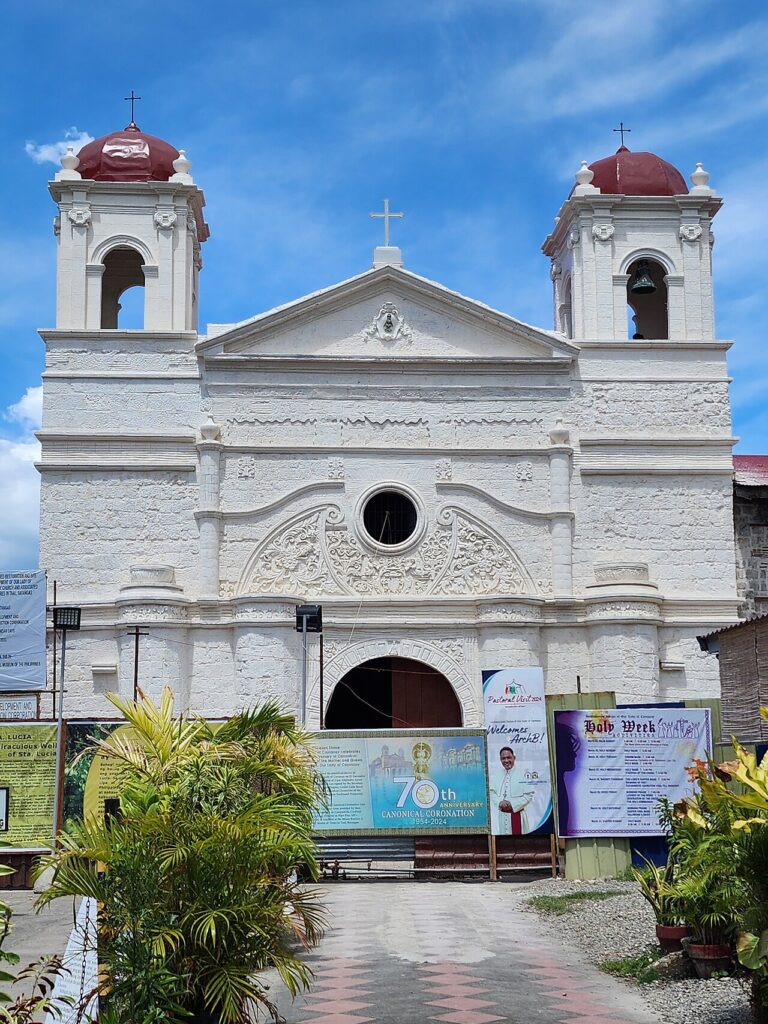
The main place of worship is the Archdiocesan Sanctuary of Our Lady of Caysasay (Archdiocesan Shrine of Our Lady of Caysasay), in the Labac district, Taal, Batangas province, belonging to the Archdiocese of Lipa. The temple is a relatively small church, made of coral stonefrom the 17th century, restored on several occasions and recently subjected to an important restoration to restore its historical splendor. The sanctuary is also related to the call well or "wells" of Saint Lucia, devotionally linked to the image. The image spends part of the week in this sanctuary and part in the Minor Basilica of San Martín de Tours of Taal, where she is also venerated.
Sponsorship and coronation
Our Lady of Caysasay is recognized as local patron of Taal and his faithfuland has received the title of "Queen of the Archdiocese of Lipa", as recognized by devotional and ecclesial sources. It is not known that it has a national patronage in the Philippines.
As for the canonical coronation, the sources agree that the image was canonically crowned on 8 December 1954. The ceremony took place at the Basilica of San Martín de Tours in Taal, and was held by Pope Pius XII; it is indicated that the act was presided over on his behalf by the Spanish Cardinal Fernando Quiroga.
Party and devotion
La main party of Our Lady of Caysasay is celebrated every 8 December, coinciding with the Solemnity of the Immaculate Conception, and is also prolonged / delinked to 9 December, according to local tradition. The commemorations include processions, solemn masses and various colorful popular rites, with special community participation Chino-filipinafor which this devotion has a particular meaning.
The devotion to Our Lady of Caysasay is characterized by pilgrimages to the Labac sanctuary y a la Basílica de Languageby the resource entrusted to the intercession of the Virgin in family and health needs, and by the dissemination of numerous testimonies of favors and "miracles" attributed to her intercession. The constant flow of pilgrims and the ancient devotion consolidate Caysasay as one of the historical Marian centers of the Philippines.
Link to the Rosary
The sources consulted do not mention a specific bond the formal history between the advocation of Our Lady of Caysasay and a particular fellowship or practice of Rosary (for example, as an official rosarian sanctuary or the seat of a rosary archcofradry). However, because of its image of the Immaculate Conception and its rooted in Filipino popular spirituality, the prayer of the Rosary is a regular part of the devotional expressions of the faithful, especially in the ninth, processions and Marian vigil around December 8.
In the context of this advocation, the Rosary is understood as a school of contemplation of the mysteries of Christ with Marywhich helps to unite the sufferings and hopes of the people of Taal and the Archdiocese of Lipa to the life of Jesus, from the Incarnation to the Paschal glory. In this way, the small image found in the Passipit River becomes, for the devotees, a sign that invites us to travel with Mary, through the Rosary, the whole path of salvation.
A flower for the Virgin
Offer a simple prayer to this Marian devotion. Pray a Hail Mary for the Philippines and for world peace.
Pray Hail MaryIs the advocation of the Virgin Mary of your people missing?
Si no encuentras la advocación mariana de tu ciudad o pueblo, cuéntanosla: la investigaremos para ubicarla y darla a conocer en este mapa del amor de la Madre por el mundo.
Propose an apvocation →