Our Lady of Lourdes
The Immaculate One who smiled at Bernadette
Our Lady of Lourdes is a Marian devotion linked to the eighteen apparitions that Bernadette Soubirous claimed to have witnessed in 1858 at the grotto of Massabielle, on the outskirts of the town of Lourdes, in France, at the foot of the Pyrenees. Associated with the dogma of the Immaculate Conception —for it was under that name that the Lady presented herself—, the Church invokes Our Lady of Lourdes as patroness of the sick, and her shrine is today one of the most visited in the world.
Key facts
Central message: Mary invites us to prayer, to penance for sinners and to trust; she shows herself as a Mother close to all human suffering.
The apparitions
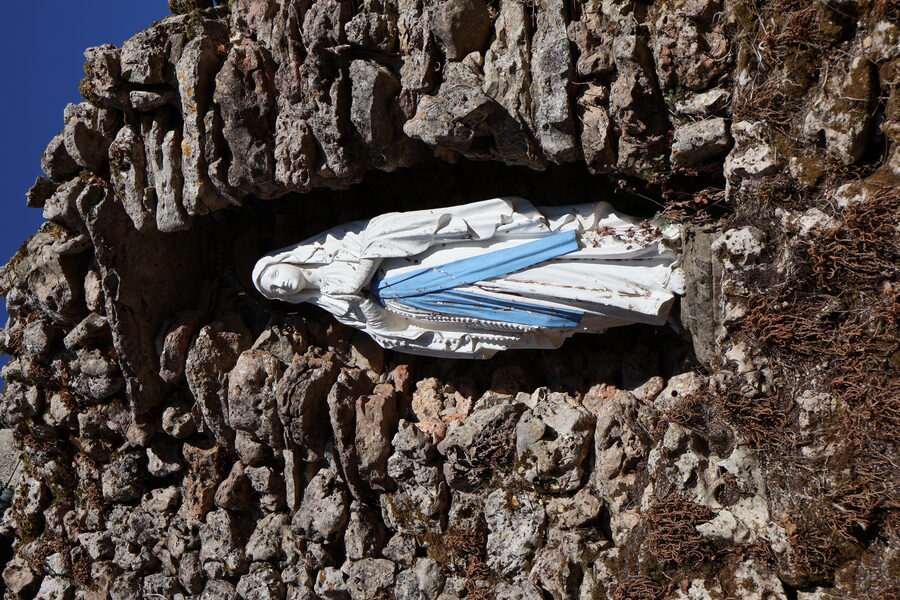
Bernadette Soubirous, a poor and illiterate fourteen-year-old girl, claimed to have seen the Virgin Mary on eighteen occasions at the grotto of Massabielle, to the west of Lourdes, between 11 February and 16 July 1858. According to her testimony, there appeared to her a young lady, dressed in white with a blue sash at her waist, her hands joined in an attitude of prayer, a rosary hanging from her arm, a golden rose on each foot and a white veil covering her hair.
At the third apparition, the girl claimed to have spoken with the Lady in Gascon, the dialect of the region. According to her account, the Lady addressed her with a courteous form of address and asked her to return to the grotto for fifteen days; Bernadette promised her that she would, and the Lady announced to her that she did not promise her happiness in this world, but in the next.
The message of prayer and penance
In the apparitions that followed, the message took shape: the invitation to penance and to prayer for sinners (21 February), the call to live a more evangelical poverty, and the request that processions be made to the grotto and that a chapel be raised there (2 March).
The spring and the sick
On 25 February, as Bernadette testified, the Lady asked her to drink from the water of the spring and pointed with her finger for her to dig in the ground. As she dug in the mud, her gestures provoked the scepticism of many of those present, for the spring did not gush forth at once; nevertheless, shortly afterwards a spring of water arose which, to this day, is a destination for pilgrimages. On the basis of the events witnessed by Bernadette, the Church regarded the Virgin Mary, in her devotion of Lourdes, as patroness of the sick, many of whom come there seeking consolation and healing.
The Church has always been very prudent with regard to healings. A medical office examines the files according to strict criteria, and only a small number of cases have been officially recognized as miracles over the course of a century and a half. Apparitions and inexplicable events do not constitute articles of faith.
«I am the Immaculate Conception»
In response to Bernadette’s repeated request that she reveal her name, on 25 March 1858, at the sixteenth apparition, the Lady answered her in Gascon:
The dogma of the Immaculate Conception had been solemnly proclaimed on 8 December 1854, three years earlier. The expression was foreign to Bernadette’s vocabulary and, at first, it was a cause of bewilderment even for the parish priest of Lourdes. Yet the girl maintained a serene attitude throughout all the interrogations, without changing her account.
The recognition of the Church (1862)
The last interrogation before the ecclesiastical commission, presided over by the bishop of Tarbes, Monsignor Laurence, took place on 1 December 1860. On 18 January 1862, Laurence published the pastoral letter in which he declared that «the Immaculate Mother of God has truly appeared to Bernadette.» That same year, Pope Pius IX authorized the local bishop to permit the veneration of the Virgin Mary at Lourdes. Bernadette Soubirous was beatified by Pius XI in 1925 and canonized on 8 December 1933, on the solemnity of the Immaculate Conception.
Lourdes today and the World Day of the Sick
The liturgical calendar celebrates the feast of Our Lady of Lourdes on the day of the first apparition, 11 February. In 1992, Saint John Paul II instituted the World Day of the Sick, which is celebrated every year on that same date, on the liturgical memorial of Our Lady of Lourdes. Various pontiffs have supported the devotion and the pilgrimage to the shrine, which today is one of the foremost places of Catholic pilgrimage in the world, with millions of visitors each year.
The spiritual message of Lourdes
The event of Lourdes still speaks to us today with simplicity:
📿 Mary invites us to prayer and penance. She asks us to pray for sinners and to live with simplicity of heart.
🤍 Mary presents herself as the Immaculate Conception. Her purity reminds us of the holiness to which God calls his children.
💧 The water and the spring are a sign of the grace that heals and purifies, and a reason for trust for the sick.
🤲 Mary chooses the littlest one. She spoke to a poor and illiterate girl, showing that God looks upon the humility of the heart.
🏥 Mary accompanies those who suffer. As patroness of the sick, she is close to those who suffer and to those who care for them.
Prayer to Our Lady of Lourdes
Most holy Virgin of Lourdes,
who forsakest none and castest none away:
look upon me with eyes of mercy
and obtain for me from thy Son the forgiveness of my sins,
that with devout affection I may celebrate
thy holy and immaculate Conception
in thy miraculous image of Lourdes,
and afterwards receive the reward of blessedness
from him whose Mother thou art.
Amen.
Pray also the Litany of Our Lady of Lourdes and prepare for her feast with the novena to Our Lady of Lourdes.
🌹 A flower for the Virgin
Pray a Hail Mary for the sick and for those who care for them, entrusting them to the maternal tenderness of Our Lady of Lourdes.
Pray a Hail Mary