
Marian devotion
Our Lady of Joy of All the Afflicted
Marian devotion of Moscow (Russia)
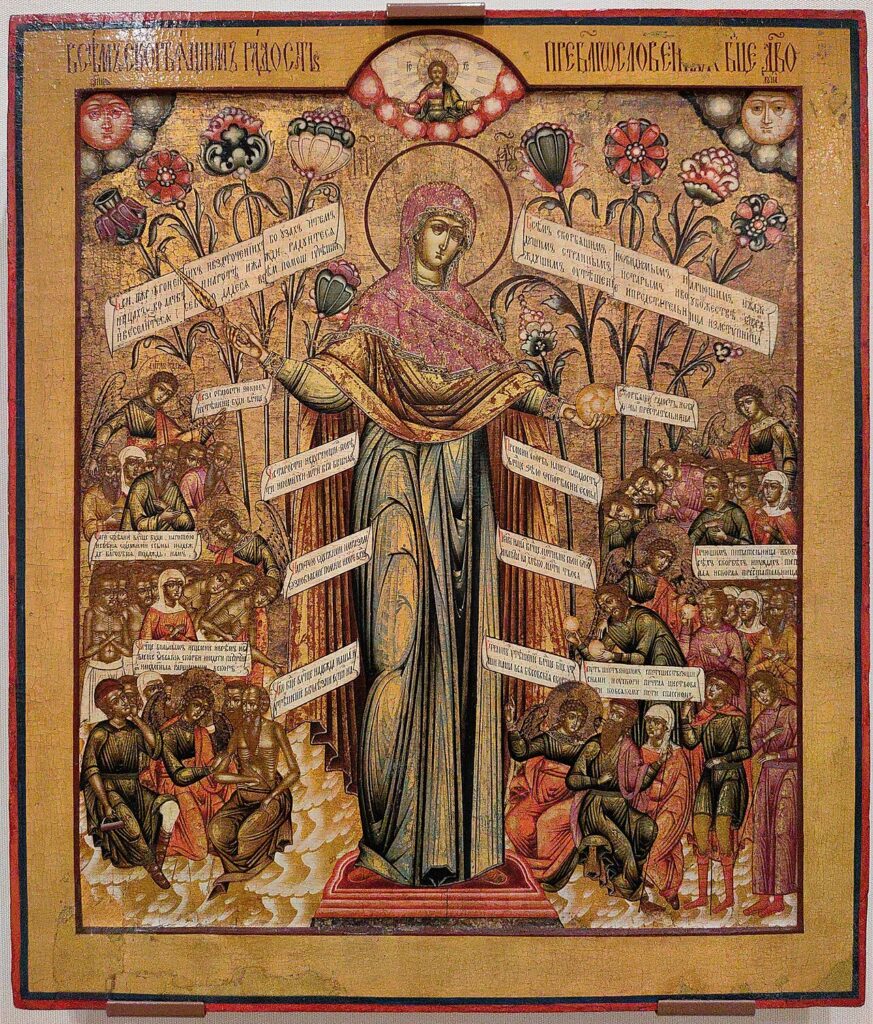
The invocation "Our Lady Joy of All the Aflids" (in Russian, Vsej Skorbiahchij Radost, "Joy of all who suffer") corresponds to a very venerated icon of the Mother of God in Russian Orthodox tradition. Several sources point to their presence in Moscow at least since the 17th century, linked to a church dedicated to this icon in the city. The iconography particularly expresses Mary's intercession for the sick, poor and needy.
Main data
Origin and history
The invocation "Our Lady Joy of All the Aflids" (in Russian, Vsej Skorbiahchij Radost, "Joy of all who suffer") corresponds to a very venerated icon of the Mother of God in Russian Orthodox tradition. Several sources point to their presence in Moscow at least since the 17th century, linked to a church dedicated to this icon in the city. The iconography particularly expresses Mary's intercession for the sick, poor and needy.
According to the tradition, the icon became famous after the Miraculous healing of Euphemy, sister of the Patriarch Joaquin of Moscow, about 1688. A very widespread version indicates that, afflicted by an incurable disease, Euphemia received the indication, in a vision or revelation, of seeking the icon of the Mother of God "Joy of all who suffer"; after praying before him, she would have received the healing, a fact that spread devotion and motivated the institution of a liturgical feast in her honor. This narrative is presented in the sources as a pious account and foundation of devotion, but it moves more in the field of Hagiographical tradition that of critical documentation.
As for the documented historythe icon was already in 1643 on the church of the Transfiguration on Moscow's Ordynka Street, where he was venerated by the faithful. It is also attested that, following the spread of the cult in Moscow at the end of the 17th century, a liturgical feast was established in memory of the Mother of God under this title, held in the Russian Orthodox calendar. The devotion then extended to other regions of the Slavic world, especially in the Russian and Ukrainian spheres.
The image and the sanctuary
El icono de Our Lady of Joy of All the Afflicted es una painting on wooden board, following the traditional technique of the Russian icon (temple on table). It represents the Mother of God standing, in an attitude of intercession, usually under the figure of Platytera (Mother of God "wider than the heavens"), and around them are arranged various poor, sick and afflicted who come to it, as well as angels who carry instruments of divine mercy; some iconographic variants include inscriptions alluding to the title "Joy of all who suffer." This composition highlights the role of the Virgin as the comfort of those who suffer all kinds of suffering.
Historically, one of the main places of veneration was the church of the Transfiguration on Moscow's Ordynka Street, where the icon was guarded at least since 1643. This church was destroyed in the 20th century (1961). There are also other temples in Moscow dedicated to this title, such as the Church of the Icon of the Mother of God "Joy of All the Aflids", which appears in graphic testimonies as a traditional Russian-style church with domes and bell tower. It is not clear from the sources consulted that these temples have been elevated to the dignity of the minor basilica or have a specific recognition as a national sanctuary within the Catholic Church; they are churches of veneration of the Russian Orthodox Iglesia.
Sponsorship and coronation
The advocation of Our Lady Joy of All the Aflids is considered, in the Orthodox field, special protection of those suffering from disease, poverty or any afflictionwithout a canonically defined patronage on a particular diocese or nation. It is, rather, an advocation. universal comfort for the afflicted faithful, spread in Moscow and in other regions of the Orthodox world, in particular among communities in Russia and Ukraine.
As regards canonical coronation in the Catholic sense (by the Pontifical Decree or by the Congregation for Divine Veneration, with a clearly documented date and delegated authority), does not contain a documented canonical coronation for this icon in Moscow. The Orthodox tradition does not use the legal figure of canonical coronation in the Catholic style, although there are painted crowns or added as an expression of veneration.
Party and devotion
On the calendar of the Russian Orthodox Church, the main party of the icon of the Mother of God "Joy of all who suffer" is celebrated the 24 October (6 November according to the Julian calendar). The establishment of this feast is linked, in tradition, to the memory of the miracle related to the sister of Patriarch Joaquin at the end of the 17th century. In some places, another commemoration is also held on July 23, associated with another miracle of the icon, but this varies according to local traditions (it is not always clearly documented in Spanish).
The devotion is characterized by the influx of faithful who come to ask for health, comfort and material and spiritual help. The sources highlight that the icon has been considered "grace support for Orthodox Christians," especially for those who suffer in western Ukraine and the Carpathian region, where copies of the icon have accompanied communities in times of persecution and poverty. Common processions and sentences of intercession (moleben) before the icon, as well as the custom of taking lists of names of the sick and needy to be placed in the liturgy.
Link to the Rosary
The sources consulted do not find a specific and documented link between this Orthodox advocation and the prayer of the Rosary in a Catholic sense. The devotion to the icon of Our Lady Joy of All the Aflids is mainly inserted into tradition litúrgica and iconográfica orientalwith hymns, akathists and own prayers, rather than with the Latin Rosary.
However, from a Marian Catholic perspective, the Rosary It can usefully accompany devotion to this advocation: painful mysteries allow us to contemplate Christ who assumes human suffering, and glorious mysteries present Mary as source of comfort and joy for those who suffer, similar to what this icon expresses. Thus, even without an explicit common tradition, the prayer of the Rosary before the image of Our Lady of Joy of All the Afflicted It helps to unite the contemplation of the mysteries of Christ's life with confidence in the intercession of the Mother who welcomes all the sick, poor and troubled.
A flower for the Virgin
Offer a simple prayer to this Marian devotion. Pray a Hail Mary for Russia and for world peace.
Pray Hail MaryIs the advocation of the Virgin Mary of your people missing?
Si no encuentras la advocación mariana de tu ciudad o pueblo, cuéntanosla: la investigaremos para ubicarla y darla a conocer en este mapa del amor de la Madre por el mundo.
Propose an apvocation →