
Marian devotion
First, to read this page well
What is said here belongs to what the Church calls private disclosure. The Catholic Church has recognized Fatima as credible (pastoral letter from the Bishop of Leiria, October 13, 1930), and this recognition has a precise scope, which we will explain on the page dedicated to ecclesial approval: does not force to believe. As Cardinal Joseph Ratzinger wrote in 2000, commenting on Fatima's message, an approved private revelation "is a help that is offered, but it is not mandatory to use the same».
Second, here are three texts, not one. What is read below comes from the Memories of Sr. Lucia, written 20 and 25 years later of the facts, always by the mandate of its superiors. We will say in each case which Memory comes and which page it is on.
And third, because in Fatima it is always confused: in these texts the one who worships is the Angel, and worships God. "Meu Deus, eu creio, adoro, Espero e amo-Vos." "Santísima Trindade... adore-you deeply." The Most Holy Virgin, on the other hand, is venerated, disgraced and asked for intercession. The distinction is in the sources themselves; it must not be forced or concealed.
1915: "A figure as if it were a statue of snow"
Before the apparitions of the Angel there was something more vague, which Sister Lucia has great caution. She herself warns that she can't date that:
— Memories of Sister Lucia I, IV Memory, p. 168 (own translation on the Portuguese text of the official edition of the Sanctuary).
That year, at the top of the Monte do Cabeço, Lucia was with three companions - Teresa Matias, her sister Maria Rosa and Maria Justino. The story published by the Shrine of Fatima itself as an official narrative says:
"What is that?" asked my companions, half-scared.
- I don't know!
We continue our prayer, always with eyes fixed on that figure which, as soon as we are finished, disappeared. "
— Memories of Sister Lucia I, 14th ed., Fatima, Secretariat of the Little Shepherds, 2010, p. 75; text reproduced by the Shrine of Fatima in the «Narrativa das apparições» (own translation).
What is to be said here clearly: Sister Lucia does not claim that that was the Angel. It says "what juzgo to be the Angel, "and says that" he did not dare to manifest himself at all. "Whoever turns this into a fourth angelic apparition is adding security that the text does not have.
A notice about the dates, said by the seer itself
This is one of the most honest things in the entire corpus of Fatima, and it is almost never quoted:
— IV Memoria, p. 168 (own translation).
That's why the three apparitions of the Angel date from stations - spring, summer, autumn 1916 - and not for days. Whoever gives an exact day is making up.
And there is a fact of documentary criticism that should be kept in mind from the beginning: Sr Lucia did not count these apparitions in 1935. The First Memory (December 1935) does not bring them. They first appear in the Second report (November 1937) and in detail in the Fourth (December 1941). The editor of the official edition himself highlights it: "In this report the themes are surprising: the apparitions of the Angel..." (Memories, p. 65).
First apparition: the Angel of Peace
Place: Loca do Cabeço, en la Pregueira dos Valinhos (Aljustrel, Fatima).
Date: spring 1916.
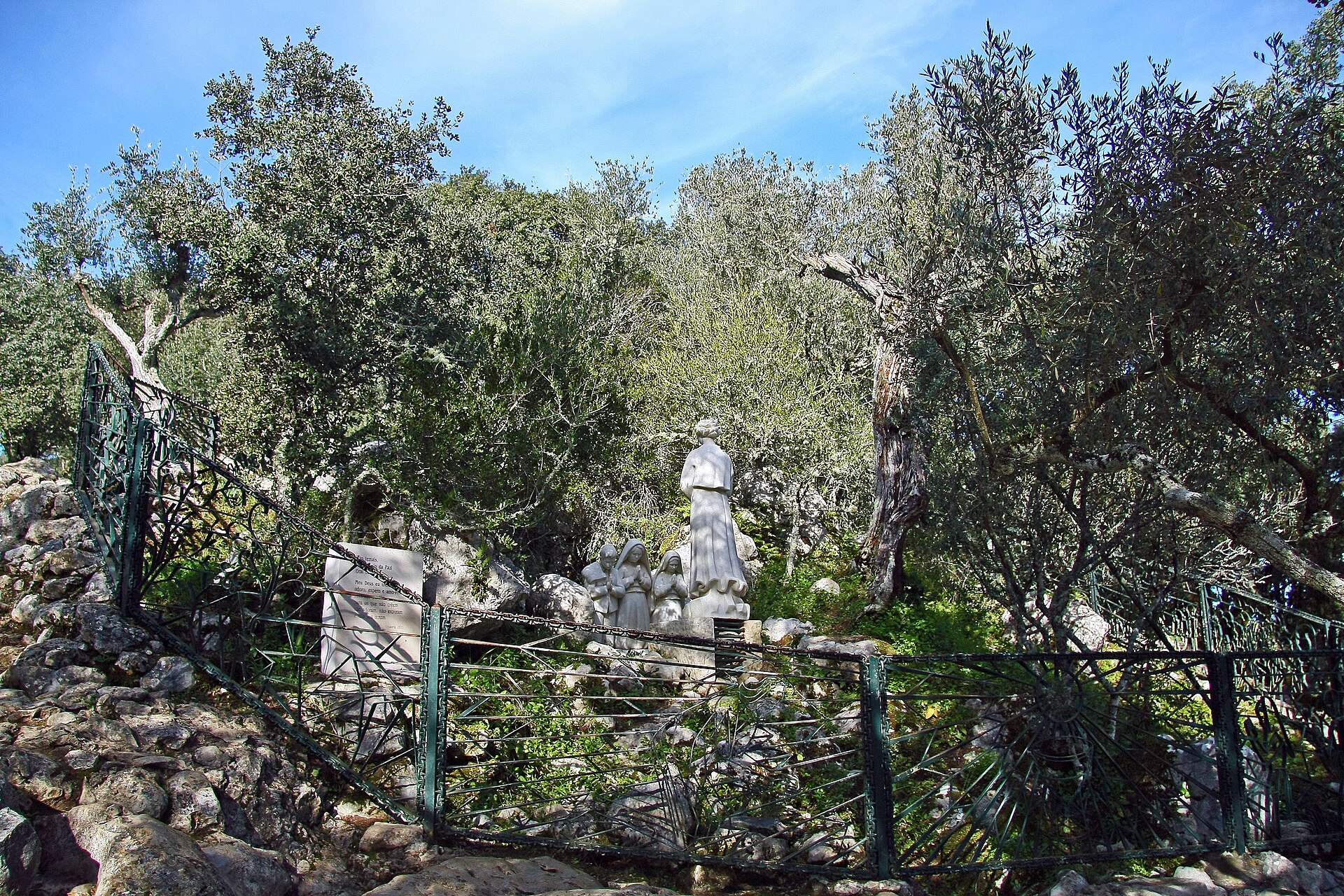
Vitor Oliveira from Torres Vedras, PORTUGAL — CC BY-SA 2.0, via Wikimedia Commons
And kneeling on the ground, he bowed his forehead to the ground. Went by a supernatural movement, we imitate it and repeat the words we hear him pronouncing:
— Oh, my God, I think, I love, I hope and I love you. I ask forgiveness for those who do not believe, do not worship, do not wait and do not love you.
After repeating this three times, he got up and said:
— Pray like this. The Hearts of Jesus and Mary are attentive to the voice of your pleas.»
— IV Memoria, p. 169; cf. II Memory, pp. 77-78 (own translation on the official edition).
This prayer is later known as the angel's prayer or "Oh, my God, I believe." Note its structure: to believe, worship, wait and love - the three theological virtues plus worship, and reparation for those who do not. It's a directed prayer. to God.
Second apparition: the Angel of Portugal
Place: the garden of the house of Lucia, next to Well of the Arneiro.
Date: summer of 1916.
— How's hemorrhaging? —Quegunte.
— Of all that you can, offer a sacrifice in an act of reparation for the sins with which He is offended and of supplication for the conversion of sinners. So bring peace upon your homeland. I am the Angel of your guard, the Angel of Portugal. Above all, accept and bear with submission the suffering that the Lord will send you.»
— IV Memoria, p. 170 (own translation).
Two things should be stressed:
1. "The Angel of his guardian, the Angel of Portugal." The idea of a guardian angel of nations is ancient in Christian tradition (cf. Dn 10, 13.20-21; 12, 1). Here it appears applied to Portugal. It is, again, private revelation: it is not defined doctrine.
2. The sacrifice requested is not extraordinary"of all you can." What is asked is to offer what is already - thirst, tiredness, food - in repair and in supplication. The page of the pastoralists will show how far three children aged nine, eight and six took.
Third apparition: the Angel of the Eucharist
Place: Mad do Cabeço.
Date: Fall 1916.
— Most Holy Trinity, Father, Son and Holy Spirit, I deeply worship you and offer you the most precious Body, Blood, Soul and Divinity of Jesus Christ, present in all the Sagrices of the earth, in reparation of the outrages, sacrifices and indifferences with which He himself is offended. And for the infinite merits of her Most Holy Heart and the Immaculate Heart of Mary, I ask you to convert the poor sinners.
And when he arose, he took the chalice and the host again in his hand, and gave me the host, and that which contained the chalice gave him to drink to Jacinta and Francis, saying at the same time,
— Take and drink the Body and Blood of Jesus Christ horribly outraged by ungrateful men. Repair your crimes and comfort your God.
Again he fell down on the ground and repeated with us three times the same prayer. "
— IV Memoria, pp. 170-171 (own translation on the official edition; the text is the one that reproduces the Santuário de Fátima in its narrative).
Why is this text theologically the denser of the three
- It's a prayer. Trinitarianaddressed to the Father, the Son and the Holy Spirit. Adoration goes to God, without ambiguity.
- Offers to God the Eucharistic Christ himself ("The most precious Body, Blood, Soul and Divinity of Jesus Christ, present in all the Sagrices of the earth"). It is exactly the logic of the Mass offering.
- And when the Virgin is mentioned, she is mentioned. for their merits, together with those of the Heart of Christ, y para order - "I ask you to convert the poor sinners," not to worship her. Intercession, not worship. The text itself respects it.
It should also be noted that Francisco and Jacinta had not yet made the first communion (the discipline of the parish did not give it before the age of ten). The scene, therefore, is also that of two children who receive for the first time, from the hands of an angel, the chalice. Sister Lucia recounts in the First Memory the questions of Jacinta about "Jesus hidden" - so they called the Eucharist - and his insistent desire to receive it (Memories, p. 41).
What the Angel leaves ready
When the Lady appears on May 13, 1917 in the Cova da Iria, the three children have been doing three things for a year that Our Lady will ask again: to pray, repair and offer sacrifices for the conversion of sinners. In the first Marian apparition, the question will be exactly that: "Do you want to offer yourself to God to bear all the sufferings He wants to send you...?."
The angelic cycle of 1916 is therefore not a quaint prologue: the catequesis previa of everything that will come after.
Sources of this page
- Memories of Sister Lucia I, 13th ed., Fatima, Secretariat of the Little Shepherds, 2007 — Official PDF of the Santuário de Fatima, sheet F002 of the collection Fonts:
https://www.fatima.pt/files/upload/fontes/F002_Memorias1.pdf(comprobado: HTTP 200). Páginas 65, 75, 77-78, 168-171. - Shrine of Fatima, ‘Narrative of appearances’:
https://www.fatima.pt/pt/pages/narrativa-das-aparicoes(HTTP 200), que cita la 14.ª ed. de 2010. - Congregation for the Doctrine of the Faith, "The message of Fatima", 26 de junio de 2000:
https://www.vatican.va/roman_curia/congregations/cfaith/documents/rc_con_cfaith_doc_20000626_message-fatima_sp.html(HTTP 200) — para el estatuto de la revelación privada.
Every interreclaimed quote of this page comes from the text downloaded from the official edition or the narrative of the Sanctuary, not from devotional repertories.
Is the advocation of the Virgin Mary of your people missing?
Si no encuentras la advocación mariana de tu ciudad o pueblo, cuéntanosla: la investigaremos para ubicarla y darla a conocer en este mapa del amor de la Madre por el mundo.
Propose an apvocation →