
Marian devotion
Our Lady of Guadalupe of Sucre, patron saint of the city of Sucre and of the archdiocese
Marian devotion of Sucre (Chuquisaca)
According to the documented history, the image of Our Lady of Guadalupe of Sucre was painted by the monk Jerome Fray Diego de Ocaña in 1601. The work reached the then city of La Plata (today Sucre) in the context of the expansion of devotion to the Virgin of Guadalupe of Extremadura to America, between the 16th and 18th centuries. In 1602 a first chapel was built by order of Bishop Alonso Ramírez of Vergara, and in 1617 it was extended and specifically destined for the veneration of the Virgin of Guadalupe by Fray Gerónimo Méndez de la Tiedra. From its origins, the population venerated this image as a nearby maternal presence.
Main data
Origin and history
According to the documented history, the image of Our Lady of Guadalupe of Sucre was painted by the monk Jerome Fray Diego de Ocaña in 1601. The work reached the then city of La Plata (today Sucre) in the context of the expansion of devotion to the Virgin of Guadalupe of Extremadura to America, between the 16th and 18th centuries. In 1602 a first chapel was built by order of Bishop Alonso Ramírez of Vergara, and in 1617 it was extended and specifically destined for the veneration of the Virgin of Guadalupe by Fray Gerónimo Méndez de la Tiedra. From its origins, the population venerated this image as a nearby maternal presence.
La popular tradition It also collects pious stories about the arrival of the image. A very widespread legend recounts the finding of a misguided mule carrying a large drawer; by opening it, the authorities and members of the ecclesiastical lobby would have found within it the image of the Virgin of a brown face with the Child in arms, identified as the Virgin of Guadalupe. This story is part of the devotional memory of the people, but it is based mainly on oral tradition, while the data on the author (Fray Diego de Ocaña) and the dates of painting and construction of the chapel come from historical and ecclesial sources.
During the 18th century, the growing veneration and generosity of the devotees led to strengthen the original canvas with a silver and gold plate which covers the cloak of the Virgin, so that only the face of the Virgin, the Child and the hands were visible from the original painting. This intervention, carried out in 1748 according to some sources and in 1784 according to others, reflects the desire to honor the Patron with precious materials while protecting the pictorial support.
The image and the sanctuary
The image is a painting on board or canvas (sources use the term "canvas") attributed to Fray Diego de Ocaña (1601), inspired by the iconographic model of Guadalupe of Extremadura. Represents the Virgin Mary with the Child Jesus in her arms, brown facein a solemn but close attitude. The picture is today almost completely coated with a metal mantle of reclaimed silver and goldwhich draws the outline of the dress and the cloak of the Virgin and the Child; on this iron have been added numerous jewellery, precious stones, pearls and ornaments offered by ecclesiastical authorities, civil personalities and single faithful. The face of the Virgin, the face of the Child and the hands of the original painting are mainly visible. The image is affectionately known as the "Mamita de Guadalupe" o “Gualala”.
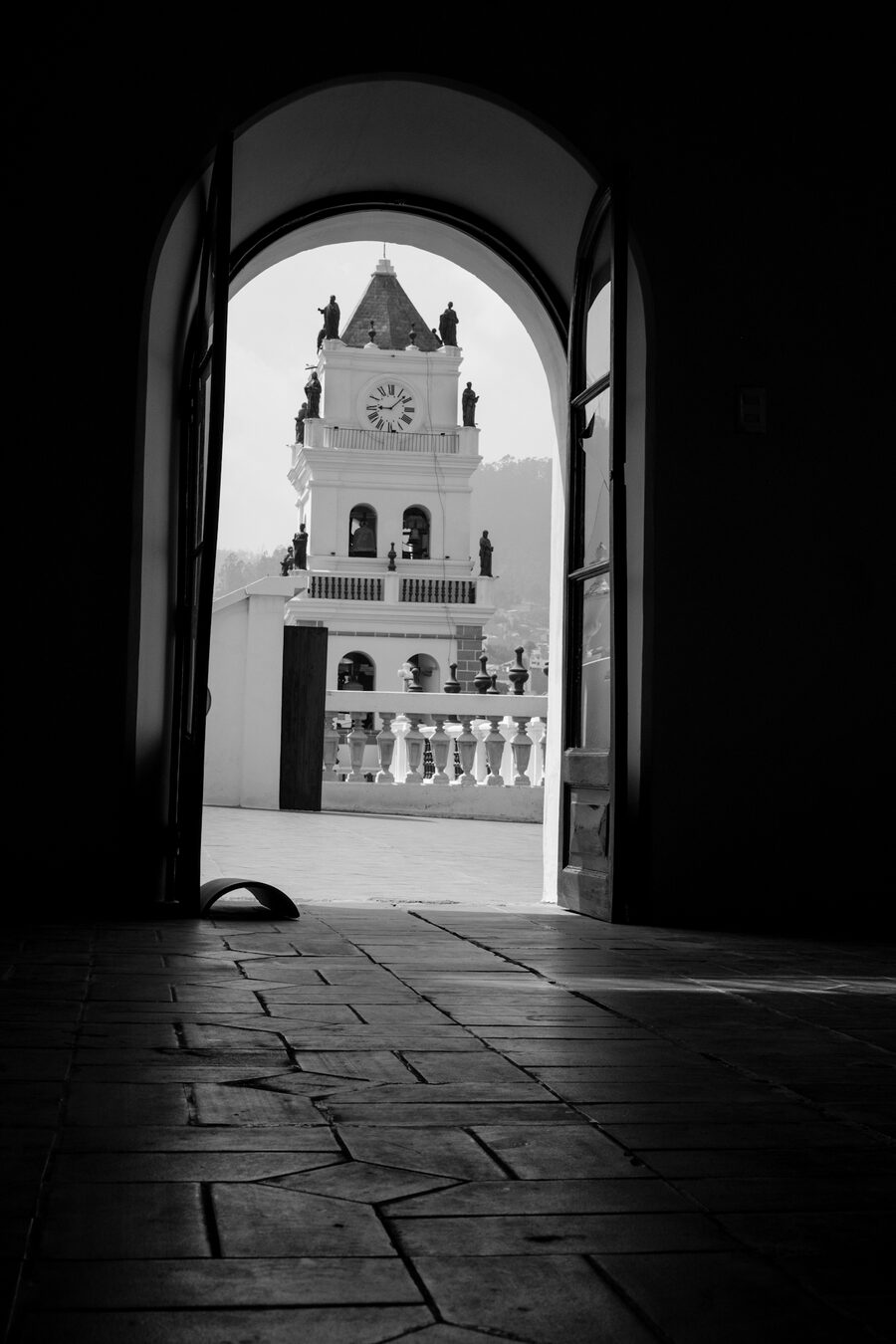
The Virgin is coming in the Chapel of the Virgin of Guadalupe, anexa a la Basilica of Our Lady of Guadalupe, also known as Metropolitan Cathedral of Sucre - Primate of Bolivia, situada en la Plaza 25 de Mayo from the city of Sucre. The cathedral is a colonial building whose construction began around 1551 and lasted for almost a century, combining elements Renaissance and Baroque. It has been declared a municipal cultural heritage of Sucre. A sacred art museum is one of the most important in Bolivia, with important pieces from the 16th to 18th centuries.
The Chapel of the Virgin, completed in its enlarged form in 1617, permanently houses the image of the Patron Saint. From this chapel and the cathedral, the liturgical and devotional life surrounding Our Lady of Guadalupe, as well as the main celebrations of September, are organized.
Sponsorship and coronation
Our Lady of Guadalupe is patron of the city of Sucre; various sources explicitly point out that the image painted by Fray Diego de Ocaña is venerated as such. He is also a very rooted spiritual patron in the entire department of Chuquisaca and is recognized as a Marian sign highlighted in the life of the archdiocese of Sucre, although the title of archdiocesan patron is not always formally explained in the sources consulted.
As for the canonical coronationin the revised sources (Wikipedia, local information on the chapel and cathedral, UNESCO documentation on the feast and Catholic press notes) does not contain in a clear and documented way a specific date or decree of pontifical canonical coronation. Therefore, according to the instruction not to invent data, it should be indicated: does not contain a documented canonical coronation.
Party and devotion
La main party of Our Lady of Guadalupe in Sucre is celebrated around the September 8, coinciding with the feast of the Nativity of the Virgin Mary. That day and the next days the cathedral is filled with flowers and numerous processions are organized throughout the city, in addition to a multitudinary candle night. The devotion to the "Mamita de Guadalupe" is described as one of the manifestations of faith more conveners of the regionwith a very large number of faithful.
La Feast of the Virgin of Guadalupe, patron of Sucre, has been recognized by the UNESCO how Intangible Cultural Heritage of Humanityas an expression in which faith, history and culture are intertwined. According to the description of the intangible heritage, the holiday begins with the image transfer within the scope of the cathedral and chapel, followed by daily prayers, candlelight processions, musical shows and public celebrationscoordinated jointly by the Catholic Church and the Association of Folkloric Groups.
The festival seamlessly blends liturgy and popular piety: solemn masses, novenas, communal prayers, urban pilgrimages, and displays of traditional music and dance. The image, richly adorned with jewels, becomes a focal point of unity for believers from diverse social backgrounds, who continue the tradition of offering votive offerings and jewelry as expressions of gratitude and intercession.
Link to the Rosary
The sources consulted about Our Lady of Guadalupe of Sucre (chapel, cathedral, UNESCO and press releases) do not expressly mention a specific relationship with the prayer of the Rosaryas it could be a historical fellowship of the Rosary, a title linked to this prayer or its own practices that highlight it in this regard. It must therefore be strictly stated that no consta a particular documented link between this advocation and a proper form of devotion to the Rosary.
However, within the framework of the Marian spirituality of the Church, the Rosary It naturally accompanies devotion to Our Lady of Guadalupe. By contemplating the mysteries of Christ's life with Mary, the faithful of Sucre find in the Rosary a means to deepen the filial relationship with the "Mamita of Guadalupe" and to put under his protection the daily goings and suffering. In the context of the September feast, the prayer of the Rosary - especially in the novena, processions and vigil - is integrated into the whole of devotional practices, as a simple and constant prayer that provides the heart to welcome the Gospel message qu
A flower for the Virgin
Offer a simple prayer to this Marian devotion. Pray a Hail Mary for Bolivia and for all of America.
Pray Hail MaryIs the advocation of the Virgin Mary of your people missing?
Si no encuentras la advocación mariana de tu ciudad o pueblo, cuéntanosla: la investigaremos para ubicarla y darla a conocer en este mapa del amor de la Madre por el mundo.
Propose an apvocation →