
Marian devotion
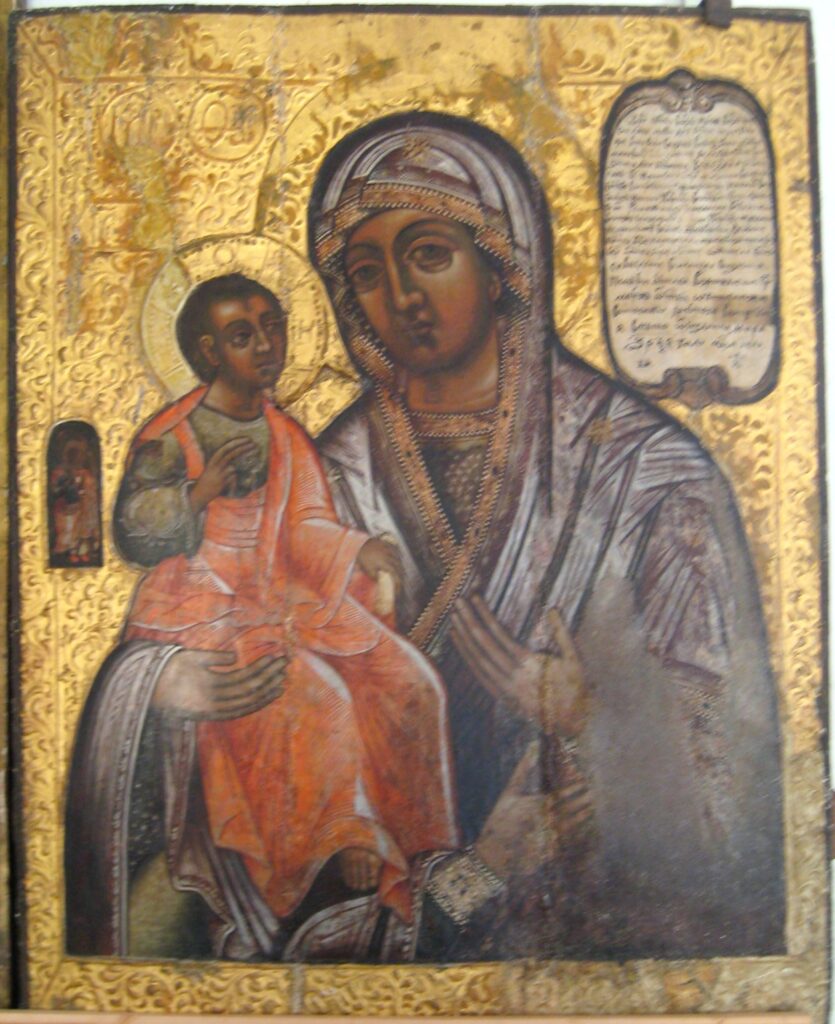
Our Lady of the Three Hands
Marian devotion of Moscow (Russia)
La advocación de Our Lady of the Three Hands (Troerúchitsa / Tricherusa) is born in the Byzantine and Orthodox sphere, linked to the figure of san Juan Damasceno. According to the tradition and the eastern hagiography, in the context of the iconoclastic crisis of the eighth century, John, a defender of the sacred images, was falsely accused before the Caliph by the Emperor Lion III. As a punishment, his right hand was publicly cut, which was exposed in visible place. John would have begged an icon of the Mother of God, asking to continue writing in defense of the cult of images; the Virgin, according to legend, miraculously restored her hand cut. In thanks, the saint ordered to place a metal hand (silver) as an exvote, which was then pictorically represented as a third hand en el icono.
Main data
Origin and history
La advocación de Our Lady of the Three Hands (Troerúchitsa / Tricherusa) is born in the Byzantine and Orthodox sphere, linked to the figure of san Juan Damasceno. According to the tradition and the eastern hagiography, in the context of the iconoclastic crisis of the eighth century, John, a defender of the sacred images, was falsely accused before the Caliph by the Emperor Lion III. As a punishment, his right hand was publicly cut, which was exposed in visible place. John would have begged an icon of the Mother of God, asking to continue writing in defense of the cult of images; the Virgin, according to legend, miraculously restored her hand cut. In thanks, the saint ordered to place a metal hand (silver) as an exvote, which was then pictorically represented as a third hand en el icono.
From the perspective of the documented historythe existence and veneration of the icon of the Theotokos de las Tres Manos (Panagía Tricherusa) en el Serbian monastery of Hilandaron Mount Athos (Greece), where one of the oldest and most famous images of this advocation is preserved. The concrete link between this athonite icon and Saint John Damasceno belongs mainly to the field of Hagiographical tradition; contemporary documentation is not available to the facts that allow to give the miracle with precision (it is usually placed "around the year 717," but as a traditional, not strictly proven data). From the dissemination of the athonite iconographic model, the Virgin of the Three Hands it spread widely throughout the Slavic world, generating numerous copies, especially in the Russian field.
In Russia, various icons of the Virgin of the Three Hands are documented since modern times, in particular from the XVIII- 19th century, as attests to the existence of Russian icons of this subject from Moscow, painted on wood and in technology of temple al huevo in the 19th century. These icons take back the theological and devotional Athonite model, integrating the advocation into the rich Marian tradition of the Russian Orthodox Church.
The image and the sanctuary
The image of Our Lady of the Three Hands es un Orthodox icon of Byzantine tradition, spread in Greek, Serbian, Bulgarian and Russian versions. It is usually a painted icon on wood board, with levka (plaster and tail) and technical temple al huevo, according to traditional iconographic practice. The Russian example of the Moscow provenance cited by the trade in religious art corresponds to the 19th century and presents these characteristics: wooden icon, with levkas, painted to the temple, with protective velvet box or curl.
Iconographically, the Virgin appears in the form of Theotokos according to type models Hodigitria or tenderness, holding the Child Jesus on one of his arms. The peculiarity of this advocation is the presence of a “tercera bro”: in addition to the normal hands of the Virgin (and, where appropriate, the Child), an additional hand is represented, usually at the bottom of the icon, which refers to the exvote of Saint John Damasceno. In origin, that third hand was a metal hand (silver) hanging from the icon as an offering; later it was integrated into the painting itself, so that the Mother of God appears "with three hands," a sign of the miracle granted and of the maternal intercession.
Concerning specific sanctuary or temple in Moscow where this advocation is primarily venerated, no constain verifiable sources of Church, sanctuary or diocese, the existence of a specific national or basilica sanctuary dedicated to "Our Lady of the Three Hands" in Moscow. In the Russian sphere, the advocation is rather distributed in various temples and iconostasiumsIn the form of locally venerated icons, a single central sanctuary of national rank for this advocation is not clearly documented. For Moscow, therefore, it can only be said that they exist. Russian icons of the type "Virgin of the Three Hands" of Moscow originbut no consta with certainty a specific official sanctuary recognized as such by the Church.
Sponsorship and coronation
In the Eastern Orthodox tradition, the Theotokos of the Three Hands enjoys a strong arraigo in the Hilandar monastery (Mount Athos), which considers it especially protective. From this centre, the advocation has radiated to the Slavic peoples, and in particular to Serbian, Bulgarian and Russian areas, where it is venerated as protection of monks, defenders of sacred and faithful images who come to it in diseases and serious needs. However, as regards Official patronage (formal designation as the principal patron of a city, diocese or country, with a documented ecclesiastical decree), no consta for the specific case of a Moscow icon under this title.
As regards canonical coronation in the proper sense of Catholic law and praxis (decree of the Holy See, coronation on behalf of the Pope, etc.), it is an advocation and an icon of origin and use mainly orthodox, so this kind of liturgical-legal recognition is not part of its usual devotional history. As far as they can verify the sources consulted, does not contain a documented canonical coronation for "Our Lady of the Three Hands (Troerúchitsa)" in Moscow.
Party and devotion
La liturgical feast de la Theotokos of the Three Hands is celebrated mainly in the calendar of the Orthodox Churches that follow the athonite and Slavic tradition; however, the specific date varies according to the jurisdictions, and in the verified sources there is no single consensus clearly documented for the whole orthodoxy or, in particular, for a Moscow icon. Therefore, for the specific area of Moscow, no con seguridad a main party date of a universally recognized nature.
La devotion is characterized by trust in the intercession of the Mother of God in situations of disease, danger and persecution, recalling the miracle given to Saint John Damasceno as a sign of the defense of the true faith and the cult of images. The presence of this icon in monasteries and parishes causes the visit of faithful who pray, light cirios and kiss the icon, following the Orthodox tradition of veneration of the sacred images. In places like Hilandar monastery y el Monastery of Troyan (Bulgaria), the Virgin of the Three Hands is associated with pilgrimages and the memory of numerous favors and cures attributed to their intercession. For Moscow, the sources consulted do not provide quantitative input data or describe in detail their own popular traditions linked to a specific sanctuary of this advocation.
Link to the Rosary
La advocación de Our Lady of the Three Hands (Troerúchitsa) is originating in Orthodox worldin the context of which the usual Marian prayer is not the Rosary as determined in the Latin tradition, but other forms of prayer, such as the repetition of the "Hail Mary" within the prayer of Jesus or various litanies and Marian akathistos. In the sources consulted no consta a specific historical relationship between this icon and the prayer of the Rosary in a Catholic sense.
However, from a Marian perspective
A flower for the Virgin
Offer a simple prayer to this Marian devotion. Pray a Hail Mary for Russia and for world peace.
Pray Hail MaryIs the advocation of the Virgin Mary of your people missing?
Si no encuentras la advocación mariana de tu ciudad o pueblo, cuéntanosla: la investigaremos para ubicarla y darla a conocer en este mapa del amor de la Madre por el mundo.
Propose an apvocation →