Marian devotion
Our Lady of Remedies, patron of Naucalpan
Marian Invocation of Naucalpan (State of Mexico)
La devoción a Our Lady of Remedies in Naucalpan is linked, according to the traditionwith a small Marian image brought from Spain in 1519 Juan Rodríguez de Villaferta, soldier of Hernán Cortés; the image would have been taken with the conquering army and hidden during the withdrawal of the Sad night. Later, always according to that tradition, it was found around 1540 by Juan Ce Cuauhtli (also cited as John of the Tovar Eagle), a natural of San Juan Totoltepec, and began to be venerated on the hill of Otocampulco, today the hill of the Remedios.
Main data
Origin and history
La devoción a Our Lady of Remedies in Naucalpan is linked, according to the traditionwith a small Marian image brought from Spain in 1519 Juan Rodríguez de Villaferta, soldier of Hernán Cortés; the image would have been taken with the conquering army and hidden during the withdrawal of the Sad night. Later, always according to that tradition, it was found around 1540 by Juan Ce Cuauhtli (also cited as John of the Tovar Eagle), a natural of San Juan Totoltepec, and began to be venerated on the hill of Otocampulco, today the hill of the Remedios.
En la documented historythe cult acquired a stable form with the erection of a hermitage first and, later, of the sanctuary in 1575 under the mandate of the Mexican City Cabildo. The Basilica of the Remedies was also one of the oldest Marian centers in Mexico, closely linked to the religious history of the Valley of Mexico and to the ancient protective function attributed to the image during the droughts and floods of the virreinal capital.
The image and the sanctuary
The image is a small wood carving of 26–27 cm of height, of origin and authorship not fully documented; it is described as an ancient image of the 16th century, covered in dresses and crowns, with the half moon at its feet in the usual iconography of the Virgin. The fact sheet should be distinguished from other homonymous claims, especially Our Lady of the Remedies of Cholula: the one of Naucalpan is the one linked to the tradition of conquest and to the ancient sanctuary of the hill of Remedios.
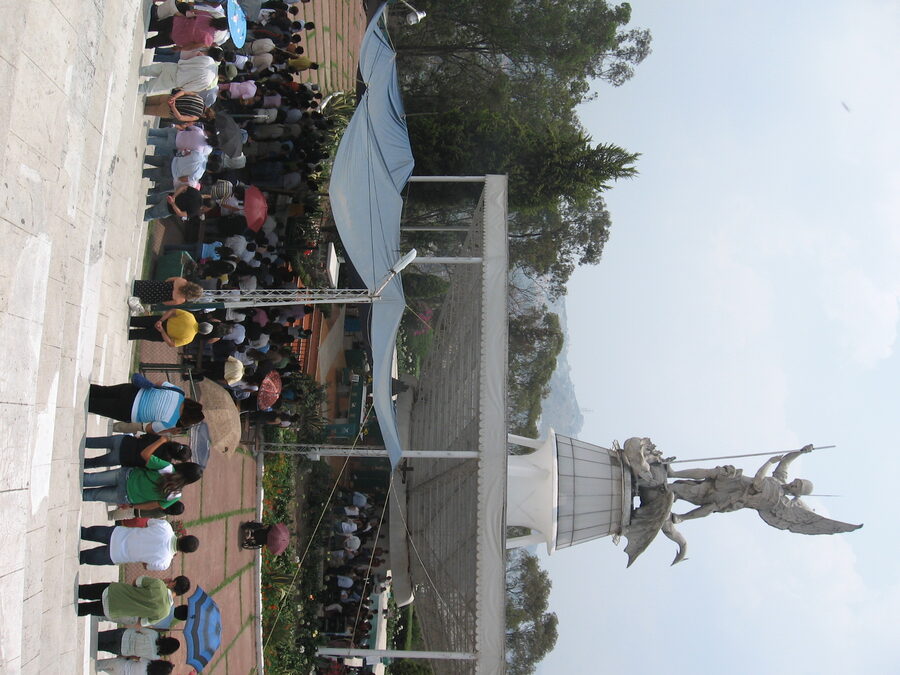
Se venera en la Basilica of Our Lady of Remedies, also called Sanctuary of Remedies, en Naucalpan de Juárez, State of Mexico. The temple was built in the 16th century and is one of the oldest Marian shrines in Mexico; it was also elevated to minor basilica en 1999according to the information disseminated by the advocation itself in devotional and divulging sources. Its architecture is described as a grey quarry, with baroque features and plateresque and neoclassical elements inside.
Sponsorship and coronation
Our Lady of the Remedies of Naucalpan is patron of Naucalpan and has a strong historical roots in the archdiocese of Tlalnepantla; was also considered in historical tradition as an ancient co-patron of Mexico City during the vireinal period. Further patronings and specific canonical formulations, if not reflected in the documentation consulted, should be indicated with caution.
On the canonical coronation, the sources consulted present Discording data: a devotional source mentions a "pontifical coronation" in 1974 and another source spread on the sanctuary's website does not here provide a verifiable data sufficient to affirm a canonical coronation in 1945 or 1964. By way of rigour, it is appropriate to write in an editorial form: "documented canonical coronation: is not safe in the sources consulted".
Party and devotion
La main party se celebra el 1 September. Devotional sources cite an approximate influx of 10,000 people on that day and of 6,000 every Sunday to the sanctuary, although these figures should be read as informative estimates, not as official counts.
Devotion includes pilgrimages, Sunday visits, masses and popular expressions of gratitude for favors received; it has historically been invoked as a protector of the Valley of Mexico in the face of droughts and floods. The sanctuary is also part of a very visited religious landscape, with a strong component of historical memory and popular religiosity.
Link to the Rosary
The sources consulted in document a liturgical link the specific history between this advocation and a fellowship, novena or particular practice of Rosary. However, like all Marian devotion, his worship is naturally harmonized with the prayer of the Rosary, which contemplates the mysteries of Christ with Mary and provides for the supplication entrusted under her protection.
A flower for the Virgin
Offer a simple prayer to this Marian devotion. Pray a Hail Mary for Mexico and for all of America.
Pray Hail MaryIs the advocation of the Virgin Mary of your people missing?
Si no encuentras la advocación mariana de tu ciudad o pueblo, cuéntanosla: la investigaremos para ubicarla y darla a conocer en este mapa del amor de la Madre por el mundo.
Propose an apvocation →